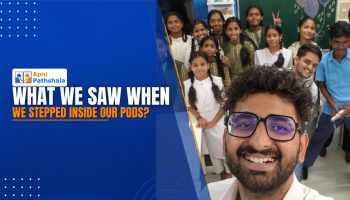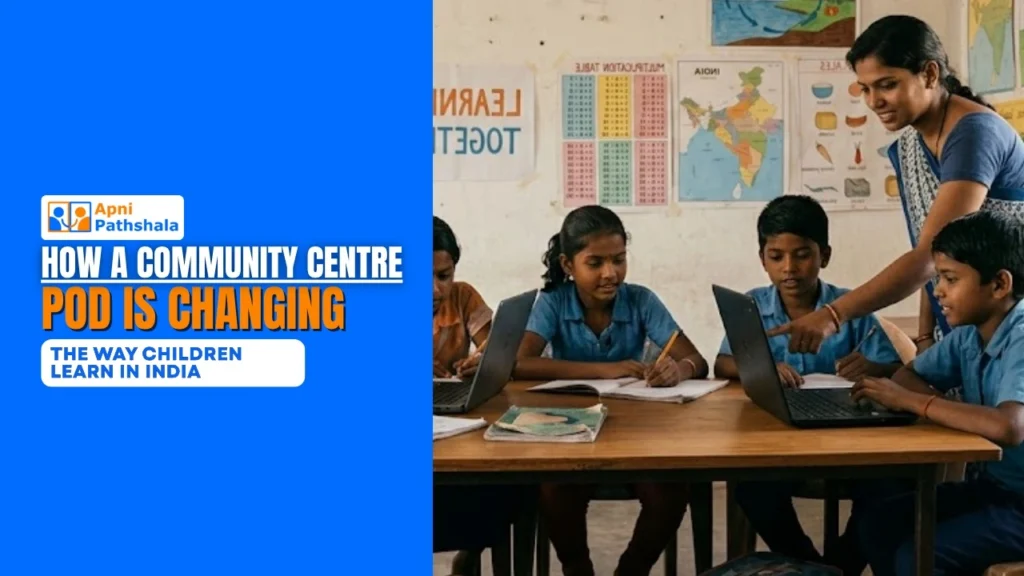
Walk through any neighbourhood in a Tier-2 or Tier-3 Indian city today, and something has quietly changed. Where coaching centre boards once lined every street, a new kind of sign is appearing. “Digital Learning POD.” “Community Learning Centre.” “Point of Digital Learning.”
Parents are noticing. Children are walking in curious. And the results inside these small, 100 sq. ft. rooms are anything but small.
This is the story of the community learning centre in India, how it works, why it is growing so fast, and why it might be the most important education revolution you have never heard of.
What Exactly Is a POD And Why Is It Different?
A POD (Point of Digital Learning) is a small, community-based digital learning centre established by local individuals, schools, or NGOs, with full support from Apni Pathshala.
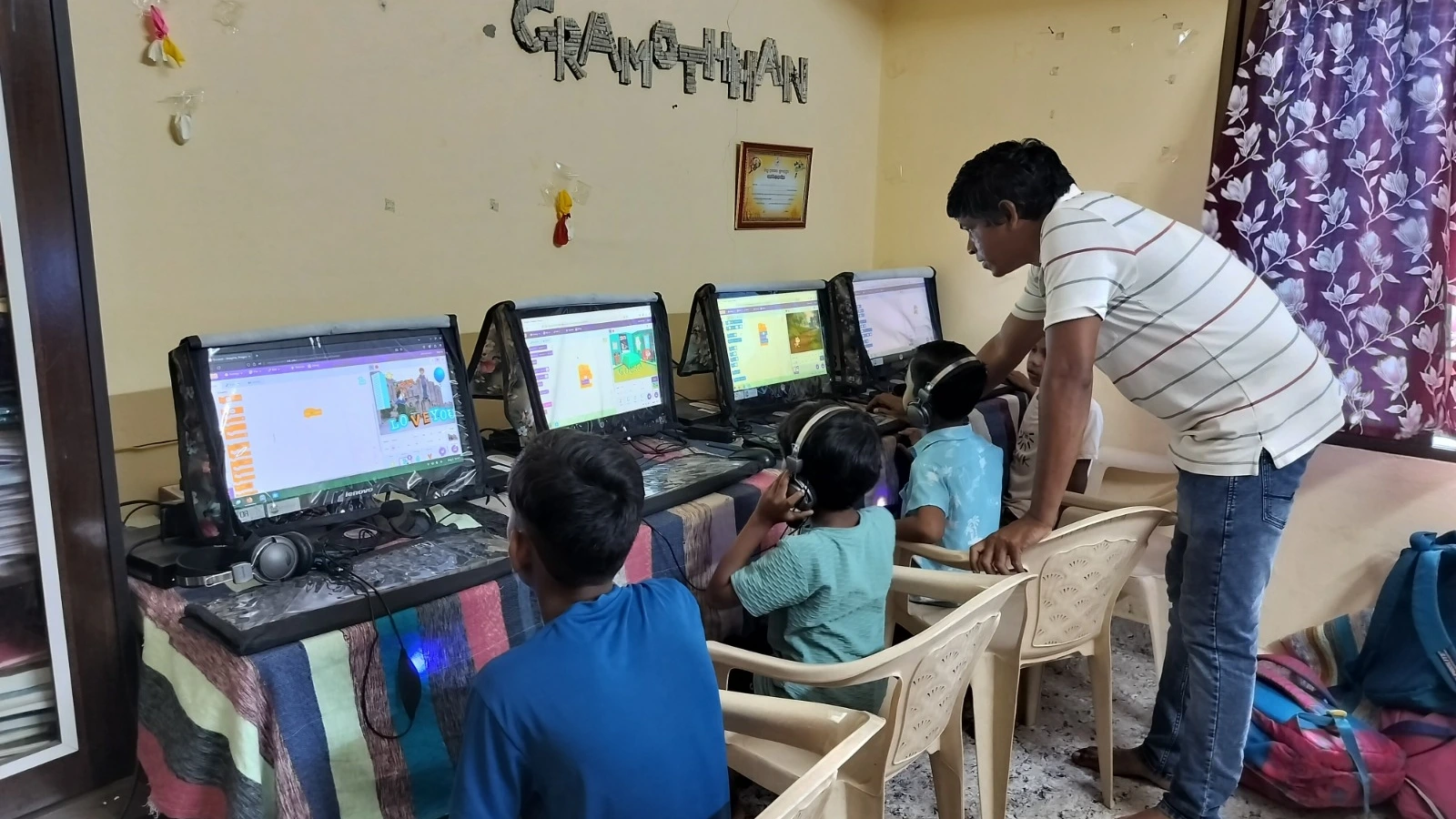
Each POD is equipped with 10 Apna PC computers, pre-loaded with educational tools, AI-powered learning platforms, and structured skill-building content. Students walk in, log on, and start learning, no lecture, no blackboard, no waiting for a “hero teacher” to arrive.
But here is what makes a POD truly different from a coaching class or government school computer lab.
In a POD, the technology teaches. The mentor guides.
The local mentor, often a trusted didi or bhaiya from the same community, does not stand at the front and deliver lessons. Their role is to manage energy, ensure safety, and keep focus. The curriculum is delivered through the device. The AI co-tutor answers doubts. The system itself blocks distractions at the software level.
This is not a shortcut. It is a design choice, one that has been tested across 100+ PODs from Mumbai to Nagaland, Kashmir to Kerala.
What Does a Typical Day Inside a POD Look Like?
If you walked into an Apni Pathshala POD expecting rows of silent students copying notes, you would be surprised.
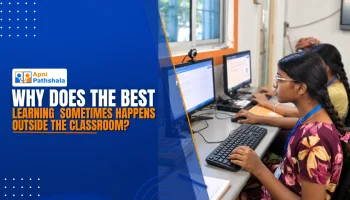
A POD session begins not with a bell, but with a login. Each student sits at their Apna PC and opens their personalised learning dashboard. From that moment, every child is on their own learning journey, moving at their own pace, exploring topics they are genuinely curious about.
Here is what a typical POD session looks like in practice:
Morning — Skill Practice A 13-year-old in Nagpur is building her first website using simple drag-and-drop tools. Beside her, a 10-year-old is creating animations on Scratch. Neither of them was taught to do this in school.
Midway — Collaborative Problem Solving A student’s code breaks. Instead of raising a hand and waiting for a teacher, she leans over to a senior student. He gives her a hint: “Check line 4, you missed a semicolon.” She finds it. Fixes it. Her screen lights up with a working programme. That moment of “I fixed it myself” builds a kind of confidence no mark sheet can replicate.
End of Session — The Commit Students do not take homework home. Instead, they save a commit, a piece of finished work. A published blog post. A completed graphic design. A game they built. They walk out not with a filled notebook, but with a digital result they can show on their phone.
This is learning by doing. And it is working.
Why Are Community Learning Centres Growing Across India?
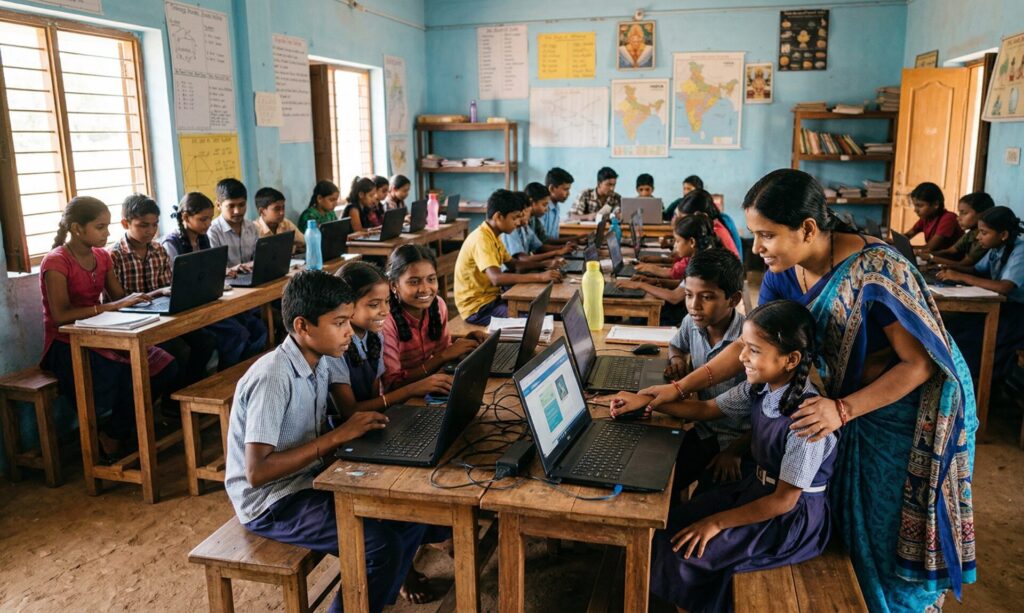
The rise of the community learning centre in India is not a trend. It is a response to three deep problems that traditional education has not solved.
1. Distance Was Always the Enemy of Access
For decades, “good education” meant “far away education.” To learn computers or advanced skills, families had to send their children to institutes in city centres, often 10 or more kilometres away. For parents in semi-urban and rural areas, that distance created real anxiety. Is the commute safe? Who are the other children? What happens if something goes wrong?
A POD changes this entirely. It opens in your lane. In the spare room of a trusted neighbour. In the local community hall. Your child walks there in two minutes alongside friends they already know.
2. The Cost of Quality Education Was Quietly Becoming Unaffordable
Quality computer education at private institutes can cost thousands of rupees per month, a significant burden for families across Tier-2 and Tier-3 India. The POD model solves this through a sharing economy approach. Because the space is local, the PCs are shared across batches of students, and the software is open-source and pre-installed, the cost per student drops dramatically. Families get world-class digital education at a fraction of what private institutes charge.
3. Traditional Teaching Could Not Scale to Every Village
India cannot train and deploy enough skilled computer teachers to reach every village in the next decade. The POD model does not wait for that. By embedding the curriculum inside the technology itself, through AI co-tutors, structured content, and guided learning platforms, Apni Pathshala has built a system where a passionate local leader with no teaching degree can run a high-quality digital learning centre.
One POD in your colony. One in the next. Connect them, support them, and you have a network. That is exactly what Apni Pathshala is building, a nationwide microschool network growing one community at a time.
What Tools Do Students Get Inside a POD?
Every Apna PC inside an Apni Pathshala POD comes pre-loaded with a carefully selected set of tools that cover the full learning journey, from basics to advanced skills.
Students have access to:
- Beyond Exam — 30,000+ courses covering school subjects, skill development, and exam preparation, with certificates upon completion
- CoTutor AI — A 24/7 AI-powered virtual teacher that answers doubts, prepares students for mock interviews, and helps cover topics efficiently through text, audio, and video
- Scratch — Visual programming that teaches coding through games, animations, and interactive stories
- LibreOffice — A complete office suite for documents, spreadsheets, and presentations
- Circuit Simulator — Design and simulate electronic circuits visually
- Apni Prerna Safety Layer — Blocks non-educational websites and apps at the system level, tracks study time, and sends progress reports to parents
Every tool is pre-installed and ready to use from day one. No setup. No technical hassle. Just learning.
Real Stories From Real PODs
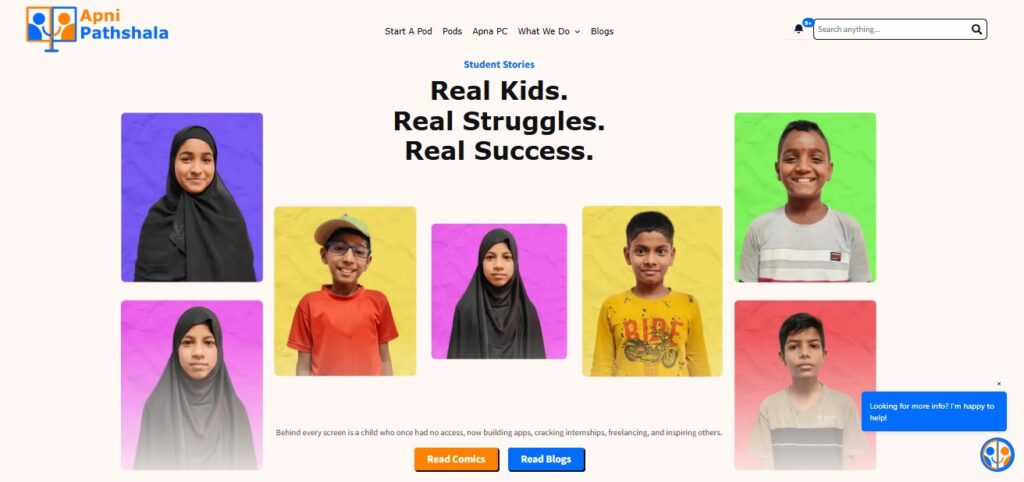
Numbers tell part of the story. The rest lives in the experiences of the students who walk through those doors.
A student in a tribal village in Nagaland who had never touched a computer before joining a POD is now building websites and freelancing small tasks online.
A shy girl from a semi-urban community in Maharashtra who could barely speak in class found her voice at her local POD, and today helps guide her peers through their first coding projects.
A boy who used to spend his evenings doing nothing now walks into his POD every day and comes home proud to show his parents what he created.
These are not exceptional children. They are ordinary children given extraordinary access.
Who Can Start a POD And How?
This is where the story becomes personal. Because Apni Pathshala is not just building learning centres, they are building a movement. And they are looking for leaders to join it.
If you have the following, you can apply to start a POD:
- A dedicated room of at least 20 x 10 feet that you own or rent
- Tables to accommodate 10 computers and peripherals
- A minimum internet connection of 10 Mbps
- The genuine desire to provide digital learning opportunities to children in your community
Apni Pathshala provides everything else, 10 fully equipped Apna PCs on a 15-month lease at zero cost, a ready learning plan, ongoing mentorship from a dedicated POD Admin, access to a network of 100+ POD leaders across India, and guidance on growth, CSR funding awareness, and day-to-day operations.
The application process is straightforward. Fill in the online form on the Apni Pathshala website with your details, space photos, and existing facilities. Applications are reviewed every month, and selected applicants submit a short proposal, with full templates and guidance provided.
Apni Pathshala approves roughly 1 in 5 applications. Not because they want to be exclusive, but because they want every approved POD to genuinely succeed.
The Bigger Picture, What This Movement Means for India
India has millions of children who deserve access to quality digital education. Not someday. Now.
The community learning centre model proves that this does not require massive infrastructure, government intervention, or billion-rupee budgets. It requires a room, a connection, the right tools, and a person who cares.
Apni Pathshala’s vision is to launch 1,000+ PODs reaching 1.5 lakh+ students across every state and union territory. The network already spans from Kashmir to Kerala, from Mumbai to Nagaland. Every new POD that opens brings that vision closer to reality.
The future of education in India is not a single great school in a single great city. It is thousands of small, trusted rooms powered by technology, guided by community, and open to every child, regardless of their postcode, their income, or their background.
That future is already beginning. It is opening in your lane. And you can be part of it.
Ready to Start or Support a POD?
Whether you want to open a POD in your community, refer someone who has the space and the will, or partner with Apni Pathshala as an NGO or school, the door is open.
Every child who walks into a POD for the first time is one step closer to the future they deserve. That step begins with you.
Frequently Asked Questions
1. What is a community learning centre POD in Apni Pathshala?
Ans: A POD (Point of Digital Learning) is a small, community-based digital learning centre set up by individuals, schools, or NGOs with support from Apni Pathshala. It comes with 10 Apna PCs and ready-to-use learning tools.
2. Why do first-generation learners struggle the most?
Ans: First-generation Because they don’t just study subjects, they navigate everything alone, without guidance or support at home.
3. How can parents support learning without being experts?
Ans: Parents don’t need to know everything. Simply being involved, asking questions, and showing interest in the child’s progress makes a big difference.
4. Is teaching AI to children enough for their learning?
Ans: No, teaching AI alone is not enough. Without proper guidance and understanding, children may use tools without actually learning concepts deeply.