Most parents operate under a massive misconception about artificial intelligence.
They think teaching kids to use it simply means showing them how to type a basic text prompt every day.
That’s a really terrible mistake.
Learning the basic interface is the absolute easiest part of the entire process right now. Clicking pretty buttons isn’t actual thinking. It never has been.
The actually difficult part is knowing exactly what to do with the final answer once the machine provides it.
Suppose a middle school student gets an assignment to write an essay explaining the complex fall of the Roman Empire.
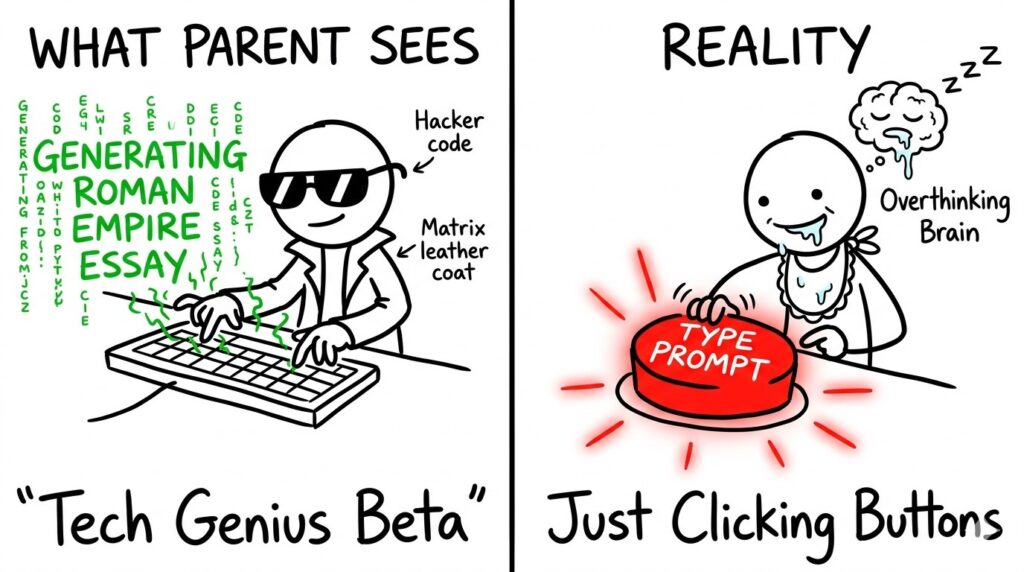
Five years ago, the primary bottleneck for that specific student was finding facts inside a physical library building
Today, the main bottleneck is knowing if the raw sentences the machine spits out are actually any good at all
The Real Educational Bottleneck Has Changed Today
We can look at the raw numbers to clearly see how drastically the educational timeline has shifted in recent years
Let us say it traditionally takes ten full hours for a student to write a highly researched history paper manually.
A modern generative AI tool can easily spit out a mediocre version of that exact same paper in ten seconds.
The student instantly saves ninety percent of their working time.
What exactly do they decide to do with freed time?
If they just hand the printed AI paper directly in to the history teacher, they learn absolutely nothing about history.
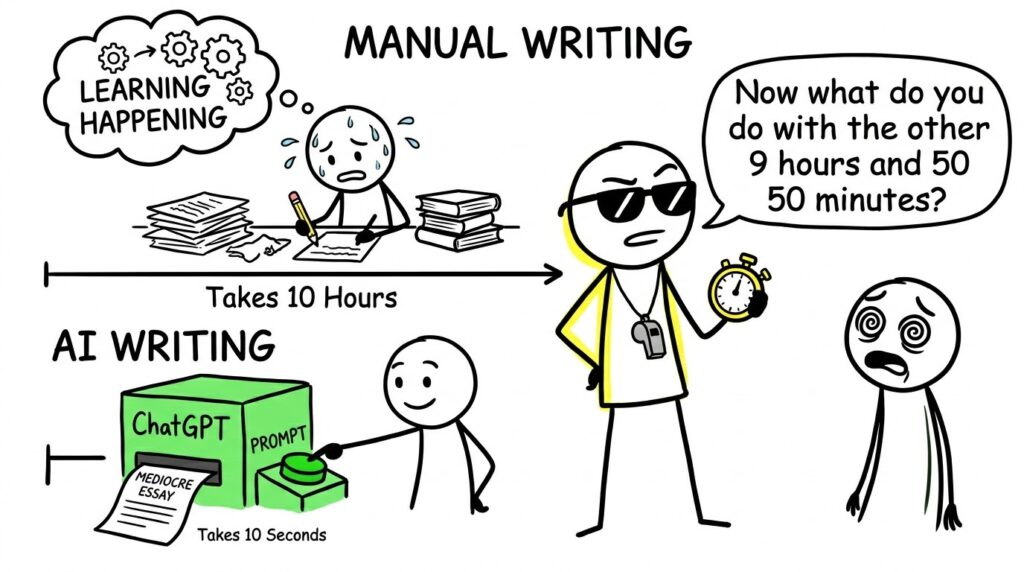
If they instead spend two solid hours carefully verifying those generated facts and making the machine’s arguments significantly sharper structurally, they actually learn the historical context.
Kids master software incredibly fast.
We see this firsthand when observing younger students reading basic educational articles or completing coursework on platforms like Apni Pathshala.
They usually figure out where all the buttons are quickly, in about five minutes.
But typing a prompt into a chat window is fundamentally just asking a machine a question. Human beings have always instinctively known how to ask questions
The real, underlying skill is properly evaluating the final answer
The Hidden Danger Of Perfect Output Today
When modern AI writes a large block of dense text, it almost always sounds perfectly confident.
It structures its internal arguments remarkably well. It looks completely correct to untrained eyes.
A student who has not yet built their own rigorous, internal sense of quality will naturally accept that generated output as perfect truth.
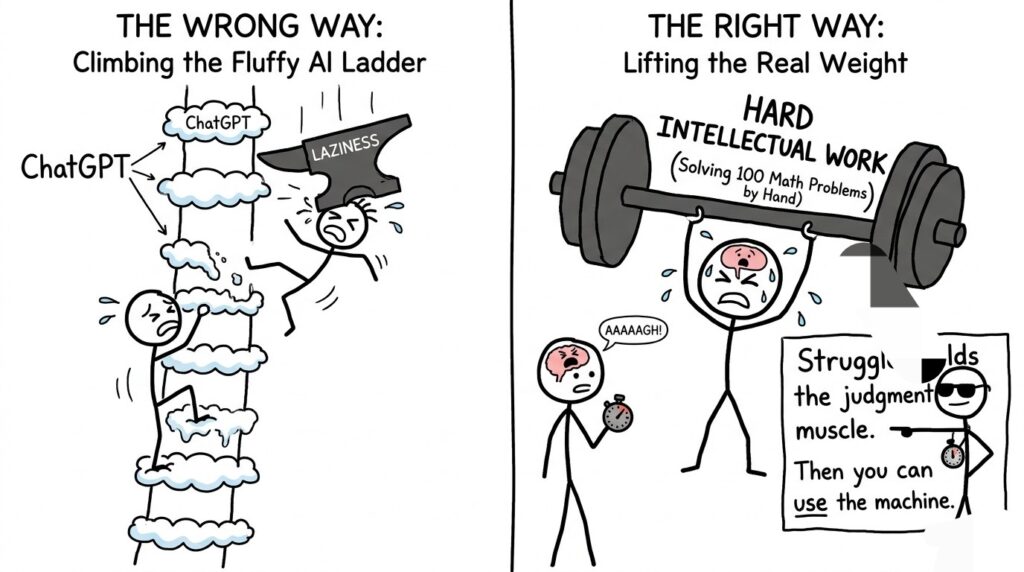
They will simply stop thinking for themselves. What happens when the AI is completely wrong about facts?
If a student cannot spot a weak argument quickly, they effectively just become a mindless human copy paste machine forever.
The true economic and intellectual value of daily human work is no longer found in generating raw text from scratch.
The real value is now found entirely in human judgment.
We are rapidly moving from a traditional world populated mostly by raw creators to a world populated almost entirely by editors.
The Massive Shift From Raw Creators To Editors
Everyone essentially gets to be a middle manager directing a tireless team of digital workers.
But effectively managing an artificial intelligence requires knowing exactly what good work looks like first (a concept that is surprisingly hard to initially grasp).
Here is what the intellectual shift actually looks like practically.
| Academic Task | The Old Way (Pre-AI) | The New Way (With AI) | The Required Human Skill |
| Writing Essays | Drafting original sentences | Fixing AI generated output | High-level taste and logic |
| Mathematics | Doing the manual steps | Checking the machine’s logic | Deep conceptual understanding |
| Research | Finding reputable sources | Verifying the AI claims | Intellectual skepticism |
The Absolute Necessity Of Deep Struggle Today
The skills required for the new way are much harder to teach than basic keyboard mechanics.
They require immense patience.
They require a child to sit quietly with a difficult, frustrating problem and intensely struggle before finding the actual answer.
How do we actually teach good taste?
We expose students to great human work and force them to evaluate it.
A student absolutely needs to read great human written essays properly to know if the AI wrote a bad one.
They need to solve hard math problems entirely by hand first to understand the physical mechanics.
We don’t let young kids use basic calculators before they deeply understand basic addition.
The real danger is not that AI will suddenly replace basic human intelligence.
The danger is humans willingly outsourcing intelligence completely because relying on the machine is incredibly easy and fast.
The default path is laziness. We must force hard intellectual work further up the chain of command.
Smart parents will not wait for schools. Focus entirely on the final human judgment today.
Where This Gets Difficult (And Where Most Homes Slip)
And to be fair, this is harder than it sounds. Not every home has a quiet space.
Not every child will sit without distractions. Not every parent has the time to supervise this every day.
In some places, this structure is built in.
That’s essentially what Apni Pathshala is trying to do with its PODs.
If you’re trying to picture what that actually looks like on the ground, this breaks it down simply:h its PODs.
Small habits today can create a better India tomorrow, read how to guide your child.
Your small support today can shape your child’s entire future, learn how.
Frequently Asked Questions
1. What should students do instead of misusing AI?
Ans: Students should use AI as a support tool, for learning, practicing, and exploring concepts, not as a shortcut to avoid effort.
2. Why is a parent’s role important in a child’s learning?
Ans: Because learning doesn’t happen only in school. A child’s mindset, habits, and confidence are built at home, and parents play a key role in shaping all three.
3. How can parents teach civic sense at home?
Ans: Through daily actions, like keeping surroundings clean, respecting others, following rules, and leading by example. children learn more from what they see than what they are told.
4. How can parents support digital learning without spending money?
Ans: By encouraging discipline, monitoring usage, helping create a routine, and ensuring children use devices for learning instead of distractions.