A classroom can teach a student a lesson.
But sometimes, the space around that lesson changes how the student learns it.
Where do students sit? Can they work together? Can they move between individual work and group work? Is there somewhere they can build something, discuss an idea, or simply try again?
These details may seem secondary.
They are not.
A growing body of research looks at learning environments not simply as physical rooms, but as spaces that can influence engagement, collaboration, and how students participate in learning.
Learning Spaces Are More Than Four Walls
When we hear “learning space”, we usually imagine a classroom.
Rows of desks.
A board.
A teacher at the front.
But students learn in many other places too.
A library.
A project room.
A community centre.
A makerspace.
Even a small room where a few students sit together and work on something they care about.
The important question is not whether the space looks impressive.
It is:
What does the space allow students to do?
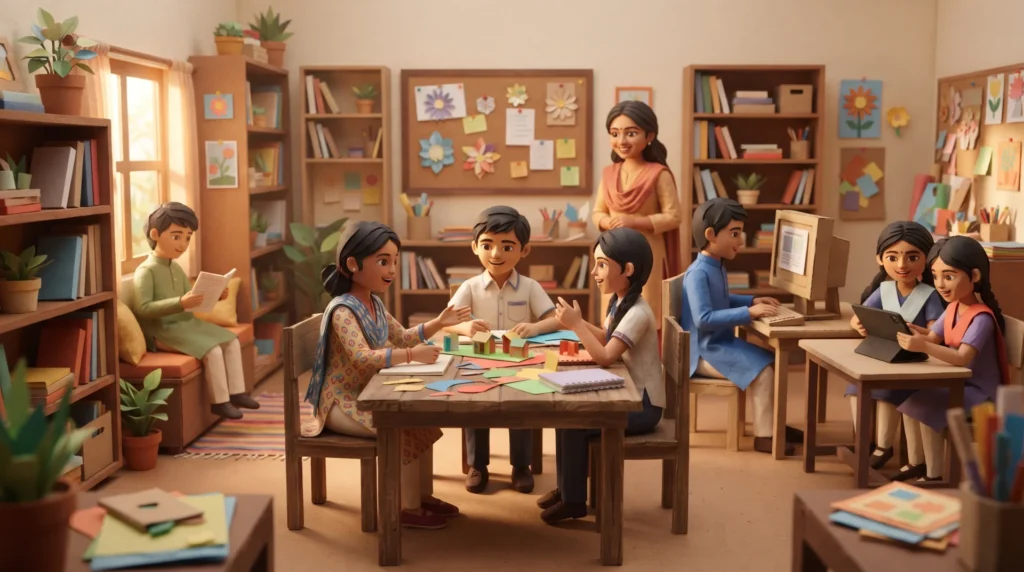
Can they ask questions?
Can they collaborate?
Can they work independently?
Can they make mistakes without feeling that the lesson has already moved on?
A 2026 study of learning commons and makerspaces found that the combination of physical design and digital tools supported peer learning, collaborative information seeking, knowledge sharing and student engagement. ScienceDirect
That is a useful way to think about learning spaces.
The room does not teach by itself. It creates possibilities for learning.
The Best Learning Spaces Give Students Something to Do
There is a difference between sitting somewhere to study and having a place designed around activity.
A student working on a project needs a different environment from someone taking an exam.
A group solving a problem needs space to discuss.
A student practising a skill needs time to try, fail and try again.
This is where project-based learning becomes interesting.
The project gives students something real to work towards.
The space gives them somewhere to work through it.
Research on secondary schools has found that students in innovative learning spaces showed stronger adoption of deeper learning approaches, including curiosity, critical interaction and a desire to understand rather than simply memorise. Institute for Educational Reform
The space is not replacing good teaching.
It is helping create conditions in which different kinds of teaching and learning can happen.
Learning Spaces Can Change Who Participates
Think about a student who rarely raises their hand.
In a large classroom, they may remain quiet.
But put them into a smaller group working on a project, and something different may happen.
They may explain an idea to a classmate.
They may show someone how to use a tool.
They may take responsibility for one part of the project.
Suddenly, they are participating.
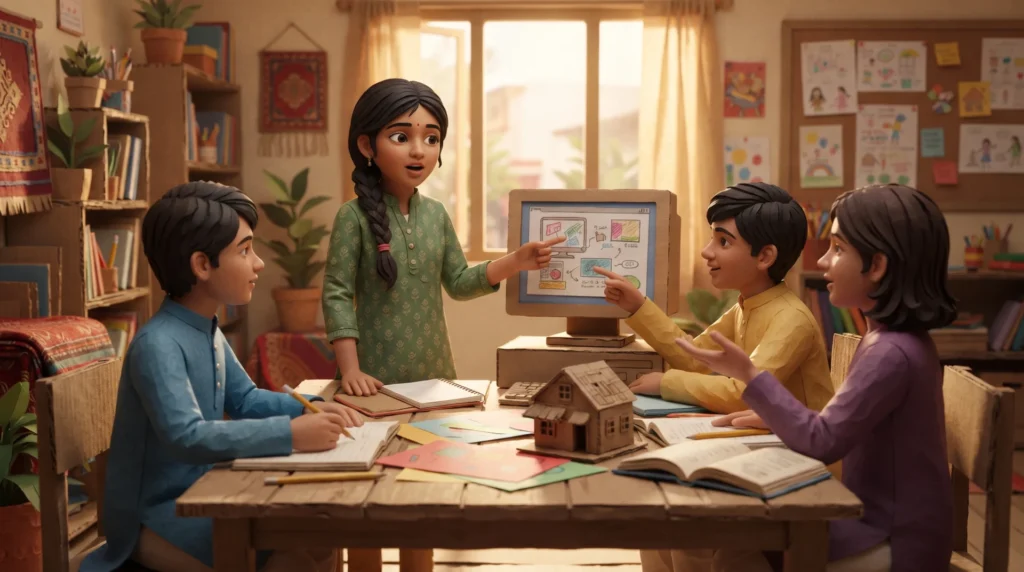
That is why student engagement cannot always be separated from the environment in which learning happens.
A recent 2026 study examining learning environments and student engagement found that different aspects of the learning environment were associated with behavioural, emotional and cognitive engagement.
The point is not that a smaller room automatically creates better learning.
It is that the environment can make certain kinds of learning easier to happen.
A Learning Space Can Also Build a Community
Learning becomes different when students are not working completely alone.
Someone knows how to solve the problem.
Someone else has made the same mistake.
Another student has already completed the task.
They can learn from each other.
This is where Apni Pathshala’s experience with Learn From Peers becomes relevant.
Peer learning turns a learning space into a community.
A student does not only receive knowledge.
They can share it too.
And sometimes, the student who was asking for help yesterday becomes the person helping someone else tomorrow.
This Is What We See Inside Apni Pathshala’s Learning Spaces
A POD may look simple from outside.
But what happens inside can be very different.
Students may be learning computer basics, working on projects, practising skills, helping each other, or exploring something they have become curious about.
When Apni Pathshala’s team visited PODs in Bengaluru, the experience reinforced an important idea: some of the most meaningful changes in a learning centre are not always visible in a report. A student taking responsibility, trying something independently, or helping another learner can be progress too.
That is what makes a learning space valuable.
Not the number of computers.
Not how new the furniture looks.
The activity that happens inside it.
The Space Should Grow With the Student
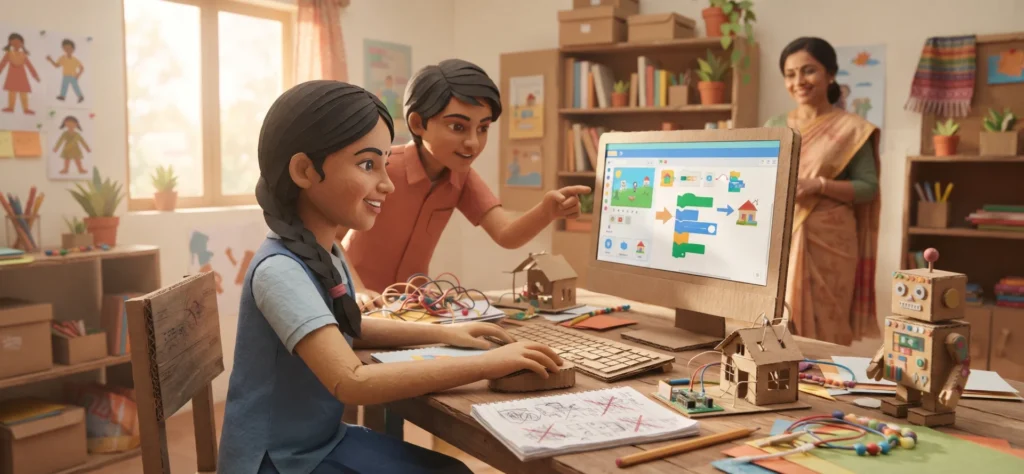
A good learning space should not force every student into the same experience.
One student may need a quiet corner.
Another may want to work with peers.
Someone may want to build a project.
Another may simply need time to practise the basics.
This flexibility becomes especially important in community learning.
Apni Pathshala’s Learning POD model is built around creating local learning environments where students can access technology, practise skills and gradually become more independent.
The idea is not to create another version of a traditional classroom.
It is to create a place where students can do more with what they learn.
A Good Space Can Change the Question
In a traditional classroom, the question can be:
“What do I need to finish today?”
In a well-designed learning environment, it can become:
“What can I try today?”
That is a small change in language.
But it can lead to a very different learning experience.
A student might start a project.
Ask a peer for help.
Find another solution.
Make a mistake.
Try again.
Eventually, they have something they created themselves.
That is where critical thinking begins to become visible.
The Future of Learning May Need More Places, Not Just More Lessons
Education does not necessarily need to become bigger to become better.
Sometimes it needs to become more flexible.
A classroom can provide structure.
A teacher can provide guidance.
A peer can provide another explanation.
A community learning space can provide time and room to practise.
Together, these create a wider learning ecosystem.
And perhaps that is the real value of a learning space.
It gives students somewhere to continue the learning after the explanation ends.
Build the Space Where Learning Can Happen
A better learning environment does not have to begin with an expensive building.
It can begin with a community that wants students to have somewhere to learn, practise and explore.
That is the idea behind Apni Pathshala’s community-based learning model.
If you are a student, educator, parent or community leader, look around your own area and ask:
Do students have a place where they can learn beyond the regular lesson?
If the answer is no, explore Apni Pathshala and see how a community can create a learning environment of its own.
And if you want to understand why these spaces matter beyond technology, read Why Community Learning Centres Matter More Than Ever?.
Because sometimes, improving education does not begin with writing another lesson.
It begins with creating a better place for the lesson to come alive.
Frequently Asked Questions
1. What makes a good learning space?
Ans. A good learning space gives students opportunities to collaborate, practise, explore and participate. Research on learning environments links the conditions around learning with student engagement.
2. Can learning spaces improve student engagement?
Ans. They can support engagement by making collaboration, interaction and active participation easier. A 2026 study found meaningful associations between learning-environment factors and student engagement.
3. Why are flexible learning spaces useful?
Ans. Flexible spaces can support different activities such as group work, individual practice, discussion and project-based learning. Research on innovative learning spaces has found stronger use of deeper learning approaches in some secondary-school settings. Read the 2026 research on innovative learning spaces.
4. How can Apni Pathshala create better learning spaces?
Ans. Apni Pathshala’s Learning POD model creates community-based spaces where students can access technology, practise skills, learn with peers and gradually become more independent.