A student can score well, finish every assignment, and still lose the habit that once made learning exciting: curiosity.
That is why this conversation matters. Education is good at recording what students remember, but some of the most important parts of learning are harder to put on a report card.
Does a student ask questions? Do they want to know how something works? Do they explore an idea after the lesson?
The latest PISA 2025 results make these questions worth asking. Across OECD countries, 73% of students said they are curious about many different things, and 74% said they like to know how things work. At the same time, several indicators of curiosity and perseverance have declined since 2022. PISA also found a positive relationship between curiosity and science performance. Read the OECD PISA 2025 findings
Education Is More Than What Students Remember
Marks are useful. They show whether a student can demonstrate certain knowledge at a particular moment.
But they cannot capture every part of learning.
A student who asks an unexpected question may be learning deeply. Another may spend an afternoon trying to understand why an experiment failed. Someone else may become interested in a topic that was not even part of the original lesson.
These moments can look unproductive from the outside.
Often, they are the moments when learning becomes personal.
Education Needs Space for Better Questions
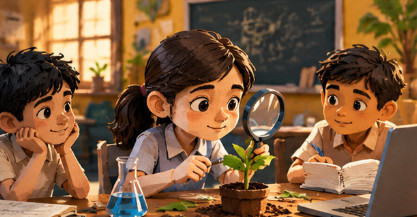
A good question can change the direction of a lesson.
Why does this happen?
Could there be another way?
What would happen if we changed this?
How do we know this is true?
A 2026 study published in npj Science of Learning found that question-asking is a skill that can develop. Students became better at asking domain-specific questions as they gained knowledge, and stronger question-asking was associated with better performance on open-ended projects. Nature
That matters because asking questions is not simply a personality trait.
It can be developed.
Education Can Turn Curiosity Into Action
Curiosity becomes more valuable when students have somewhere to take it.
A student who wonders how a website works can build one.
A learner curious about numbers can explore a dataset.
Someone interested in a local problem can research it and try to design a solution.
This is where project-based learning becomes useful. A project gives curiosity a destination. Instead of only asking a question, students investigate it, make decisions, test ideas, and explain what they discovered.
OECD research on high-quality teaching also highlights the value of open questions, student voice, and opportunities for learners to connect their education to real-world purposes. OECD
Education Should Not Punish the Wrong Answer
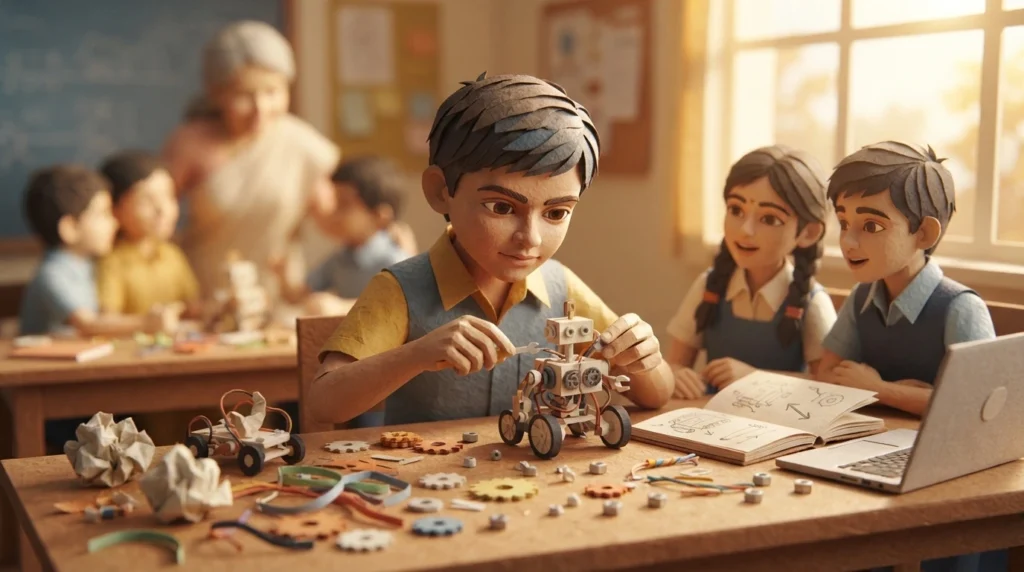
If every mistake feels like failure, students learn to protect themselves.
They stop guessing.
They stop asking unusual questions.
They wait until they are sure before speaking.
But discovery rarely works that way.
A student trying to solve a problem will often get something wrong before getting it right. The mistake gives them information. It tells them what to change.
This does not mean lowering standards.
It means making room for the thinking that happens before the correct answer.
Education Looks Different When Students Can Explore
A student needs more than a lesson.
They need time to explore an idea, people to discuss it with, and opportunities to try something themselves.
At Apni Pathshala, this thinking appears in the way we approach learning. Students are encouraged to explore interests, learn from others, practise skills, and gradually become more confident in figuring things out.
Research published in 2026 on curiosity-driven learning is also examining how curiosity can influence attention, memory encoding, and long-term retention. ScienceDirect
Education Should Leave Room for “Why?”
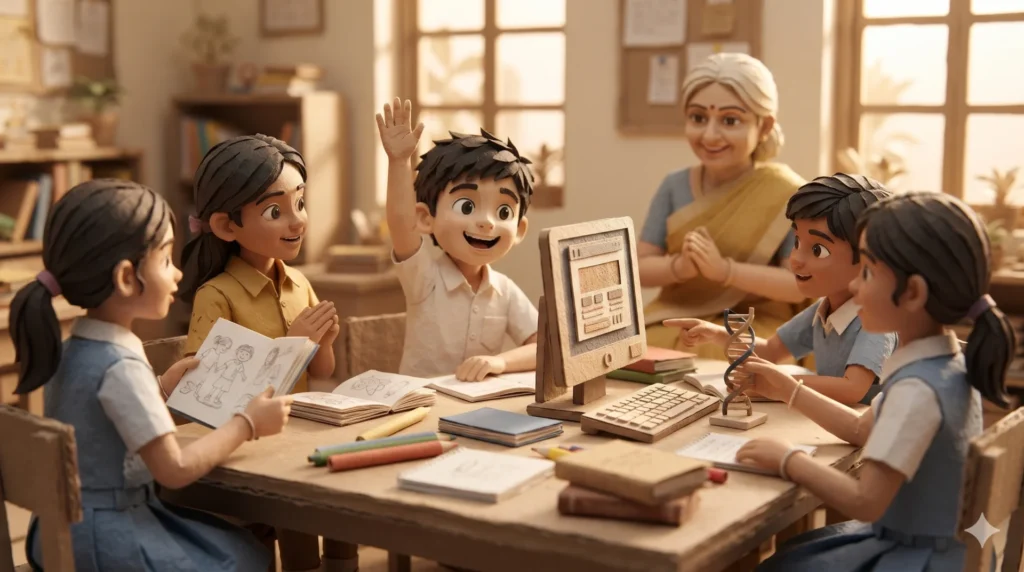
The most useful question a student asks may not be the one that has an answer in the textbook.
It may be a simple “why?” that leads somewhere unexpected.
Why does this work?
Why does it fail?
What happens if I change it?
Can I find another explanation?
Those questions are not distractions from learning.
They are often the beginning of it.
At Apni Pathshala, the aim is not to make every student curious about the same things. It is to help students keep the habit of wondering, investigating, and trying.
That is also why the learning environment matters. When students see other learners exploring their own interests, curiosity can become something they experience rather than something adults simply tell them to have.
Give Curiosity Somewhere to Go
If you are a student, try one small experiment today: write down one question you genuinely want to understand and spend 20 minutes investigating it before asking someone for the answer.
If you are a parent or teacher, try asking “What do you think?” before immediately giving a child the answer.
And if you want to see what curiosity can look like inside a real learning environment, read Unlocking Curiosity: Inside Apni Pathshala’s Learning Pods.
For a deeper look at the philosophy behind Apni Pathshala’s approach, read What Do We Teach at Apni Pathshala?.
You can also continue with Why Community Learning Centres Matter More Than Ever? to see why the environment around a learner can shape what they believe they are capable of.
Because a report card can tell us what a student answered.
The questions they keep asking can tell us how they are learning.
Frequently Asked Questions
1. Why is curiosity important in education?
Ans. Curiosity encourages students to explore, question, and engage more deeply with learning. PISA 2025 found a positive relationship between curiosity and science performance. OECD
2. Can students learn to ask better questions?
Ans. Yes. Question-asking can develop as students gain knowledge and practise inquiry. The 2026 study on question-asking and learning found that domain-specific questioning developed as students gained knowledge.
3. How does Apni Pathshala encourage curiosity?
Ans. Apni Pathshala gives students opportunities to explore, practise, learn with peers, and gradually build confidence. What Do We Teach at Apni Pathshala? explains this learning approach.
4. How can community learning give students more room to explore?
Ans. Community learning gives students space to explore interests, learn with others, and continue practising beyond a fixed lesson. Why Community Learning Centres Matter More Than Ever? explores this idea.