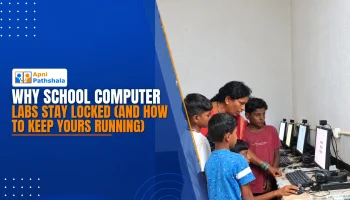
Students see computers and learning resources at a digital learning centre. Behind that experience, websites must work, content must be available, devices must be ready, and teams need accurate information.
As Apni Pathshala grew, disconnected tools and manual work made these responsibilities harder to manage. The challenge was to build dependable education technology for the people behind every POD.
This case study brings together five Tech Team improvements across website reliability, content publishing, computer deployment, operational management, and team practices.
Education Technology: Fixing Problems at Their Source
On an AWS-hosted WordPress website, images repeatedly disappeared from live pages even though the files had not been deleted. Clearing the cache restored them temporarily, but the issue returned two or three times daily.
Caching and SSL/HTTPS checks did not solve the issue. Further investigation found that some image URLs referenced the AWS server IP instead of the production domain. The team corrected the site/domain configuration in the WordPress and Bitnami environment.
The team monitored the website for approximately one month without manually clearing the cache. Images remained visible, and the approach was applied to relevant AWS-hosted WordPress websites. For technical context, see Bitnami’s WordPress domain configuration guidance.
| Before the fix | After the fix |
| Images repeatedly disappeared | Images remained visible during validation |
| Cache cleared 2–3 times daily | No manual cache clearing during one-month validation |
| Some image URLs referenced the server IP | Production domain correctly configured |
| Root cause was unclear | Configuration issue identified |
| Recurring maintenance was required | Issue did not recur during validation |
Software Automation: Making Content Easier to Publish
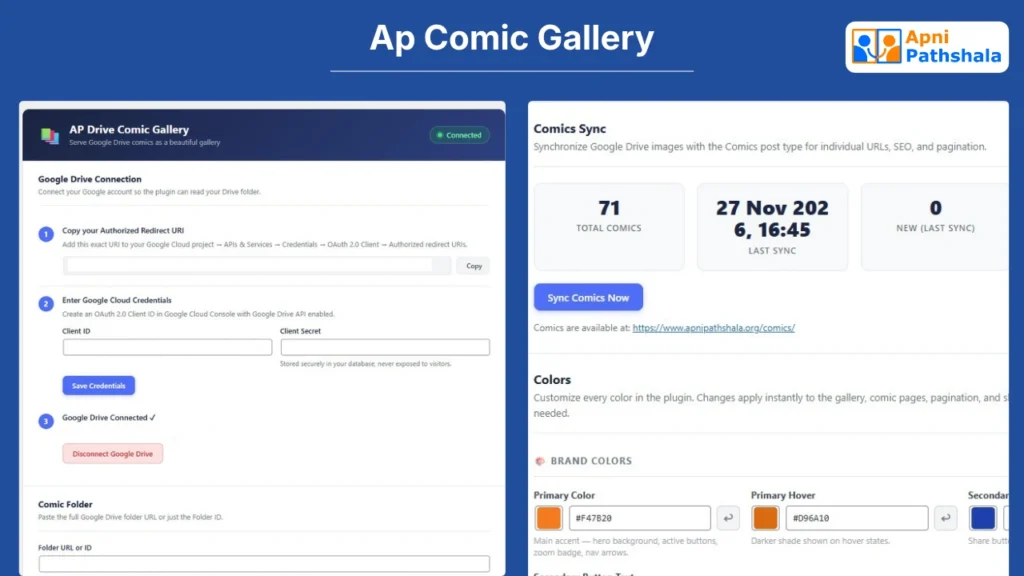
Publishing comics also involved repeated work. Each new comic in Google Drive had to be transferred, arranged, designed, and published on WordPress.
The team developed AP Comic Gallery, a custom WordPress plugin connecting Google Drive with the website. It fetches comic images, applies a predefined design, and supports individual WordPress pages with dedicated URLs and SEO content. It also offers one-click import if automation fails and manual design customisation.
Keeping source images in Google Drive reduces the need to store the entire collection on WordPress hosting. The plugin combines automation with manual control, avoiding a return to the full manual workflow if automation fails.
Digital Learning Infrastructure: Simplifying Computer Setup
Previously, Windows installers were shared through WhatsApp. Linux/Zorin users had to open Terminal, run a script, and enter a system password, creating extra support needs for POD Leaders.
The team created an installation script that detects existing SSS software, stops its services, removes its components, and installs Apni Prerna. Installation then moved into the Apni Prerna Dashboard, which detects the operating system, provides the correct Windows or Linux/Zorin installer, and automatically registers the device after installation.
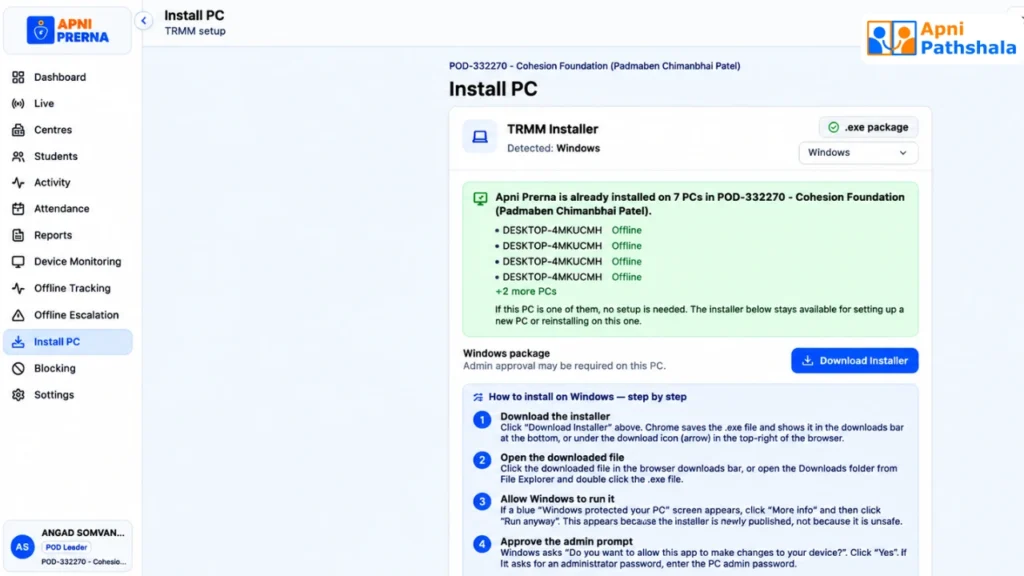
Previously, one PC took approximately 10 minutes to install, so 10 PCs could require around 100 minutes. With the dashboard-based process, centre-level deployment can take approximately 10 minutes, depending on the number of computers and installation conditions. This is a documented estimate, not a universal guarantee. The improvement moved technical complexity from the POD Leader into the product.
Education Management System: Bringing Operations Together
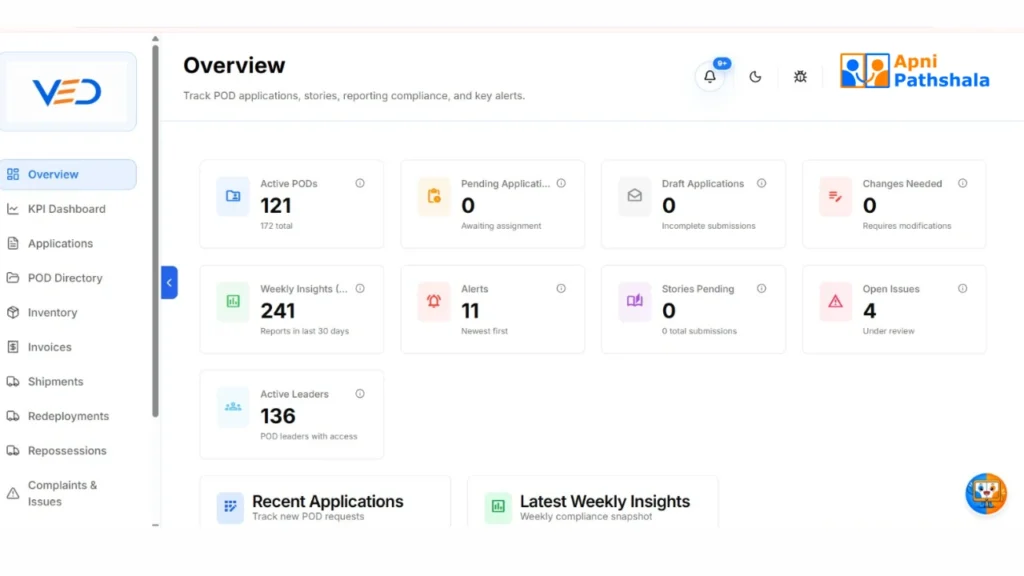
As the POD network grew, applications, onboarding, coordinator assignments, weekly updates, monthly reports, and status changes were managed through Forms, spreadsheets, WhatsApp, and manual follow-ups. Repeated updates increased the risk of inconsistencies and delays.
Apni Pathshala developed the POD Management System (PMS) to bring these workflows into a centralised operational platform. Applications could be tracked through defined stages, coordinator assignments became structured, weekly updates could be linked to individual POD records, and status information became easier to access.
Initially piloted with five PODs in the Apni Pathshala 2.1 programme, PMS helped the team identify bugs and unexpected user behaviour. It supports applications, onboarding, reporting, performance tracking, and issue resolution. Learn more about the Apni Pathshala POD programme.
Outcome-Driven Engineering: Changing How Teams Work
Completing features and closing issues showed activity, but did not always explain whether organisational operations had improved.
Adapting ideas from Measure What Matters, the team connects quarterly objectives with success metrics, monthly plans, weekly targets, and daily execution. Orbit centralises task updates, while Saturday Baithak covers achievements, blockers, feedback, and learning.
One reported change was a reduction in daily management follow-up time from approximately one hour to 30–40 minutes. The team aims to support a decentralised network of more than 1,000 PODs. Its focus is increasingly shifting from “What did we build?” to “What changed because we built it?” What Matters explains OKRs and CFRs.
| Earlier working model | Evolving working model |
| Task-oriented planning | Outcome-oriented planning |
| Quarterly goals with limited execution cascade | Quarterly, monthly, weekly, and daily alignment |
| Features and issues as main productivity indicators | Greater focus on measurable outcomes |
| Scattered task tracking | Orbit as a central task-management system |
| Frequent status follow-ups | Task updates and structured reviews |
| Management-driven task direction | Greater team autonomy |
| Individual work visibility | Shared visibility through Baithak |
What These Education Technology Improvements Mean Together
Together, the five initiatives make digital learning operations easier to manage as the organisation grows.
| Technology area | Challenge | Improvement |
| Website reliability | Recurring missing images | Corrected AWS site/domain configuration |
| Comic publishing | Repeated manual uploads and page creation | Google Drive-connected publishing plugin |
| Computer deployment | Technical, device-by-device installation | Dashboard-based installation and registration |
| POD operations | Fragmented forms, sheets, and follow-ups | Centralised management workflows |
| Team practices | Task completion without outcome visibility | Measurable goals, Orbit, and Baithak |
Not every initiative has a verified time-saving figure, so these projects should not be presented as one combined productivity gain. Their value is visible in fewer recurring fixes, repeatable publishing, simpler deployment, structured records, and clearer coordination. These improvements strengthen learning infrastructure, but do not prove improved student learning outcomes.
Building Better Systems for Better Learning
Education technology creates value when it responds to real needs. Reliable websites, accessible content, easier setup, organised data, and clear ownership strengthen learning environments.
Apni Pathshala aims to build dependable systems that help teams work better and support community-based digital education. Explore the Apni Pathshala POD programme and our Curriculum AI case study.
Behind every POD is more than a computer. It is a connected system of people, processes, and education technology working together to make learning possible.
Frequently Asked Questions
1. What does education technology include in a learning centre?
Ans. It includes computers, websites, learning resources, management systems, and the processes that connect them.
2. How can software automation help education organisations?
Ans. It reduces repeated publishing, installation, and data-handling tasks, giving teams more time for support.
3. Why is a centralised education management system useful?
Ans. It helps teams manage applications, updates, assignments, and operational information through consistent workflows. Explore the Apni Pathshala POD programme.
4. How does Apni Pathshala use technology to support personalised learning?
Ans. See the Curriculum AI case study for AI-assisted planning with human review.