Most NGOs working with children already know digital learning matters. Your students need it for school projects, exam forms and their first jobs. Funders increasingly ask about it. And in many communities you serve, the NGO centre is the only place a child could ever use a computer. Only 36.5% of Indian schools have a working desktop, according to UDISE+ 2025-26.
The hard part isn’t the why. It’s the how. Adding a digital learning programme usually means buying computers, finding a curriculum, training someone to teach it, fixing machines when they break and tracking whether children are actually learning. For a small NGO, that is a second organisation’s worth of work.
A digital literacy NGO partnership with Apni Pathshala is designed to take most of that off your plate. You bring the community, the space and the trust you’ve already built. Apni Pathshala brings the computers, curriculum, training and tracking. Together, you run a digital learning centre, called a POD, built to last.
Why Digital Learning Is Hard for NGOs to Start Alone
NGO founders who try to start a computer centre on their own usually run into the same four walls:
- Devices. Donated laptops arrive in mixed brands and ages. Half need repairs within a year, and no one is responsible for them.
- Content. Free resources exist, but stitching them into a structured course that a 9-year-old and a 15-year-old can both follow takes time most teams don’t have.
- People. The volunteer who set up the centre moves on, and the knowledge leaves with them.
- Proof. Funders want to know what children learned, not just how many attended. Without a system to track progress, that’s hard to show.
Each of these is solvable. But solving all four while also running your core programmes is where many centres stall or shut down. If you’re designing a programme yourself, our guide to building a digital literacy programme for ngo teams walks through each piece. If you’d rather not build every piece, read on.
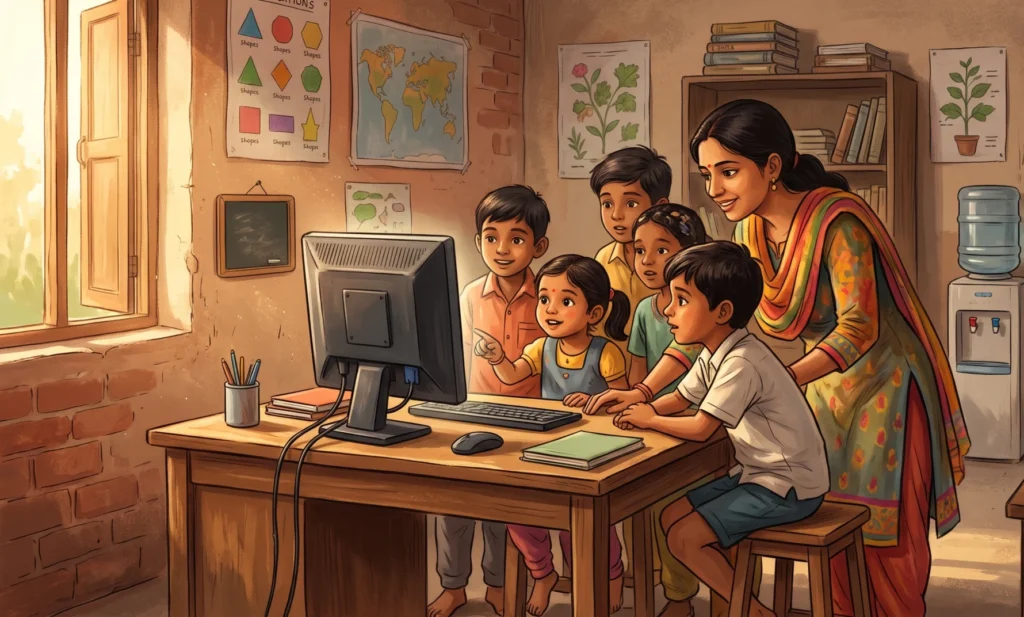
What Apni Pathshala Provides in an NGO Partnership for Digital Education
The partnership runs on a no-cost lease. Apni Pathshala does not charge NGOs any fee to run a POD, even if the POD later charges students a small fee to become self-sustaining. In return, it asks for commitment: keeping the POD open, caring for the computers and sharing regular updates.
| Apni Pathshala provides | Your NGO provides |
| 10 Apna PC computers with accessories, on a 15-month lease under an MoU (renewable) | A room of at least 300 sq ft with tables, chairs and power sockets |
| A Learning Management System for structured courses and progress tracking, which works even with low or no internet | Wi-Fi of at least 100 Mbps |
| Eklavya, Apni Pathshala’s own AI tutor, with step-by-step explanations and instant feedback | At least one person comfortable with technology to run the POD |
| Beyond Exams, a library of 30,000+ courses and notes with completion certificates | At least one CCTV camera for safety |
| Apni Prerna, which blocks non-educational sites and apps and reports study hours | Students from your community and regular timings |
| Training and ongoing guidance for POD leaders, plus tools to manage students | Regular updates to Apni Pathshala and open communication about problems |
The split is deliberate. Apni Pathshala handles the parts that are hard to build from scratch. Your NGO keeps what only you can do: earn the community’s trust and keep children coming back. Strong PODs also get help opening a second, “sister” POD.
If you’re planning the physical space, our guide to setting up an ngo computer lab on a small budget covers room size, power and layout.
How the Apni Pathshala NGO Partnership Works, Step by Step
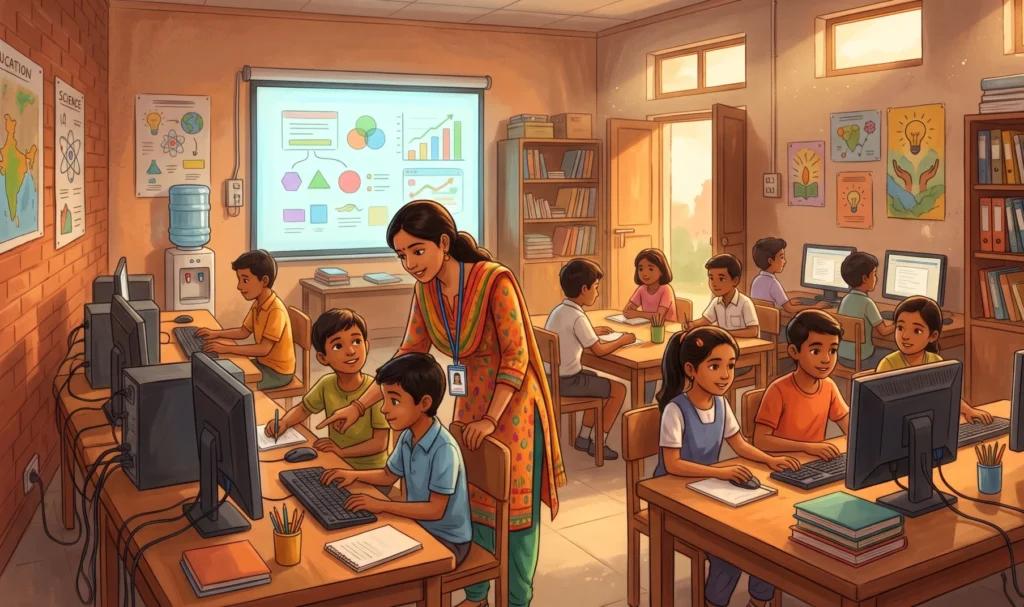
- Apply online. Fill in the “Start a POD” form on the Apni Pathshala website. NGOs, schools and individuals can all apply. Applications are reviewed within 3-5 working days.
- Send a proposal. If shortlisted, share your student plan, curriculum plan and long-term goals, along with a 3-5 minute introduction video.
- Complete KYC. Submit identity and address proof, and your NGO registration documents.
- Verification meeting. A short online meeting with the Apni Pathshala team.
- Set up the room. Arrange tables, chairs, power and safety, then share a short setup video.
- Sign the MoU. The lease and responsibilities are set out in a standard agreement.
- Receive the computers. Unbox and check the 10 Apna PCs, then submit a quality-check report within 24-48 hours.
- Launch and report. Start your first batch and share regular updates, so progress is tracked from day one.
That last step is often what unlocks future funding. Our guide to writing an impact report for ngo funders shows how to turn POD data into a report CSR partners want to read.
Digital Literacy NGO PODs Already Running
Apni Pathshala has worked with more than 120 Learning PODs across rural and urban India, and over 30 non-profit PODs took part in the last phase of its 2.1 initiative. A few examples show how differently NGOs use the same model:
| NGO POD | Who it serves | What it achieved |
| Uva Jagriti Sansthan, Kotputli | Youth preparing for jobs and exams | 665 student attendances in 6 months, 175 digital literacy certificates, 230+ skill certificates and 5 job placements |
| Modern Education System | Youth and rural communities | 350+ students trained in job-oriented digital skills, and 21 selections at placement fairs |
| ATMA Foundation, Kerala | Students in three government schools | 441 students learning computers regularly |
| USR Indu Samiti | Differently-abled children at a special school | 180 students learning MS Office, Canva, internet skills and online safety |
| KSSD | Rural students | 110-130 students a month, plus 90-day STEM and AI programmes that introduced AI to 150 students |
| Ashayen-Jigyasa | Street children | Free computer basics and typing, with batches expanding |
The common thread: each NGO focused on its own community and purpose, from jobs to special education, while the computers, software and training came from Apni Pathshala. Uva Jagriti Sansthan has since opened a second POD with Apni Pathshala’s help.
Frequently Asked Questions
1. Can my NGO partner with Apni Pathshala?
Ans. Yes. NGOs, schools and individuals can all apply to start a POD. Apni Pathshala looks for partners who are credible, have the capacity to run a centre and are genuinely committed to students’ growth.
2.What does the NGO need to provide?
Ans. A room of at least 300 sq ft with tables, chairs and power, Wi-Fi of at least 100 Mbps, one CCTV camera, at least one tech-comfortable person to run the POD, and students from your community.
3. What does it cost?
Ans. Nothing in fees. The 10 computers come on a no-cost, 15-month lease under an MoU, and Apni Pathshala does not charge anything to run a POD. Your costs are the room, electricity, internet and your POD lead’s time.
4. How are results tracked?
Ans. Through Apni Pathshala’s Learning Management System, which records courses and progress, along with regular updates from the POD to the Apni Pathshala team.