Not every learner needs the same learning path.
One student may want to learn graphic design, another coding, AI tools, digital marketing, or basic computer skills. Their starting level, available time, learning goal, and pace can all be different.
But creating a different learning path for every learner creates another challenge. Someone still has to understand what the learner needs, find the right resources, create daily tasks, define outcomes, and turn everything into a structured curriculum.
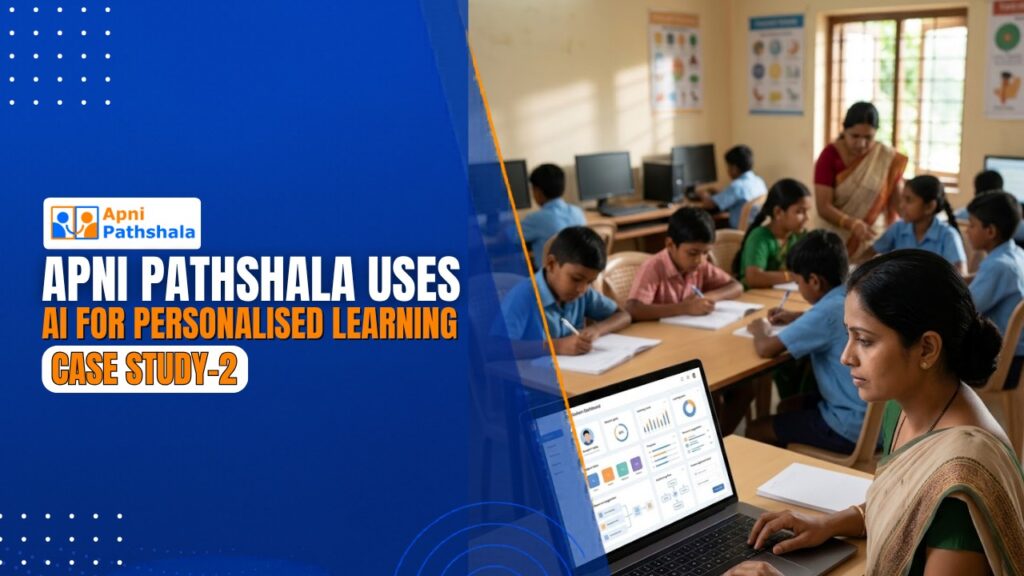
At Apni Pathshala, Academic Associates were doing much of this work manually. For one personalised curriculum, the complete preparation process could take approximately 6–15 minutes. As the number of learners increased, the same research, structuring, and documentation had to be repeated.
To reduce this work, Apni Pathshala’s Software Team developed Curriculum AI.
Early internal experiments show that a process that previously required approximately 6–15 minutes per curriculum can now be completed in approximately 3–5 minutes, including human review. The AI-generated curriculum itself can be produced in under 60 seconds.
The bigger change isn’t just speed. It shifts the Academic Associate’s role from creating everything manually to reviewing whether the learning plan works for the learner.
The Challenge Behind Personalised Curriculum Creation
Creating a personalised curriculum requires more than choosing a subject.
The Academic Associate needs to understand what the student wants to learn, how much time they can spend, how long the programme should run, the learning sequence, and which resources can support it.
Before Curriculum AI, the Academic Associate had to analyse student requirements, decide the topic sequence, research resources, select material, create objectives and tasks, define outcomes, document the curriculum, review it, and share it with the POD Leader.
Internal measurement showed that this preparation normally required approximately 6–15 minutes per curriculum.
This matters in Apni Pathshala’s community-learning model, where learners may enter a POD with different goals and learning levels. Learn more through the Apni Pathshala Community Centre POD model.
What Curriculum AI Changed
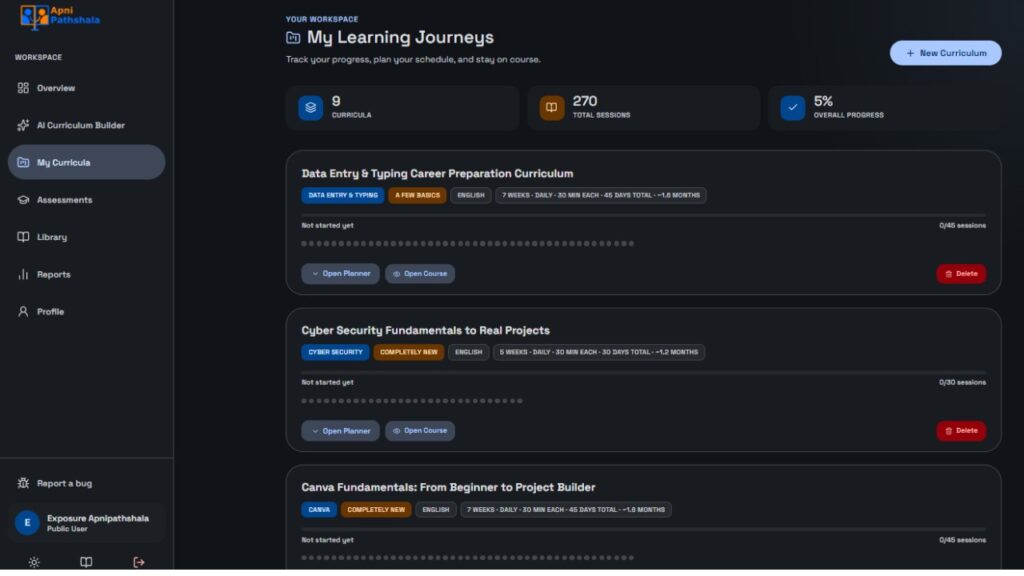
Curriculum AI was created to automate repetitive parts of curriculum preparation without removing the Academic Associate.
Instead of manually researching and structuring everything, the Academic Associate provides the learner’s requirements.
Curriculum AI then helps analyse those requirements, organise topics, identify learning resources, create objectives and daily activities, define expected outcomes, and produce a structured day-by-day curriculum.
The AI-generated curriculum can be produced in under 60 seconds.
The Apni Pathshala AI Curriculum Designer demonstrates this approach by turning a learner requirement into a structured learning plan.
But the process doesn’t end when AI generates the curriculum. The Academic Associate reviews the output before sharing it with the POD Leader.
That matters because faster generation does not automatically mean better learning.
UNESCO’s Guidance for Generative AI in Education and Research also highlights human-centred use and pedagogical validation when generative AI is used in education.
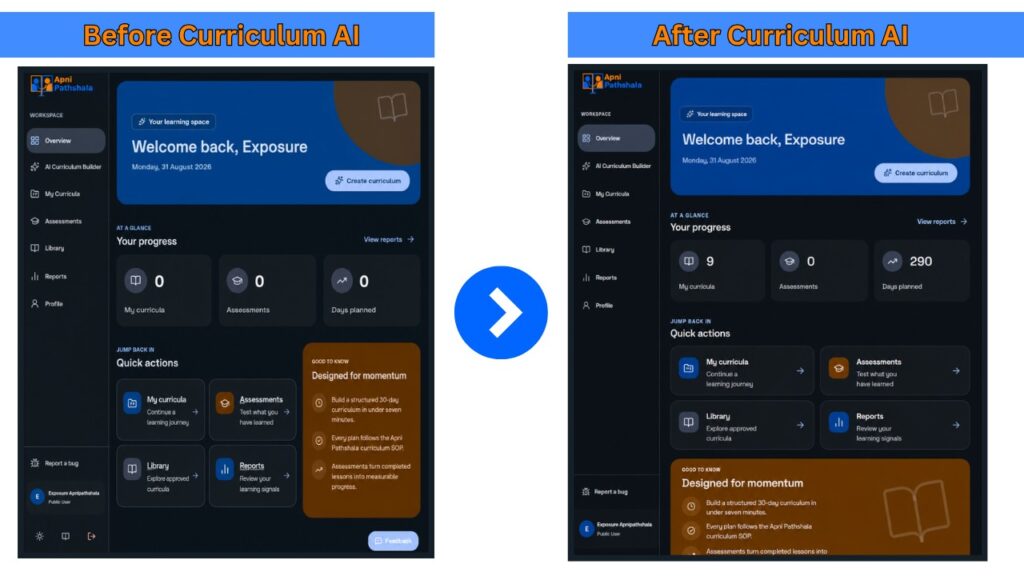
Before and After Curriculum AI
Before Curriculum AI:
Understand → Research → Analyse → Structure → Document → Review → Share
With Curriculum AI:
Provide requirements → AI generates → Human reviews → Refine if required → Share
Earlier, much of the Academic Associate’s preparation time was spent creating the first version of the curriculum.
Now, AI can handle much of the repetitive research and structuring, while the Academic Associate can focus more on whether the curriculum matches the learner’s goal, whether the sequence is practical, whether the resources are appropriate, and whether anything needs to change before sharing.
What Did the Initial Experiment Show?
Academic Associate Pratik was the first internal user included in this case study.
During the initial validation, he generated five personalised curricula using Curriculum AI.
Before Curriculum AI, preparation took approximately 6–15 minutes per curriculum.
With Curriculum AI, AI generation takes under 60 seconds, while the complete workflow, including review and sharing, takes approximately 3–5 minutes.
Using the midpoint of the reported ranges, the previous average was approximately 10.5 minutes per curriculum, while the current average is approximately 4 minutes.
That represents an estimated reduction of approximately 6.5 minutes per curriculum, or around 62 per cent.
At approximately five curricula per week, the midpoint calculation indicates around 32.5 minutes of curriculum-preparation time saved each week.
The World Bank’s Digital Technologies in Education work also recognises technology’s potential to support personalised learning and augment educators rather than simply replace them.
Why These Results Need Context
Five curricula are a useful beginning, but they are not proof that Curriculum AI has solved personalised curriculum creation at scale.
This is still early internal validation.
More Academic Associates, students, subjects, and learning requirements need to be tested before stronger conclusions can be drawn.
UNICEF’s Guidance on AI and Children also highlights responsible implementation, appropriate oversight, and children’s best interests when AI systems affect young people.
For Apni Pathshala, the stronger cycle is:
Generate → Review → Collect feedback → Improve → Measure
Why This Matters Beyond Time Saving
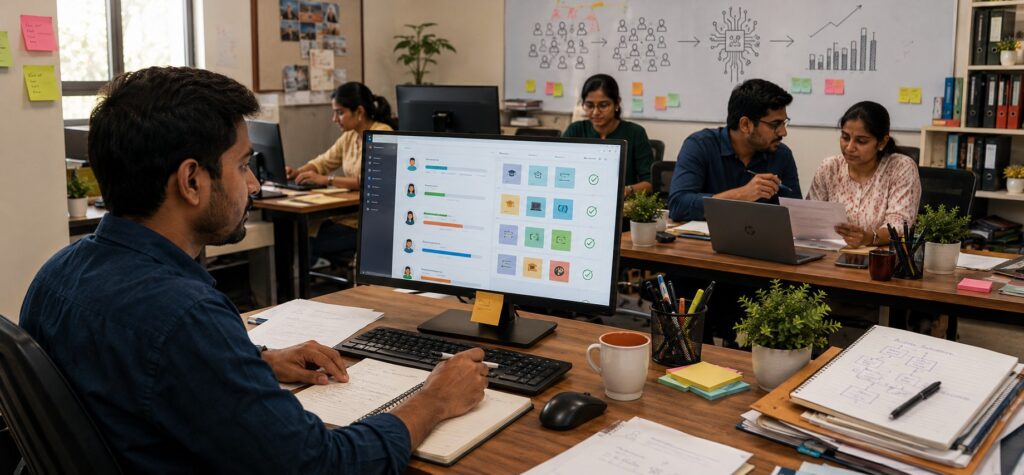
Saving several minutes on one curriculum may appear small. The impact becomes more meaningful when you repeat the same process across more learners and PODs.
If personalised curriculum requirements increase, manual research, structuring, and documentation would normally increase alongside them.
Curriculum AI creates another possibility:
More learners → More personalised requirements → AI handles repetitive preparation → Academic Associates review → Learning plans are shared
The long-term opportunity is not simply faster curriculum generation. It is exploring whether personalised learning can grow without manual preparation increasing at exactly the same rate.
What Apni Pathshala Learned
The strongest learning from this experiment is not that AI can generate a curriculum in under a minute.
It is that AI may create greater value when it removes repetitive parts of a workflow while keeping people responsible for quality.
For Apni Pathshala, this represents a more meaningful way to think about AI in education:
Less time on repetition. More time on learning quality.
This keeps the system useful for operations while preserving the human judgement needed to make each learning plan practical for students today.
See How Apni Pathshala Is Building Better Learning Models
Curriculum AI shows how technology can reduce repetitive work while keeping human judgement at the centre of personalised learning.
But personalised learning is only one part of the journey.
See how students themselves can become active participants in learning through our previous case study, Learn From Peers: A Case Study on Peer Learning Impact.
Discover how Apni Pathshala is combining technology, educators, and peer learning to create learning environments where students can learn more independently and confidently.
Explore more Apni Pathshala learning models and see how small changes in the way learning is delivered can create a bigger impact.
Frequently Asked Questions
1. How does peer learning help shy students become more confident?
Ans. Peer learning gives students regular opportunities to explain concepts, participate in group discussions, and help classmates solve problems. This gradually improves their communication and confidence.
2. How can AI support children’s learning without compromising their rights and well-being?
Ans. UNICEF says child-centred AI should support learning, inclusion and skill development while ensuring fairness, transparency, privacy and children’s best interests.
3. How can digital technology improve education for students?
Ans. Digital technology can make learning more personalised, accessible, and flexible while helping teachers provide better support. The World Bank emphasises that technology should support teachers, not replace them.
4. How can I create a personalised curriculum for a student?
Ans. Use Apni Pathshala Curriculum AI to quickly create a personalised learning plan based on the student’s goals, level, and learning needs.