A 14-year-old in a metro city uses an AI tool to summarize a physics chapter in ten seconds.
A 14-year-old in a rural village sits with a cracked, second-hand smartphone, scrolling through Instagram Reels for three hours because the local school teacher didn’t show up today.
We love to tell ourselves that cheap data solved the problem. We think the digital divide in India is just about internet access.
It isn’t. It is about knowing what to do with that access.
In this blog, we are going to expose the harsh, uncomfortable reality of rural education in India, explain why simply handing out free tablets is a massive failure, and reveal the exact physical and digital ecosystem needed to actually close this gap by 2026.

The Smartphone Illusion
Here is the biggest lie we believe about access to technology in rural India: We think that because everyone has a smartphone, everyone is digitally literate.
That is completely false.
Having a smartphone doesn’t make you digitally literate any more than owning a microwave makes you a chef. Cheap 4G data brought entertainment to the villages, but it did not bring education.
When you put a screen in front of a rural student without giving them a framework, they default to pure consumption. They watch YouTube. They play BGMI. They consume dopamine.
They don’t know how to write a professional cold email. They don’t know how to use ChatGPT to learn a coding language. They don’t know how to use Google Workspace.
They have the exact same hardware as the kid in the city, but their software, their mindset and environment is completely different.
The Brutal Cost of the Digital Divide in India
Let’s be brutally honest about what happens when these two 14-year-olds turn 21.

They will both enter the exact same job market. They will both apply for the exact same remote jobs. And the rural student will lose every single time.
Not because they aren’t smart. Not because they don’t work hard.
They will lose because the urban student spent the last seven years learning how to manage digital tools, while the rural student spent the last seven years memorizing a dusty textbook for an exam that no employer cares about.
The system left them completely defenceless.
The “Free Tablet” Trap
For the last decade, governments and NGOs have tried to solve this problem by throwing hardware at it.
They distribute thousands of free laptops and tablets to village schools. But here is what actually happens: The tablet gets taken home. The parents use it to watch movies. The screen breaks in three months. The kid goes back to memorizing the textbook.
You cannot solve a behavioural problem with a piece of plastic.
Technology without an environment is just a distraction. If a student is sitting in a room where nobody is building, creating, or learning, handing them a tablet won’t magically turn them into a software engineer. It will just turn them into a faster scroller.
How Apni Pathshala Actually Fixes It
This is where the conversation has to fundamentally shift.
You cannot fix the digital divide in India from a distance. You have to physically step into the environment and change it.
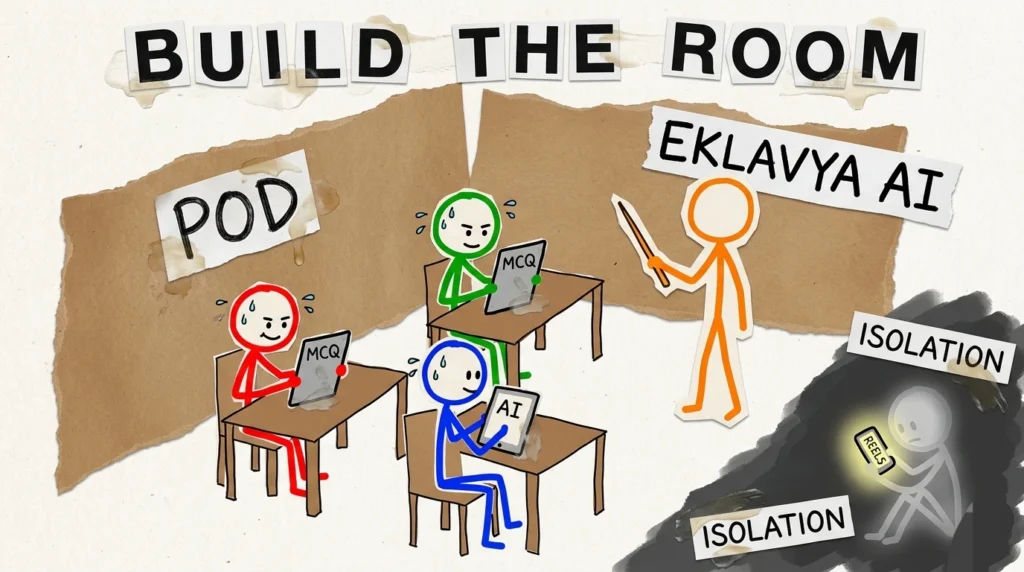
This is exactly why Apni Pathshala built the POD (Community Centre) ecosystem. It is the most aggressive, effective solution to rural education currently operating in the country.
Here is why it works when everything else fails:
1. We Don’t Provide Apps; We Provide Environments
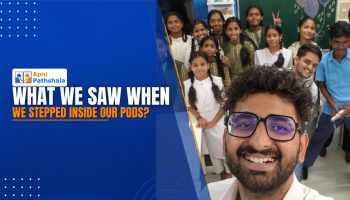
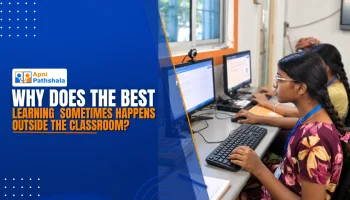
Apni Pathshala doesn’t just give a rural student a login ID and tell them to figure it out on their own at home. We put them inside a physical POD. They sit at a desk. They are surrounded by other ambitious kids. They have a mentor in the room. We upgrade the physical environment so that digital learning can actually happen.
2. We Kill Passive Consumption
Inside the POD, students use the Eklavya AI. It doesn’t let them scroll. It doesn’t let them watch videos passively. It forces them to interact, answer MCQs, and prove they understand the concept before they can move forward. It turns passive consumers into active thinkers.
3. We Filter the Garbage
Through the Apni Prerna software, the digital environment is entirely curated. The wild-west distractions of the internet are removed. The tablet becomes a pure weapon for learning, not a portal for social media addiction.
We don’t need to feel pity for rural students. They have hunger. They have the grit.
They just need the right room to sit in, and the right tools to build with. Apni Pathshala isn’t just teaching rural India how to pass board exams; we are teaching them how to build their own leverage.
At last, you have exactly two choices right now.
You can let that student keep scrolling through Reels until they become just another unemployable statistic at 21.
Or, you can pull them out of the passive loop and put them in a room where the internet is actually used as a weapon.
👉 Find your nearest Apni Pathshala POD here (Don’t have one in your town yet? [Apply to open a Community Centre] and become the environment your community desperately needs.)
👉 Read why we need more self-dependent learners more than ever in the history of education. Know more
Frequently Asked Questions
1. Is teaching kids to use ChatGPT enough for their future?
Ans: No. Teaching a child to use ChatGPT is like teaching them to use a calculator. It’s a baseline requirement, but it doesn’t teach them the underlying logic required to solve messy, real-world problems. A country of passive AI users is not the same as a country of AI-ready citizens.
2. Why do children struggle with self-learning? 2026?
Ans: Because without proper guidance and structure, self-learning becomes confusing and inconsistent.
3. Can a rural student pass CBSE Class 10 without expensive coaching classes?
Ans: Yes. What a student actually needs is a feedback loop, not “coaching.” Any tool that identifies specific conceptual gaps and corrects them in real-time (like Eklavya AI) serves the exact core function a physical tuition class is supposed to provide.
4. What are the best self-learning tools that help students become independent learners?
Ans: Structured digital tools and guided learning platforms help students learn on their own while staying focused and consistent.