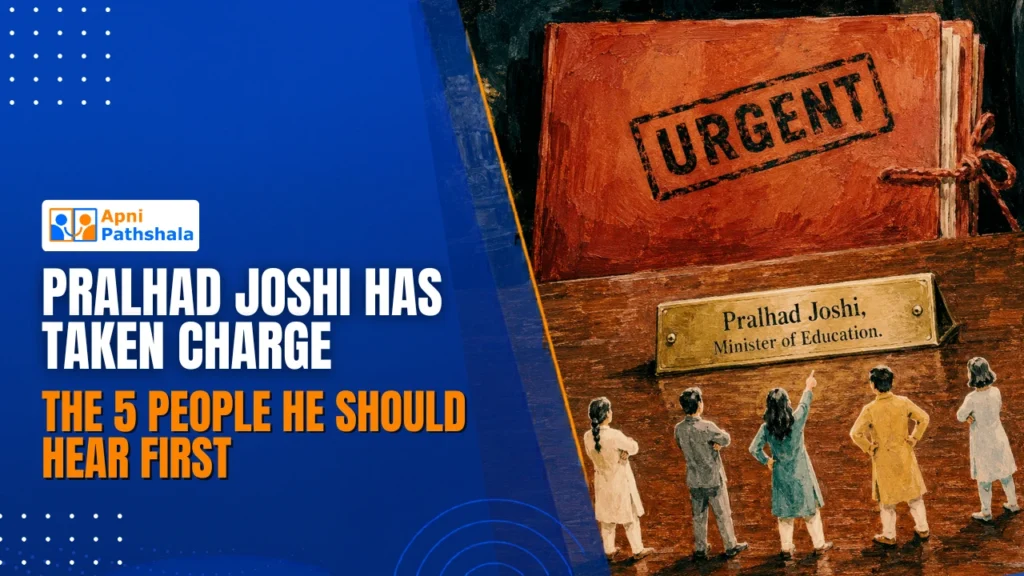
Now that Pralhad Joshi has taken charge, his first review meeting covered schemes and initiatives. His next meetings should test how those plans work on the ground.
Pralhad Joshi has taken charge of India’s Ministry of Education.
His first day began inside Kartavya Bhavan. Senior officers briefed him on schemes. That made sense. A new minister should know what the ministry is doing before deciding what it should do next. Joshi currently holds the Education Ministry in addition to his existing portfolios.
A ministry meeting shows education from the top.
A report can show enrolment. It cannot show why a child stopped asking questions. Exam data cannot show what one uncertain result does to a family at midnight.
Here are five people he should hear.
1. The Student Who Followed Every Rule and Still Lost Trust
Meet the student who studied for years.
They completed the syllabus, paid the fees, and reached the centre on time. Their family planned money and hope around one exam.
Then the exam process came under doubt.
For the ministry, the issue becomes dates, investigations, and new rules. For the student, it becomes lost sleep and another month of waiting.
A fresh exam date does not erase that feeling.
This student has one question:
When an institution fails, who protects the learner who did everything right?
Trust is part of education too.
2. The Child Whose Internet Leaves With the Phone
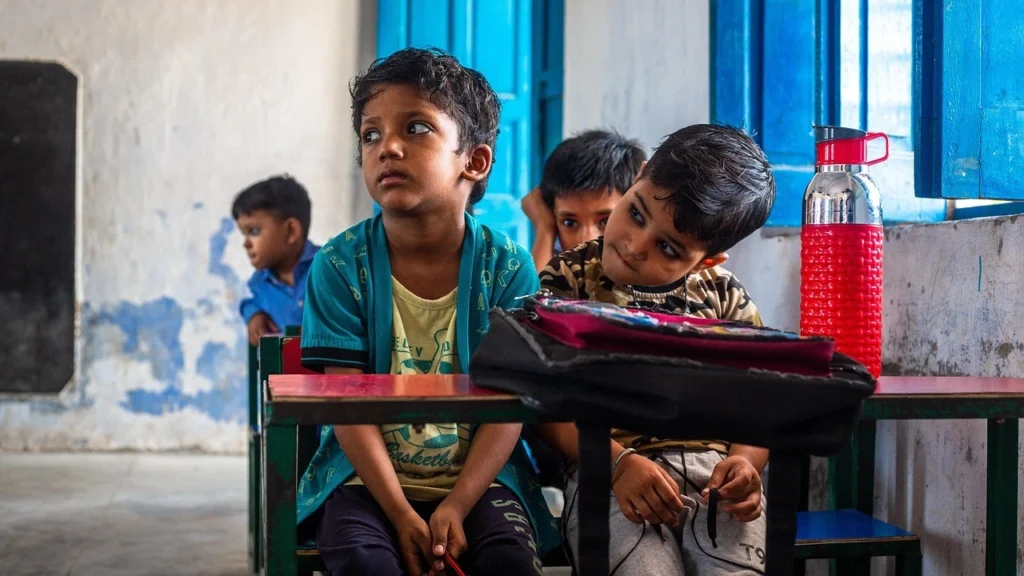
Now meet a child learning through a parent’s phone.
The lesson loads. The child watches. Then the parent leaves for work, and the classroom leaves inside their pocket.
On paper, the child has internet access. In life, they have a small screen, weak data, little time, and nobody nearby when they get stuck.
A learner needs a device, time to test ideas, and a place where mistakes are safe. Watching technology does not teach you how to use it.
3. The Learner Marks Keep Calling Average
The third learner has an ordinary report card.
Yet they can repair things, explain ideas, draw, sell, organise, or notice a problem adults walked past.
The answer sheet never asked.
Exams test memory, speed, accuracy, and written answers. They see one slice of the child. Curiosity, judgment, communication, and practical skill often sit outside that slice.
We call many children average because our window is small.
This learner should ask: Where can I show what I know when the exam never asks me to use it?
4. The Parent Who Can See Only One Safe Path
The fourth person is the parent pushing marks, coaching, medicine, or engineering.
It is easy to call them narrow-minded. Try seeing the road from their side.
They want safety. Marks look clear. Degrees look familiar. New careers arrive as confusing names online. Nobody shows the family how a project becomes an opportunity or how a skill becomes work.
Then we tell them to support creativity. Support it toward what?
Their question is fair: How do I trust a new path when nobody can show me where it leads?
Fear fills gaps left by missing information.
5. The Local Mentor Building With Almost Nothing
The fifth person may be a college student, teacher, retired worker, volunteer, or community leader.
They have one room. Maybe two computers.
They know local families. They know which learner goes quiet and which one lights up when given a real task.
What they lack is structure.
Communities already hold rooms, skills, trust, and people willing to help.
The System Sees India. Communities See the Child.
These five people point to five gaps:
trust after failure access that works ability hidden by marks parents choosing through fear local people ready to help
A national system needs scale. It handles exams, funding, curriculum, universities, and millions of learners.
A child needs a response. One needs a computer. Another needs confidence. Another needs a project. Another needs validation.
What an Apni Pathshala POD Can Show
An Apni Pathshala POD is a small learning centre inside a community. Local leaders use computers, learning tools, mentors, and practical activities to help students build digital and real-world skills. (Apni Pathshala)
Picture one learner entering.
They choose a project. They try. They get stuck. They ask a mentor, a peer, or Eklavya AI for guidance. Then they return to the work and explain what they made.
Eklavya AI supports independent learning at the learner’s pace.
The computer matters but the deeper gain is agency.
One POD cannot solve every education problem but it can show a useful direction: support local mentors, give communities tools, and let children practise abilities that exams rarely reveal.
Turn Listening Into a System
One student meeting can create a photograph. A listening system can change a decision.
In his first 100 days, the minister should build a simple loop:
Listen to students, parents, teachers, and local mentors. Visit homes, classrooms, coaching centres, and community learning spaces. Compare official data with daily experience. Test small local ideas before scaling them. Publish what changed and who owns the work.
Pralhad Joshi will hear from officers, boards, universities, and experts. He should.
But don’t stop at this. We need to expand our domain.
Let the student who lost trust enter. Let the child with one shared phone enter. Let the learner hidden behind marks enter. Let the worried parent enter. Let the local mentor enter.
These five people can show what happens after policy leaves Delhi.
Have space, devices, skills, funding, or local trust? Start or support an Apni Pathshala POD and help children learn, build, and show what they can do.
Frequently Asked Questions
1. Why has Pralhad Joshi taken charge of the Education Ministry?
Pralhad Joshi was given the Education Ministry as an additional charge after Dharmendra Pradhan resigned. He began by reviewing current schemes with senior officers.
2. Why should the Education Minister meet students and parents?
Officials can explain rules, budgets, and schemes but students and parents can explain how those decisions work once they reach homes, exam centres, and classrooms.
3. Who are the five people he should hear first?
He should hear from a student affected by exam failure, a child with limited digital access, a learner whose skills are hidden by marks, a worried parent, and a local mentor already helping children.
4. How can Apni Pathshala PODs help?
A POD gives local learners access to computers, projects, mentors, peers, and AI-supported guidance. It helps children practise useful skills and show what they can do beyond exam scores.