You might be sitting in a college lecture you don’t understand, or staring at an exam prep book feeling like you are already behind.
And that is completely okay. We have been conditioned to believe that our future in Indian education depends on a grand “Master Plan”, a prestigious admission, a government syllabus, or a giant campus. But the recent news that the central government has rejected a new IIM in Telangana shouldn’t dishearten you. It is the greatest invitation you will ever receive to take your power back.
Education is an internal state of relentless curiosity. When you strip away the pressure of the bureaucracy, you realise that your ability to learn independently is the most potent superpower you have.
Yet, millions of beautiful, capable minds are currently paralysed, believing they are “failures” simply because they didn’t get into the right institution or fit into a standardised box.
When the government rejects a new college, claiming there is an “existing sufficiency,” they are looking at a spreadsheet. They don’t see the individual student burning the midnight oil, wondering if their dreams are valid.
And even for those inside the giant legacy institutions, the reality is often bleak. The Kerala High Court recently had to intervene to protect students from ragging because massive, centralised hubs cannot even monitor their own campuses.
The bureaucracy is painfully slow. Until a recent digital shift, researchers at Gujarat University waited up to a year just to get a thesis evaluated. Whether you are in college, dropped out, or grinding for an exam, this centralised machine is designed to make you feel helpless.
But wait, you don’t need to change the system. How about we change the way we learn? Let me explain that to you.
You Are a Speedboat

Think of the legacy education system as a massive, slow-moving cargo ship. It takes miles just to turn a few degrees. But you? You are a speedboat. You are agile. When the winds of the 2026 economy shift, you can pivot instantly.
Steve Jobs famously operated within what his team called a “Reality Distortion Field“. He didn’t accept the limitations placed on him by society or industry standards. He bent reality to his will through pure, focused belief and action.
You must create your own reality distortion field when it comes to your education. Do not let a rejection letter dictate your reality.
Abraham Lincoln, one of the most revered leaders in human history, had barely a year of formal schooling. He once said:
“The things I want to know are in books; my best friend is the man who’ll get me a book I ain’t read.”
He self-educated his way to greatness through pure willpower.
The most successful minds do not blame others. Most of them leveraged micro-campuses, setting their own gentle but practical goals, and falling in love with the process of learning.
This is the heart of true decentralisation. States like Maharashtra are already pushing autonomous norms because they know the giant, centralised model is too slow. The future belongs to small, autonomous, self-driven nodes of learning.
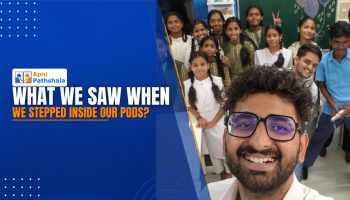
This is exactly why Apni Pathshala PODs are so vital. We don’t wait for a federal budget. We create a warm, hyper-focused micro-learning POD right in your neighbourhood.
Ramanujan story: Greatness from the Edges

If you ever feel like you don’t have the right resources, remember the story of Srinivasa Ramanujan.
He was a young man in India who failed his college exams because he was so consumed by his love for mathematics that he neglected his other subjects. He didn’t have access to the elite universities of Europe. He didn’t have professors guiding him. He had one outdated textbook (Carr’s Synopsis) and a slate board.
Ramanujan is a perfect example of self-study. He sat on his porch in Madras, deriving theorems that would baffle the greatest minds in the world, and he mailed his work directly to Cambridge.
He created his own reality distortion field. If he had waited for a centralised master plan to hand him a degree, the world would have lost one of its greatest mathematical geniuses.
So, the takeaway is you just need curiosity and a problem to solve
How to Build Your Own Future of Indian Education Today
Whether you are currently enrolled in a college you dislike, preparing for a competitive exam, or trying to carve your own path entirely, here is exactly how you can take control of your learning today:
1. Forgive Your Current Situation
If you are in a college that feels useless, stop fighting it. Use the campus as a networking ground. Use the library for your own projects.
If you are preparing for a difficult exam like the JEE, do not tie your soul and self-worth to the rank. Treat the preparation as a mental gym (a way to build discipline, focus, and a high tolerance for difficult tasks).
One exam doesn’t define you, but the work ethic you build will serve you forever.
2. Create a 30-Day Plan
Do not wait four years to see if what you are learning is valuable. Shrink your timeline. Ask yourself: What can I build in the next 30 days?
- Can you use Claude AI to build a simple web app for Indian users?
- Can you write and explain whatever you learn in simple words?
- Can you learn the basics of a high-demand skill?
Set a gentle, achievable goal. The dopamine hit you get from actually building something real will teach you more than a semester of passive lectures.
3. Use AI as a Mentor, Not a Shortcut
When you study alone, it is easy to get stuck. But in 2026, you have the greatest tutors in human history available on your laptop.
Instead of asking AI to write your code or do your homework, ask it to act like Eklavya. Say:
“I am struggling to understand this concept. Don’t give me the answer, but ask me guiding questions so I can figure it out myself.”
This is how you build deep, unbreakable neural pathways.
How we can help you

No need to leave your hometown to find greatness. The future of education is decentralised, empathetic, and local.
This is the core mission of the Apni Pathshala PODs. We are building safe community centres for all types of students.
In a POD, there is no public shaming. There is no anxiety about fitting into a quota. There is only a quiet room, supportive mentors, and the freedom to explore your own brilliant mind.
Just remember one thing! YOU are more capable than any exam score will ever show.
Pick up a book, build a project, and watch how quickly the world opens up to you.
Discover Your Potential. Partner With Apni Pathshala.
We are building a kinder, smarter alternative. Apni Pathshala is creating decentralised community PODs where students learn self-reliance, real-world skills, and emotional resilience.
If you direct a CSR fund, lead an NGO, or hold local public office, we invite you to collaborate. Let’s work together to create safe, localised learning spaces that nurture greatness.
Contact us today.
Frequently Asked Questions
1: What does decentralisation mean for a student’s daily life?
Ans. It means you no longer have to rely on a massive, slow-moving university to dictate what and how you learn. By using local micro-learning PODs, online communities, and AI, you can access world-class education and build real projects right from your hometown, completely bypassing bureaucratic delays.
2: How can I stay motivated if I am studying on my own?
Ans. Draw inspiration from self-taught figures like Abraham Lincoln or Srinivasa Ramanujan. Focus on building short, 30-day projects (like a blog or a simple app).
3: I am preparing for competitive exams and feel overwhelmed. What should I do?
Ans. Separate your self-worth from the exam. Treat the preparation process as a way to build your discipline and work ethic, rather than a definitive judgment of your intelligence. Remember that the 2026 economy values your adaptability and ability to solve real problems far more than a single test score.
4: How do Apni Pathshala PODs support self-study without the stress?
Ans. PODs provide a structured but gentle environment. Instead of rote memorisation and competitive shaming, students are guided by Eklavya AI, which acts as a mentor. The POD provides the physical space and community support needed for independent learning.