You’re probably going to forget everything you memorized for your next exam, because schools refuse to teach the most important skill in 2026. And that’s okay.
Most students do (studies show 80-90% of crammed information vanishes within weeks) because most people don’t actually want to learn on a deep, internal level. That is, they go about educating themselves in the completely wrong way.
They memorize a textbook because everyone else does. Humans want to impress society with their grades more than they want to build actual competence. We create a superficial meaning out of report cards and status games. But they don’t meet the requirements for true intelligence, which goes a lot deeper than convincing yourself you’re going to study for 14 hours a day this year.
I’m not here to talk down on you. I’ve crammed for exams and forgotten everything the next day just like you. I think that should be the case for most people who are forced through the traditional schooling system.
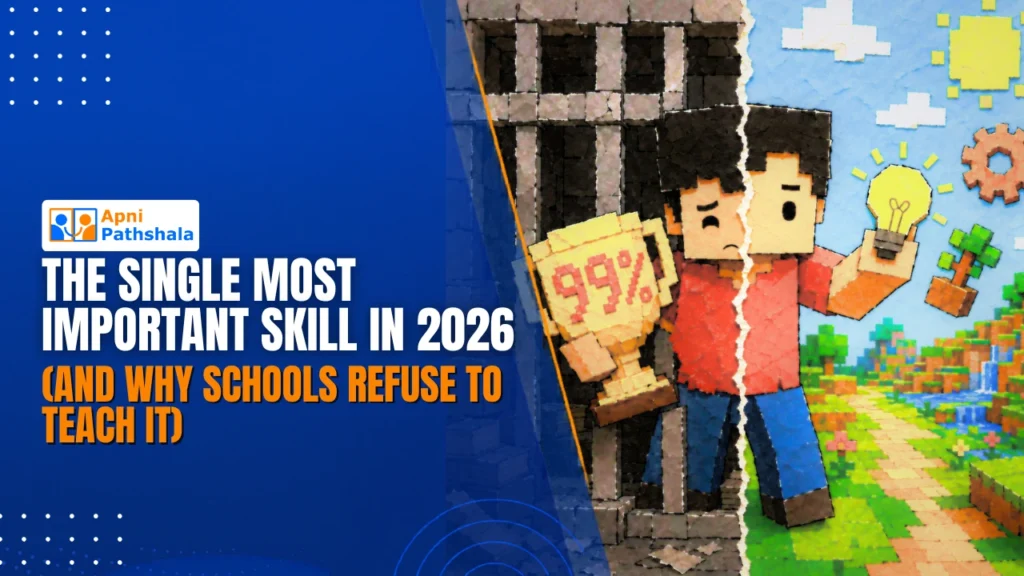
But the fact that students try to prepare for their lives and utterly fail almost every time holds true. So much so that it’s a modern tragedy to watch a “genius” with a 99% in their board exams completely freeze when a manager asks them to solve a problem that doesn’t have an answer key at the back of the book.
However, as much as I think traditional schooling and boring books are stupid, it’s always wise to reflect on the educational trauma you hate so you can launch yourself toward something that much better.
The Paralysis of the 99% Scorer
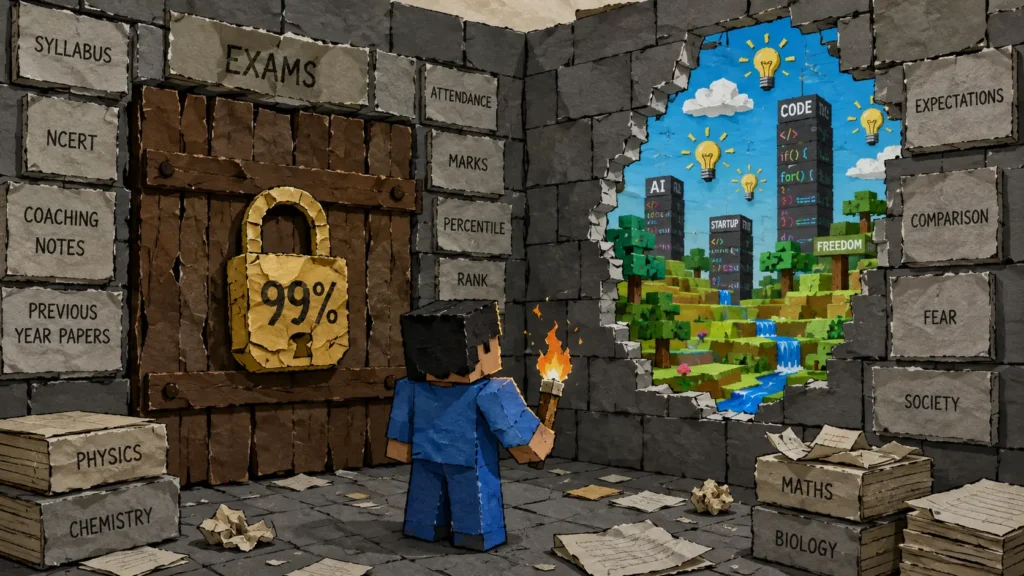
Human nature is complicated, and the worst feeling is when you study for years and can’t help but feel completely unprepared for reality.
You start to feel helpless. If you don’t know what you’re doing, you may continue the cycle for years on end: always wanting to build something real, but never being able to.
Just memorizing for school will make your brain eventually stop trying to think. We are seeing the brutal consequences of this in exams like JEE and NEET. Those exams demand critical thinking and logical deduction, but students are trying to survive them through rote memorization. They know the formula, but they have no idea why the formula works.
This paralysis translates directly to the real world. In jobs, you need problem-solving. To develop problem-solving, you again need critical thinking. It all comes down to one core foundational pillar.
But right now, we are treating the 2026 AI-driven economy like a multiple-choice test. We are using AI tools to outsource our thinking, actively avoiding the cognitive friction required to actually grow.
The True Measure of Intelligence
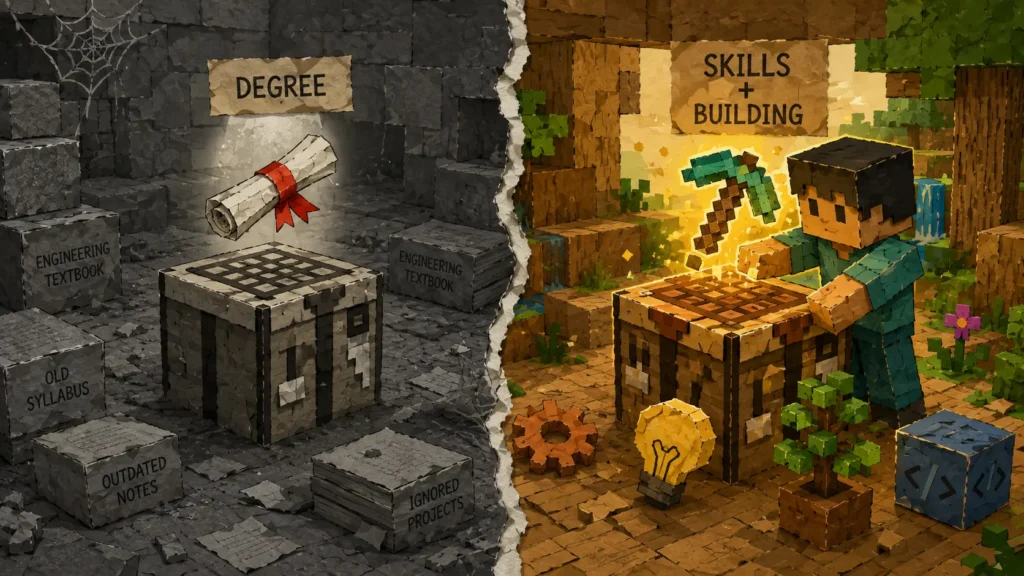
So whether you want to start a business, learn high-income skills like sales and copywriting, or take a risk by building apps that solve real problems, you cannot do it with the mindset of a passive student.
You are not where you want to be because you are missing the single most important skill of this decade. You must be highly adaptable to technology, and you must master the skill of learning to learn.
When I observe patterns in people who successfully navigate this modern chaos, I realize something profound. Do you think the 19-year-old app developer has to “grind” to learn a new coding framework? Do you think the master copywriter has to force themselves to study human psychology?
To you, it may seem like that on the surface, but the truth is that they can’t see themselves living any other way. They aren’t reading boring books to pass a test. They are building things because they are deeply obsessed with the outcome. When I was learning to build products, I didn’t wait for a teacher to give me a syllabus. I just started building, failing, searching for answers, and building again.
If you want a specific outcome in life, you must have the lifestyle that creates that outcome long before you reach it.
I hate to break it to you, but if you don’t adopt the lifestyle of continuous, unstructured exploration for life, you will go straight back to being a human memory card.
AI will replace you, not because AI is smarter, but because you refused to adapt.
The Childhood Scrapbook (Bringing Authenticity Back)
You say you want to change. You say you want to become financially free and build a great career, but your study habits show otherwise for a reason. You are waiting to be spoon-fed.
If you want to change who you are, you must understand how the mind works so that you can start to reprogram it. You have to completely deconstruct how you think about education.
To fix your brain, you have to go back to childhood. Think about how authentic childhood activities work. Children don’t read a manual before trying to walk; they fall down, recalibrate, and try again. This is authentic learning. It’s an active, chaotic scrapbook . You do not build muscle by watching someone else lift weights. You have to lift it yourself.
We need to explore a lot of things to bring our authenticity back. We need to use that inherent curiosity to build things that solve real problems.
Whether it’s learning sales by getting rejected on the phone, learning copywriting by writing a real email campaign, or building a software tool that fixes a genuine issue in your community, this is the only way to develop the critical thinking skills the real world demands.
The Apni Pathshala POD
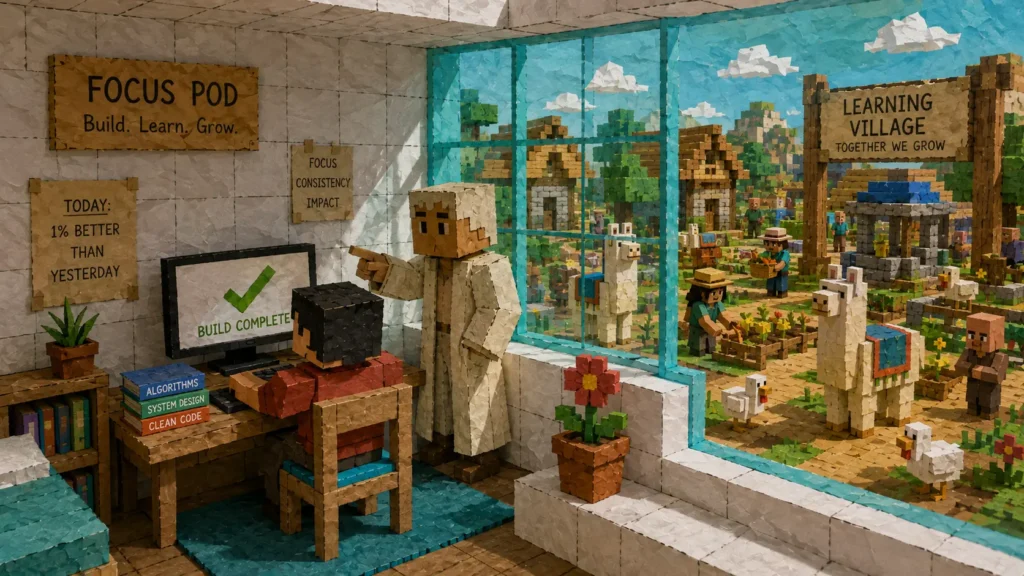
The only real test of intelligence is if you get what you want out of life. High intelligence is the ability to iterate, persist, and understand the big picture. The mark of low intelligence is the inability to learn from your mistakes.
Intelligence is realizing that the skill of learning to learn is the operating system for reality.
We must reject the known path and dive into the unknown. Instead of asking, “What new programming language should I memorize?” the only question that actually matters is:
“How do I place myself in an environment where I am forced to struggle independently, without a safety net?”
This is exactly why the traditional system is collapsing, and why Apni Pathshala is deploying decentralized micro-learning PODs across the country.
A POD is not a place where you go to be taught. It is a place where you go to learn how to learn. Inside a POD, there is no teacher lecturing at a whiteboard. There is no spoon-feeding. It is a guided independence simulator that forces you to bring your authenticity back.
When a student encounters a problem, they use Eklavya AI as a strict, Socratic digital partner. It forces the student to explain their logic, test their hypotheses, and struggle through the friction until they solve it themselves. It forces them to adapt to technology rather than just consume it.
The future belongs to those who can adapt instantly. We have all the components that lead to a good life, but we have to stop funding systems that build human memory cards. Turn your life into a video game where learning is the ultimate boss fight.
Let your kids and yourself struggle in a safe room today, so you actually have the muscles to survive tomorrow.
Build and Partner With Apni Pathshala.
The era of passive learning is over. Apni Pathshala is building community PODs where students learn both academics and real-world digital leverage.
If you direct a CSR fund, lead an NGO, or hold local public office, we invite you to collaborate. Let’s work together to create safe, guided learning spaces that actually make our youth adaptable and employable.
Contact us today to visit our ground operations.
FAQs
Q1: What does “learning to learn” actually mean?
It is the ability to acquire new knowledge or skills independently, without relying on a structured curriculum, a textbook, or a teacher. It is the capacity to drop into an unfamiliar situation, figure out how the tools work, and solve the problem through trial and error.
Q2: Why is memorization failing students in exams like JEE and NEET?
Exams like JEE and NEET are designed to test critical thinking and the application of concepts to novel situations. Students who only memorize patterns fail when they encounter a question that requires them to combine multiple concepts logically. They know the “what,” but not the “why.”
Q3: How do Apni Pathshala PODs force students to adapt to technology?
PODs completely remove the traditional teacher-led model. Students are given problems and must use tools like Eklavya AI to solve them. Because the AI acts as a strict guide rather than an answer key, students are forced to think critically, experiment, and build digital leverage on their own.
Q4: Can this mindset be applied to non-academic skills?
Absolutely. The blog highlights that true authenticity is found in building real-world projects like learning sales, practicing copywriting, or developing apps. The exact same critical thinking required to crack physics is required to build a business. You learn by doing, failing, and recalibrating.