You are a parent who cares deeply about your child’s future.
You have sacrificed for it. Lost sleep over it. Sat through parent-teacher meetings where the teacher knew your child’s rank but not their name.
You have done the math on coaching fees you could not quite afford and paid them anyway because you were not willing to find out what happens to children whose parents do not.
The pressure you feel is backed by the reality of the system:
- 66 per cent of Indian parents report feeling pressure to ensure their children perform academically. Research gate
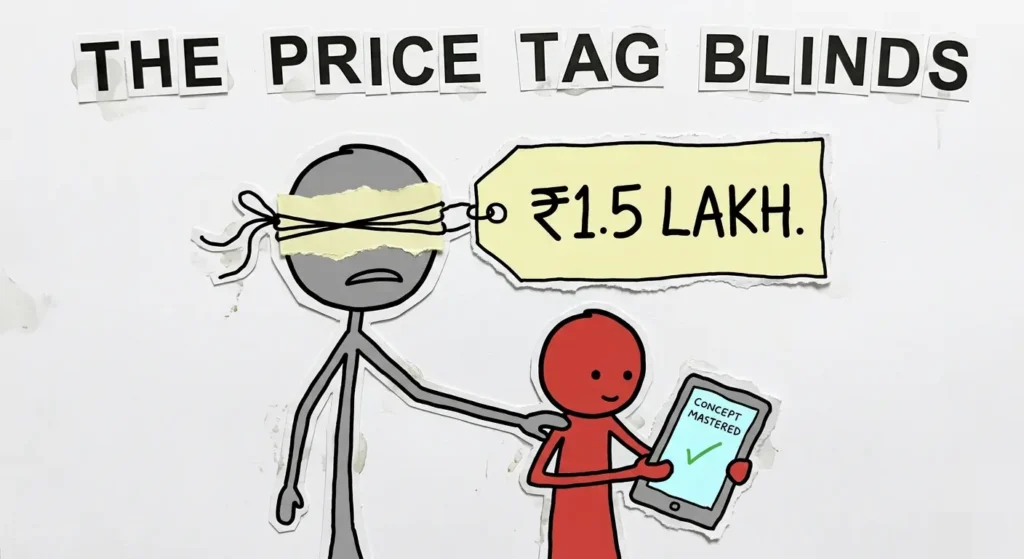
- India’s coaching industry is currently valued at a staggering 1.5 lakh crore. classpro
- 29 students died by suicide in Kota alone in 2024 under the weight of this exact pressure. source
You are not unusual. You are the norm.
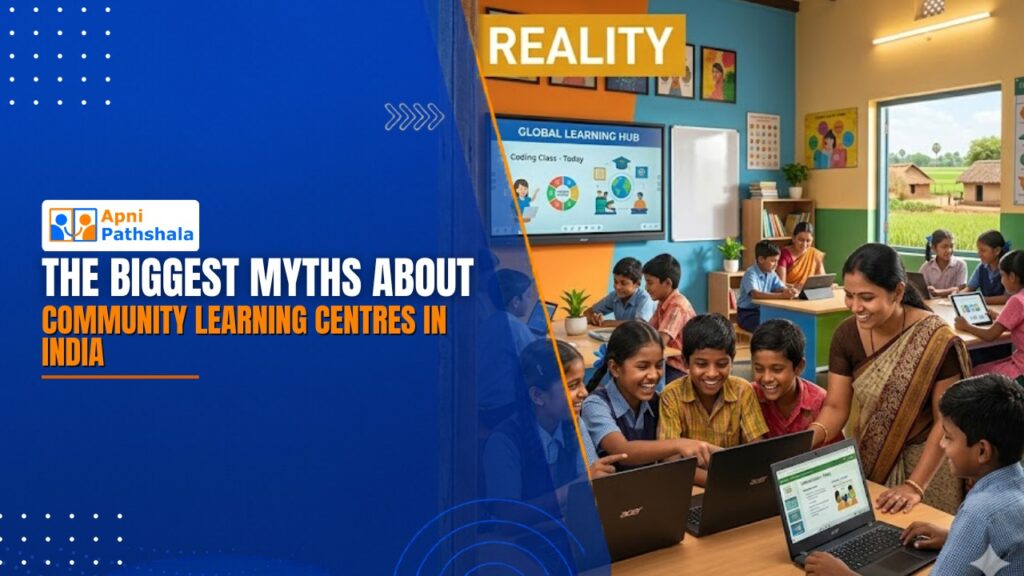
So when someone mentions a community learning centre, a room, some computers, and a local volunteer, your first instinct is not curiosity.
It is a quiet, rational alarm. This is not for my child. And here is the thing about that alarm. It is not unreasonable.
It is actually based on real experience with real schemes that promised things and delivered nothing, with real programmes that helped the very poor and therefore felt like a ceiling rather than a ladder.
The alarm is reasonable. The conclusion it leads to is wrong.
The Fear Underneath the Myth
Every myth about community learning centres is actually a fear in disguise.
Not a stupid fear. A completely understandable fear held by a parent who loves their child and has seen enough broken promises to be sceptical of new ones.
The fear sounds like: This is cheap, therefore it is inferior.
What it actually is: I cannot afford to make the wrong choice. My child’s future cannot absorb a mistake.
That fear is real, and it deserves a real answer. Not a dismissal.
The coaching industry is worth 1.5 lakh crore because it has successfully convinced millions of parents that expensive equals safe.
The fee is not just for education; it is for insurance against getting it wrong.
The problem is that the insurance does not pay out.
These children who struggle in the current system are not children whose parents stopped caring.
These are children whose parents cared so much that they mortgaged their futures on a system that took the money, created immense pressure, and, in many cases, delivered neither the rank nor the resilience to survive not getting it.
The expensive option is not automatically the safe one. It is just the familiar one.
The Signal versus The Reality
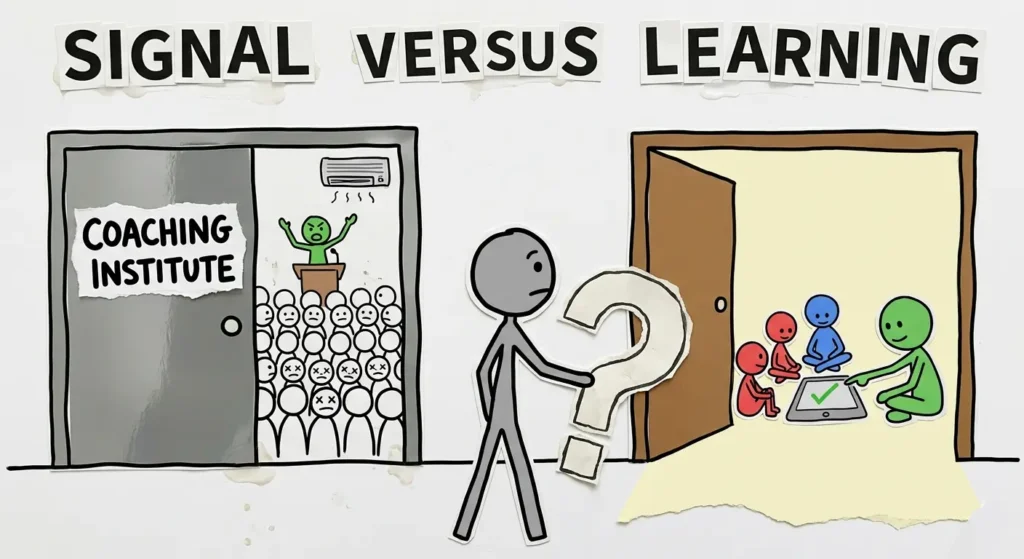
When a parent walks into a community learning centre for the first time, they are not evaluating the learning.
They do not yet know enough to evaluate that. They are evaluating the signals.
The building. The equipment. The person running it. The other children are there.
Whether it looks like a place where their child’s future belongs or a place for children whose parents have fewer options.
The hardest battle in running a community learning centre is not teaching the students.
It is brainwashing the parents.
Not because parents are wrong to use signals. Signals are rational shortcuts in a world with too much information.
But the signals for educational quality in India were calibrated against coaching institutes, against buildings with names on them, glossy brochures, and reception areas with air conditioning.
None of those signals measures learning. They measure presentation.
Here is what you are actually buying when you look past the packaging:
| Feature | Traditional Coaching Institute | Apni Pathshala POD |
| Where Your Money Goes | Building brand, air conditioning, and brochures. | Direct access to dedicated technology. |
| Learning Style | Passive learning in a crowded 80 person room. | Active learning driven by the student. |
| Feedback Loop | Occasional exams with generic grades. | Instant, chapter by chapter personalized feedback. |
| Environment | Creates extreme stress and comparison. | Creates structured autonomy and real capability. |
A room with ten computers running Eklavya AI, which gives each child personalised, chapter-by-chapter feedback in their own language, finds the exact concept they have not understood, and refuses to move forward until the gap is genuinely closed, that room delivers something the glossy building rarely does.
Individual attention. Real feedback. Learning that actually holds.
The Specific Myths, Plainly Answered
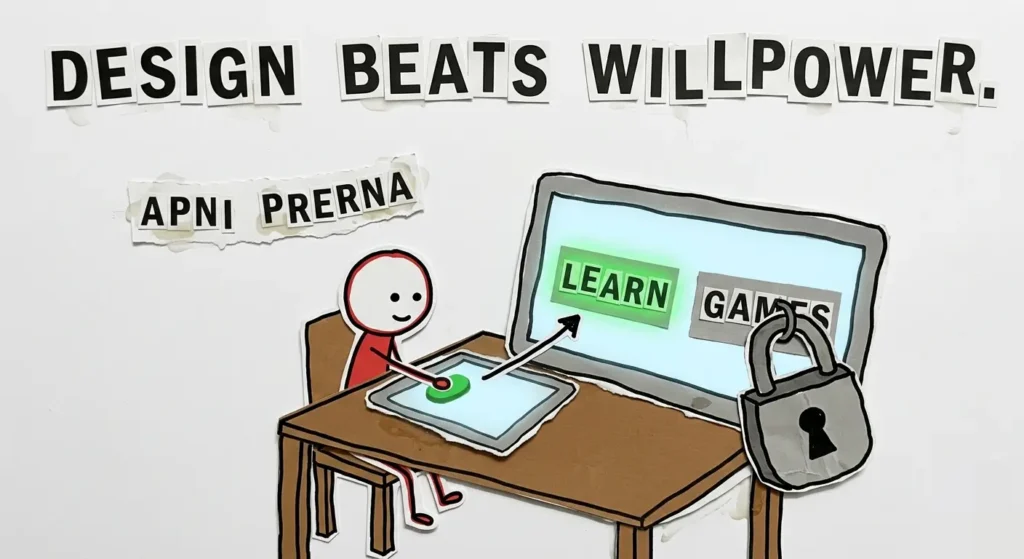
“Without a formal teacher, my child will just play games.”
This is the most common fear and the one most practically solvable.
Apni Pathshala’s PODs run Apni Prerna on every machine. The moment a child logs in with their roll number, the digital environment changes.
Games do not load. Entertainment sites do not load.
The path of least resistance leads to learning not because the child is forced, but because the alternative has been quietly removed.
Your child does not need more willpower. They need a better-designed environment. This is it.
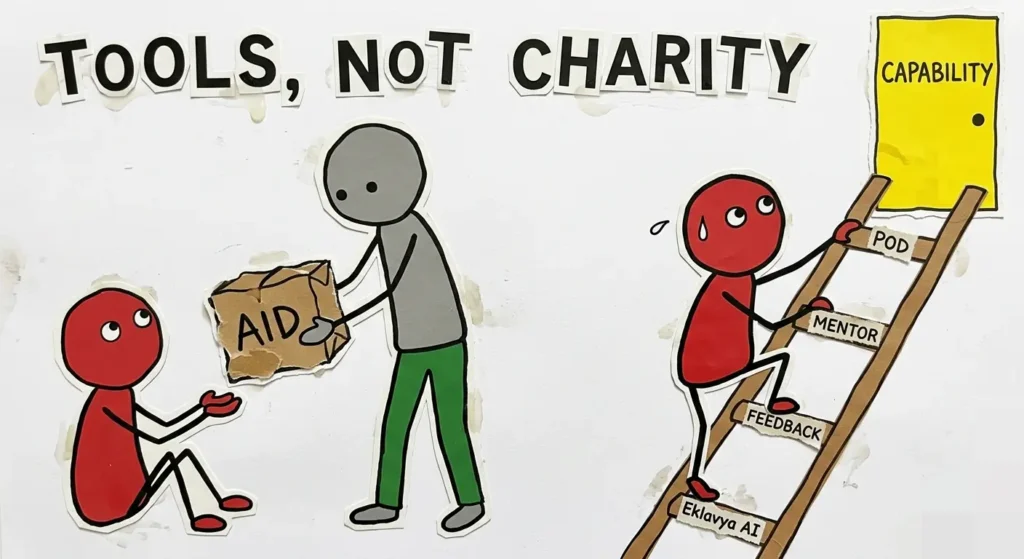
“This is charity. It will hold my child back.”
109 PODs. 22 states. 22,000 students.
Many of them are children whose parents had exactly this fear and watched it dissolve when their child came home able to explain a concept the school had never properly taught them.
Charity is a handout. A community learning centre is a tool. The distinction is not semantic.
One creates dependency. The other builds capability.
What the Parent Who Visits Actually Finds
A room that takes learning seriously.
A child who is engaged not because someone is standing over them, but because the tool in front of them is responding to them specifically, catching their mistakes, adjusting to their pace.
A POD Leader who knows their name.
It does not look like a coaching institute. It was never trying to.
It looks like something that might actually work, which, for 22,000 students already, it does.
Visit apnipathshala.org. See what it looks like before you decide.
Frequently Asked Questions
1. Can technology really help students take control of their own learning?
Ans: Yes, but only when it’s used the right way. Technology gives students access to unlimited resources, but without direction, it often leads to confusion and distraction. When structured properly, it can turn passive learners into independent thinkers who understand concepts deeply and learn at their own pace.
2. Is Eklavya the smarter way to study in 2026?
Ans: Eklavya is designed for how students learn today, fast, digital, and independent. It combines AI with structured guidance to help students learn better, stay consistent, and move forward without relying only on traditional methods.
3. Why does self-learning fail many students despite having access to tools?
Ans: Because without guidance and structure, students often consume content without truly understanding it, leading to confusion instead of real learning.
4. How can I start my own POD (learning centre) with Apni Pathshala?
Ans: You can start a POD by applying through Apni Pathshala, getting guidance, and setting up a local learning centre using their support, resources, and digital tools.