The results are out. You passed 12th.
Now comes the part nobody prepared you for.
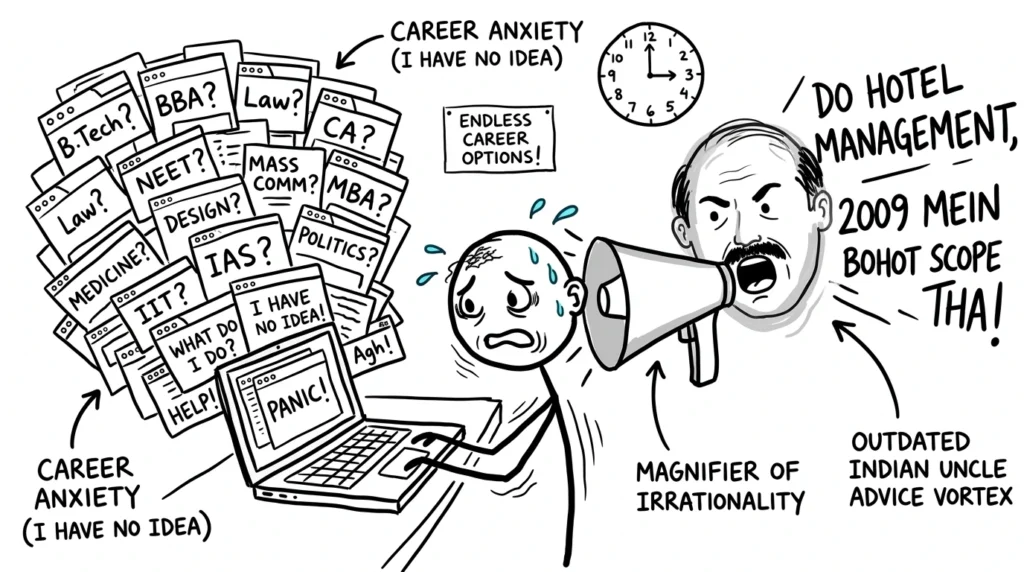
You open Google. Type “courses after 12th.” Forty-seven tabs open. Three contradictory lists. One article still recommending Hotel Management like it’s 2009. Meanwhile, your parents are consulting an uncle in Pune. Your cousin who did BBA is currently selling insurance not entirely by choice.
And somewhere between Engineering Entrance and 5-Year Law, you spot skill-based courses.
You hesitate. Because honestly? It sounds like what people choose when they didn’t get somewhere real.
Pause.
That hesitation isn’t your fault. It’s 40-year-old software running in your brain, built for an economy where degrees were scarce, government was the biggest employer, and “which college?” was a genuinely useful filter.
That economy has changed considerably. Let’s debug the software.
A Number That Should Bother You
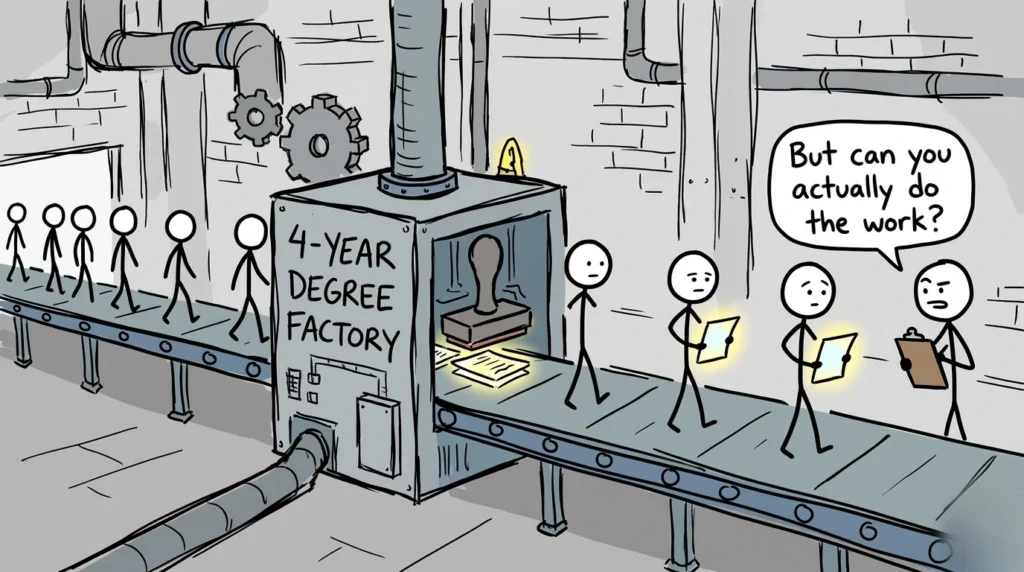
India produces roughly 1.5 million engineering graduates every year. Approximately 80% are considered not industry-ready at the time of hiring.
This isn’t an insult to those graduates. They worked hard. Cleared competitive exams. Attended four years of lectures. But the system optimized them for passing exams, not for doing the actual work.
That gap between graduation and job-ready has a cost. Someone pays it. Usually, the student pursues extra certification courses purchased after the degree.
Which raises an inconvenient question.
The Weird Thing Nobody Talks About
The person running corporate English training for a roomful of office employees? Completed a 6-month communication course. Maybe ₹25,000.
The people receiving the training? Spent 3 years and ₹4 lakhs on degrees.
Wait. Hold on. The person with fewer credentials is selling knowledge to people with more credentials.
Why does this keep happening?
What Degrees and Skills Actually Measure
A degree measures something real: your ability to complete a long program, survive exams, and show discipline over 3 years. Not useless traits.
But a skill-based course asks a simpler, more uncomfortable question: Can you actually do the thing?
- Can you run a Google Ads campaign that gets results?
- Build a working website?
- Edit a video someone would pay to watch?
- Prepare a financial statement without supervision?
The market pays for the second list. The degree gets you into the room. The skill gets you the job. The job teaches you what the degree couldn’t.
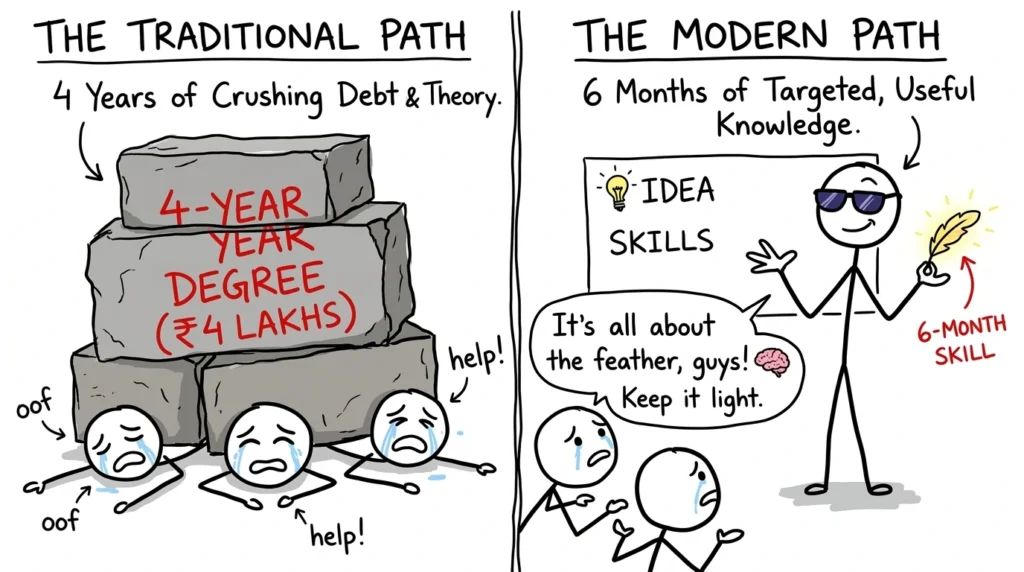
Skill-based courses just compress that timeline.
What Are Skill-Based Courses After 12th?
These are structured programs typically 6 months to 2 years designed to teach one specific, market-applicable capability. Here are five categories worth knowing:
- Digital and Tech: Web development, digital marketing, UI/UX, data analytics. Entry-level salaries start at ₹3–6 LPA and scale fast.
- Finance Tools: Tally, SAP, advanced Excel, and financial modelling. Massive demand in India’s SME economy.
- Healthcare Technical: Lab technician, radiology, OT technician. Severe shortage of trained workers leading to stable, dignified employment.
- Creative: Fashion design, animation, photography. Portfolio-driven, the work speaks before you do.
- Skilled Trades (The Underrated One): ITI programs. An experienced electrician in a Tier-1 city earns ₹30,000–60,000 monthly. Nobody mentions this at parent-teacher meetings. That’s a problem.
The April–June Household Conversation
In roughly 60% of Indian homes, between April and June, this happens:
“Maa, I’m thinking of doing a digital marketing course.”
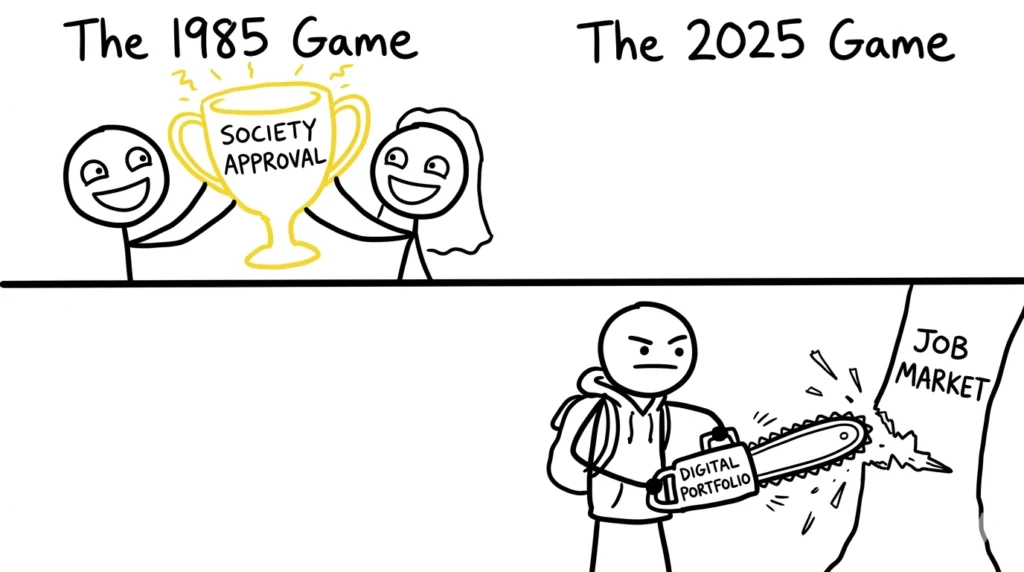
“Course? Not a degree? Log kya kahenge? Sharma ji’s son is doing engineering.”
Relatives consulted across three cities. Decision made based on what sounds impressive at a shaadi.
Nobody here is wrong. They’re just playing 1985 rules in a 2025 game. In 1985, a degree was a genuine signal, scarce, meaningful, reliable. In 2025, employers have LinkedIn, portfolios, GitHub, skills assessments, and probation periods.
The degree signal still matters, but it’s no longer sufficient. And in many fields, it’s no longer even primary.
The Frame From a Different World
In open-source software, nobody asks where you studied. They look at your code. Running. Doing something real. Open source solved the credentialing problem twenty years ago: show your work, not your certificates.
Skill-based courses run on the same logic.
Your degree is a permission slip. Your skills are the actual passport.
You’re Not Settling. You’re Switching Games.
Choosing a skill-based course after 12th isn’t settling because you couldn’t get into a “real” college. It’s recognizing that two games are being played simultaneously with different rules, different timelines, and different payoffs.
| Feature | The Degree Game | The Skill Game |
| Runway | Longer (3-4 years) | Shorter (6 months – 2 years) |
| Cost | High | Low |
| Primary Currency | Social credibility & theoretical knowledge | Portfolios & early earning potential |
| Feedback Loop | Slower (Wait until graduation to test market value) | Faster (Immediate feedback on whether you’re building something useful) |
Neither is wrong. But only one is being honestly presented to you right now. You’re not the backup option. You’re the early mover.
The Uncomfortable Truth
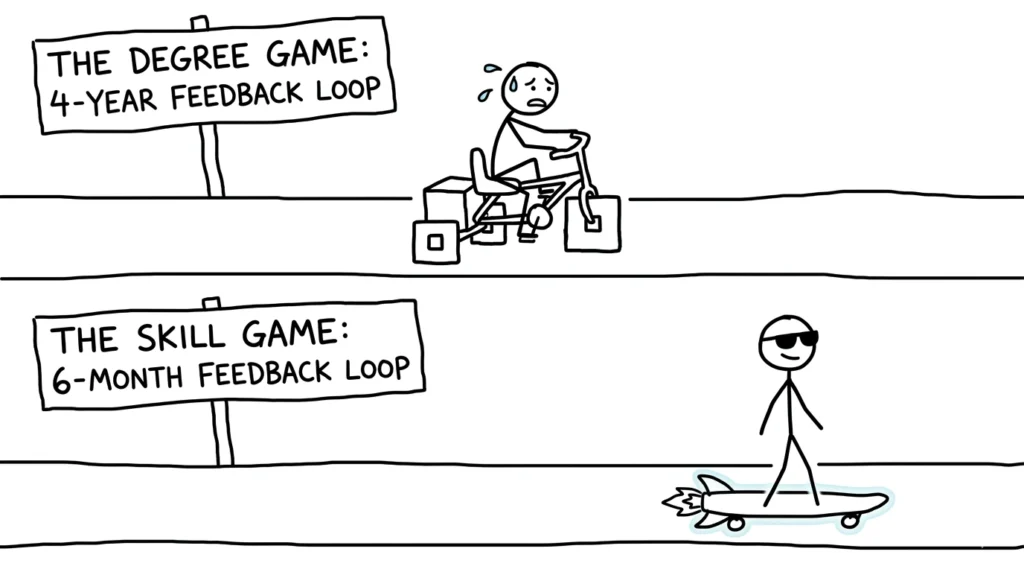
Most degree holders in India spend their first two years at work learning the actual skills their role requires.
- The degree got them the interview.
- The skill got them the job.
- The job taught them what the degree couldn’t.
Skill-based courses collapse that gap. That’s not a lesser path. That’s a faster feedback loop. And in a market that changes every 18 months, a faster feedback loop is a structural advantage, not a consolation prize.
Pick one skill the market willSpay for. Go deep. Build something real.
Discover what students should really focus on after 10th in today’s digital world
What is the most important thing students should start learning after 10th today?
Along with school subjects, learning digital skills and technology can open many future career opportunities.
Are today’s tech-savvy kids truly prepared for the digital world?
Not always. Many students are comfortable with devices but lack the deeper digital literacy needed for learning, safety, and future careers.
If ChatGPT can do the homework, are students still learning?
AI can assist learning, but without understanding the concepts, students may lose the habit of thinking critically.
What is the best way for students to start learning AI in 2026?
Students don’t need to become programmers immediately. The best way is to start with AI tools, digital thinking, and practical problem-solving skills.