

You are reading this because you are frustrated.
Whether you direct a corporate CSR fund, lead an NGO, or shape local government policy, you are asking the exact same question: Why is it so hard to fix education through a traditional community learning centre?
Every year, billions of rupees are poured into grassroots education.
You build a massive, concrete school campus. You paint the walls. You buy expensive desks. You cut the ribbon, take the press photos, and wait for the test scores to rise.
But they don’t. The learning gap only widens.
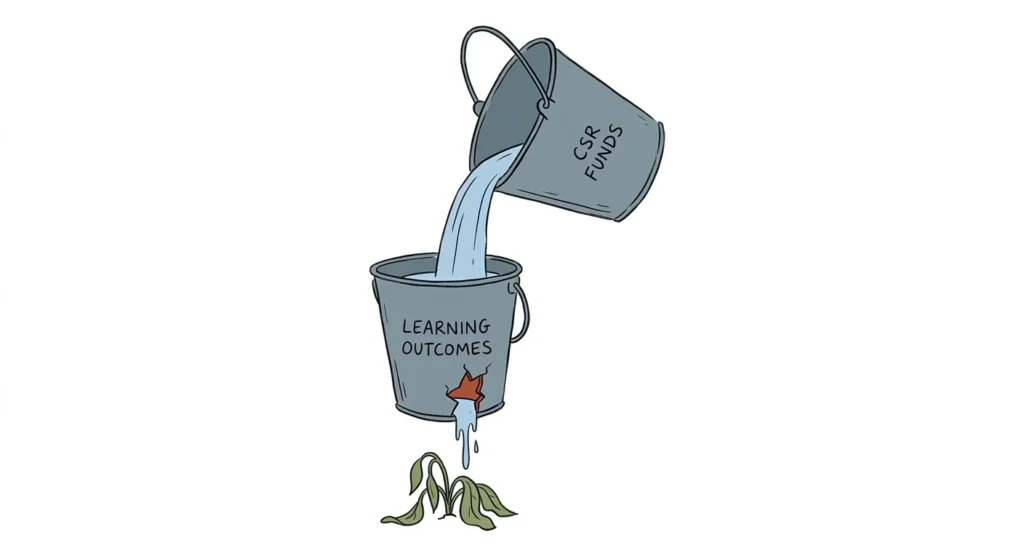
You are confused. It feels like you are pouring water into a bucket with a hole in the bottom. But the problem isn’t your intention, and it certainly isn’t the students.
The problem is the model itself.
Here is the brutal truth that traditional institutions will not tell you:
You are funding real estate, not learning ecosystems.
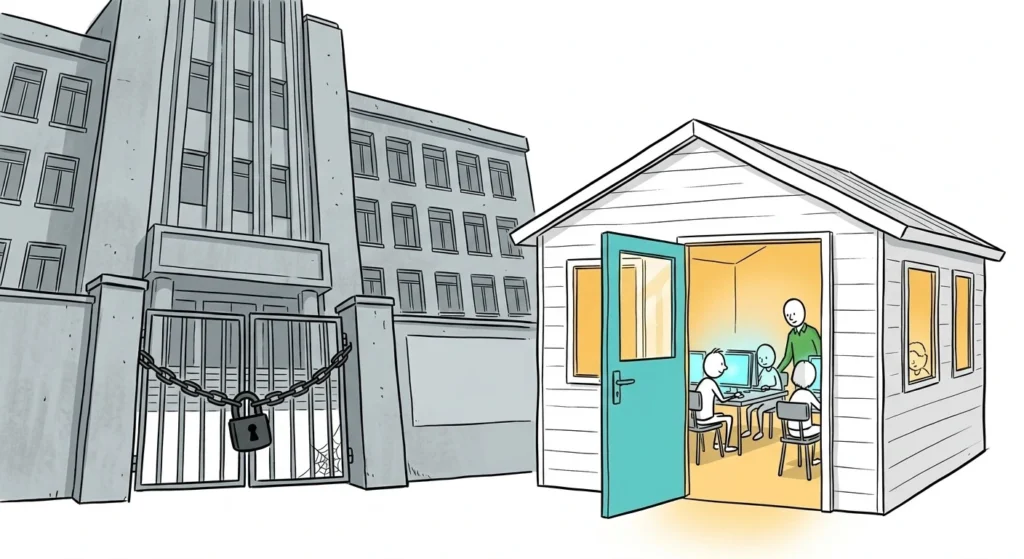
To achieve real change, we have to stop building giant, slow-moving institutions.
What if the answer to India’s education crisis isn’t a multi-million-rupee campus… but a quiet, 150-square-foot room?
Why Schools Alone Cannot Close India’s Learning Gap
The traditional education system is fracturing under its own weight.
Look at the post-COVID reality. We are seeing millions of out-of-school children falling dangerously behind. But even the children inside the formal classroom are struggling.
Why? Because the modern school was built for the industrial age. It was designed to process hundreds of students at the exact same speed.
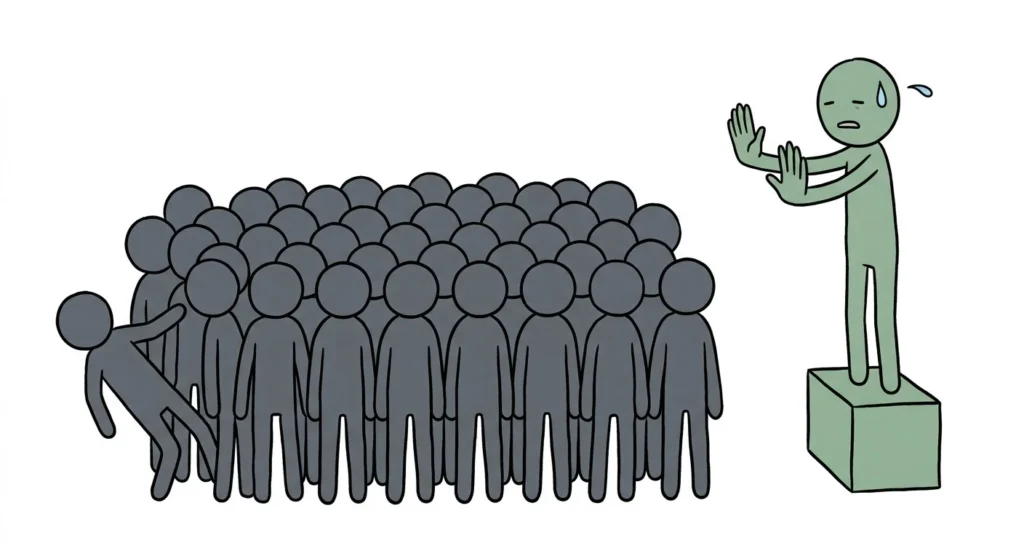
When a single teacher is staring down a 40:1 student ratio, they are not teaching. They are running a daily crowd-control exercise.
Schools are excellent at providing basic, standardized instruction. But they completely fail at providing the individualized, after-school retention required for the modern economy.
They do not teach a lifelong learning mindset. When a student doesn’t understand a math concept at 11:00 AM, the teacher has to move on. That student goes home, gets confused, and eventually gives up.
The traditional school cannot survive alone. It desperately needs local, decentralized support systems to catch the students who inevitably slip through the cracks.
What a Modern Community Learning Centre Actually Looks Like
This is where the paradigm shifts.
The solution to a failing macro-system is a hyper-focused micro-system. Enter the true community learning centre.
Historically, this term meant a dusty room with a few outdated books and a broken fan. That model is dead.
A modern community learning centre is a highly optimized, safe environment operating just outside the formal school system. It provides students with essential study support, strict discipline, and peer collaboration.
But to work in today’s ruthless economy… it must evolve into something much sharper.
Why Every Community Learning Centre Needs Digital Access
A physical library is no longer enough. To survive the future of work, students need an advanced digital learning centre.
This is the only scalable, realistic method for bridging the digital divide.
You cannot simply hand a child a smartphone and expect them to become a software engineer. By providing shared infrastructure, high-speed internet, and locked-down computers… these specific centres transform passive screen scrolling into actual, measurable skill-building.
They bring high quality education access directly to rural and urban neighborhoods. Students get to use adaptive AI tools that act as 24/7 personal tutors, allowing them to learn at their own pace without the fear of judgment.
Btw, This year alone, ten students from this single micro-learning space cracked the highly competitive IIT JEE Advanced exam. Read more
The Role of Mentors in Community Learning Centres
But beware the “tech trap.”
Many initiatives fail because they throw expensive laptops into an empty room and walk away. Technology without human connection is completely useless.
The secret engine behind a successful local learning centre is localized mentorship.
A local facilitator does not need to teach advanced physics. They just need to enforce discipline, ensure digital safety, and provide human motivation.
They are the anchor that keeps the student coming back every single day.
A Scalable Education Model for CSR and NGOs
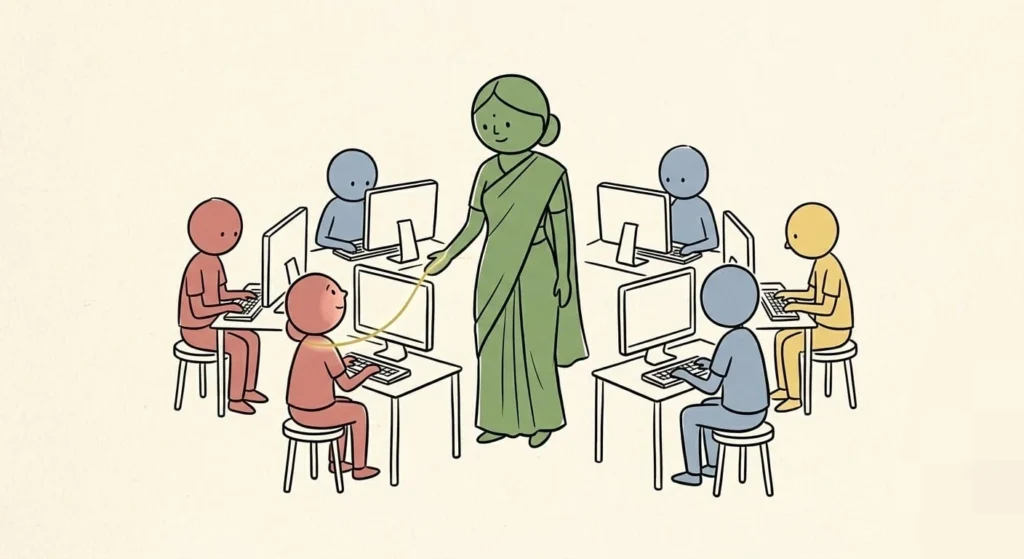
This is not just a high-level theory. It is a proven, operating machine.
Enter the Apni Pathshala PODs. A POD is the ultimate, optimized education centre for students. It is highly cost-effective, perfectly scalable, and completely plug-and-play.
Instead of waiting five years to secure land, navigate government bureaucracy, and build a traditional school… a POD can be deployed in a matter of weeks.
It brings immediate, measurable impact directly to the neighborhood level.
Let’s look at the hard data. This is what decentralized learning actually looks like in practice:
- 107 Active PODs fully operational across communities.
- 22,000+ Students Reached through localized, distraction-free spaces.
- 16,000+ Digital Literacy Goals Met, proving real skill acquisition over mere attendance.
How CSR Leaders and NGOs Can Create Immediate Impact
If you are a CSR leader, an educator, or an NGO director, you do not need to wait for top-down policy changes to make a difference.
You can drive immediate, aggressive impact today.
By directing your CSR education initiatives toward these micro-learning spaces, you completely bypass the red tape. You deploy capital efficiently. You stop measuring success by the number of bricks laid, and start measuring it by the number of minds activated.
You do not need a massive budget to change a child’s trajectory. You need a quiet room, a few computers, adaptive tools, and a dedicated mentor.
It is time to embrace alternative education models. We do not need to fight the old system.
We simply need to build a better one from the ground up, one 150-square-foot room at a time.
Partner With Apni Pathshala: The future of education is decentralized, and we are looking for visionary partners to build it. Apni Pathshala is officially open for collaboration with CSR funds, NGOs, and local leaders.
Let’s build a POD in your community today. Contact us to start the conversation.
We analyzed the data across dozens of micro-centres to see why removing digital freedom actually unlocks human potential. If you want to see the exact blueprint of how structural isolation creates genius, read what happened next: The Silent Accelerator: Why Some Students Grow Faster With Online Learning.
Frequently Asked Questions (FAQs)
Q1: What is an Apni Pathshala POD?
Ans. A POD (Point of Digital Learning) gives students a quiet, distraction-free room in their neighborhood. It provides locked-down computers and fast internet so students can focus purely on self-study and building digital skills without interruptions.
Q2: Why do students learn faster on a computer?
Ans. Computers wait for the student. Students control the speed, hit pause, and fix their mistakes using adaptive AI tools without feeling embarrassed in front of their classmates.
Q3: What is the difference between computer skills and digital literacy?
Ans. Computer skills are physical actions, like typing on a keyboard or clicking a mouse. Digital literacy is brainwork, like spotting fake news, protecting personal data, and knowing how to use the internet for actual skill-building.
Q4: Can a student crack IIT without coaching?
Ans. Yes. Students can crack IIT without coaching by relying on a strict self-study plan, mastering PYqs, reputed books, and using adaptive digital tools. Consistent mock tests in a disciplined environment are far more important than passive classroom lectures.




9 Responses
Well written! The impact of local learning centres on students’ lives is truly remarkable.
Thank you so much! We truly believe that local learning centres can create a strong difference in a student’s confidence, learning, and future opportunities.
I think we have to implement or may be compulsory it for all urban and rural area school from 5th to 10th std.
Thank you for sharing your thoughts. We truly agree that digital learning and future-ready skills should reach students from both urban and rural schools, especially from 5th to 10th standard. This is exactly the kind of change Apni Pathshala is working towards.
Powerful blog. It clearly shows why India needs small, local digital learning spaces that focus on real learning, not just infrastructure. Apni Pathshala’s POD model can truly help communities create immediate impact through digital access, mentorship, and future-ready skills.
Thank you for sharing this. Glad this message resonated with you. Small local learning spaces can truly create big impact.
perfect blog
who is the writer of this wel written blog??
This article shows that opportunities don’t depend on the size of a classroom but on the quality of learning. Very inspiring read!