

Watch a child play a video game.
They fight a boss. They lose. They try again. They fail 30 times in a row. But they do not cry. They do not quit. They lean closer to the screen and try harder.
Now watch that same child do a math worksheet. They get the first question wrong. They get frustrated. Within two minutes, they throw the pencil down and want to give up.
Parents look at this and think the video game is evil. They think the screen has hypnotised their child.
But here is the harsh truth. The child loves the video game because it is fair. School is not.
If we want our kids to actually learn, we need to stop fighting video games and start stealing their secrets.
Secret #1: Video Games Never Leave You Guessing
We need to stop lying about why kids stare at screens for hours.
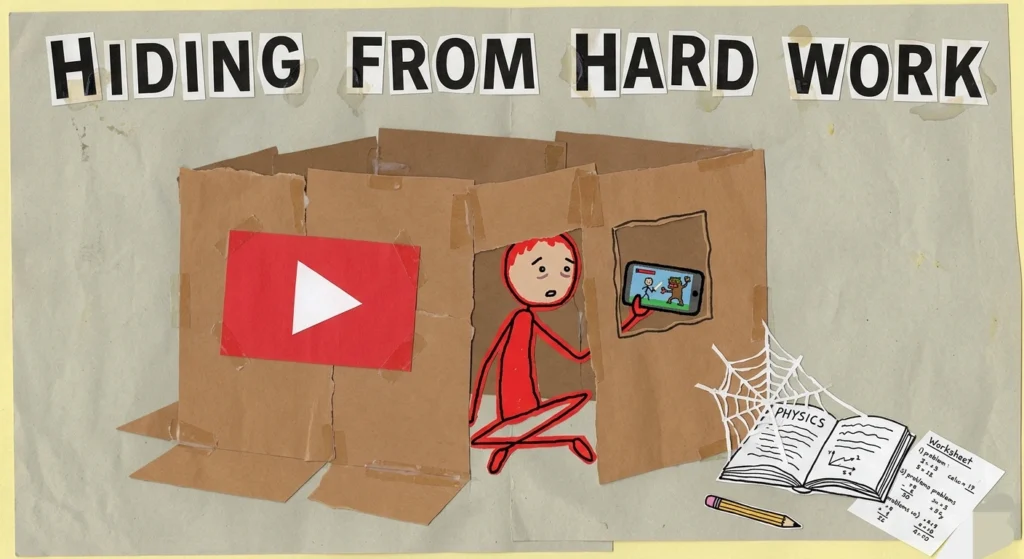
It is not just laziness. It is a hiding place.
Learning is painful. When a student tries to understand a tough physics concept, their brain hits a wall. It feels friction. It hurts. Nobody likes that feeling of frustration. So, the student looks for an escape.
Instead of doing the hard work, they open YouTube.
- They will sit and watch ten hours of “how to crack the exam” strategy videos.
- They will debate with strangers in the comments about which online teacher is the best.
- Or they will just start talking about the IPL.
They do everything except solve the actual problem.
In a video game, when you lose, the game tells you instantly what went wrong. You died because you jumped too late. You adjust. You try again.
Passive consumption is just a clever way to hide from hard work.
We saw this exact behaviour when we first opened the Apni Pathshala PODs. When a student walks into our 150-square-foot learning room, their first instinct is to find a distraction.
If the work gets hard, their hand automatically reaches for a new tab to watch a video. We quickly realised that you cannot rely on a student’s willpower.
You have to build a physical environment where hiding is impossible.
Secret #2: Video Games Have Faster Feedback Than School
There is only one real difference between a normal person and someone like Elon Musk.
It is not magic. It is the speed of their feedback loop.
Think about how Musk learned to build rockets. He did not sit in a classroom for four years taking notes. He read a book. He built a part. He tested it.
The part exploded.
He instantly knew he was wrong, so he fixed it the next day.
Fast feedback.
Now look at how a student learns in India:
- A child memorises a textbook in July.
- They sit in a hot exam hall in March.
- They finally get their result in May.
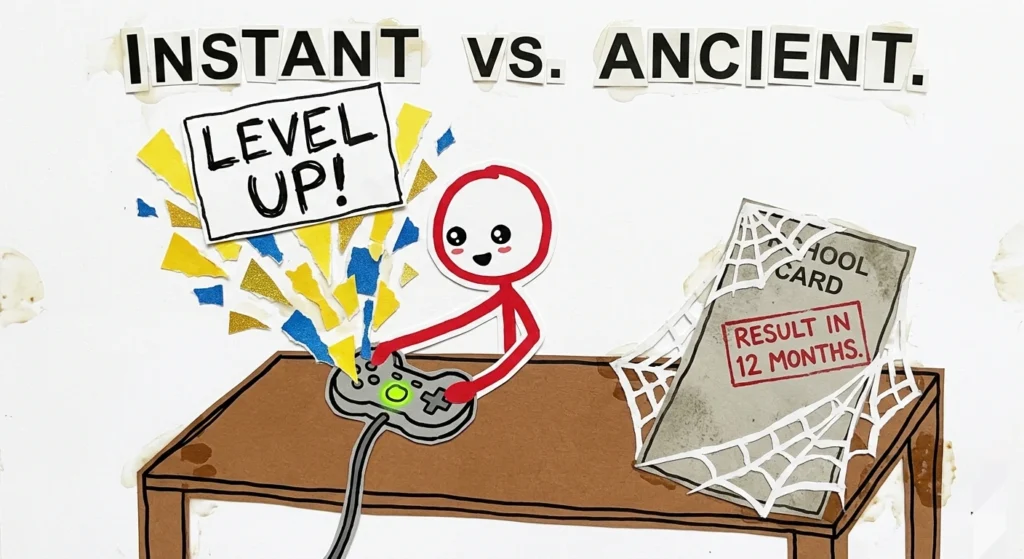
It takes an entire year for the system to tell them if they were right or wrong.
This slow, terrible feedback loop completely kills all human motivation. This is exactly why kids get addicted to video games. A video game tells you instantly if you win or lose. The Indian education system makes you wait a year.
If we want students to actually build skills, we have to give them the fast feedback of a video game. But we have to do it for real-world knowledge.
Secret #3: Video Games Force You to Improve
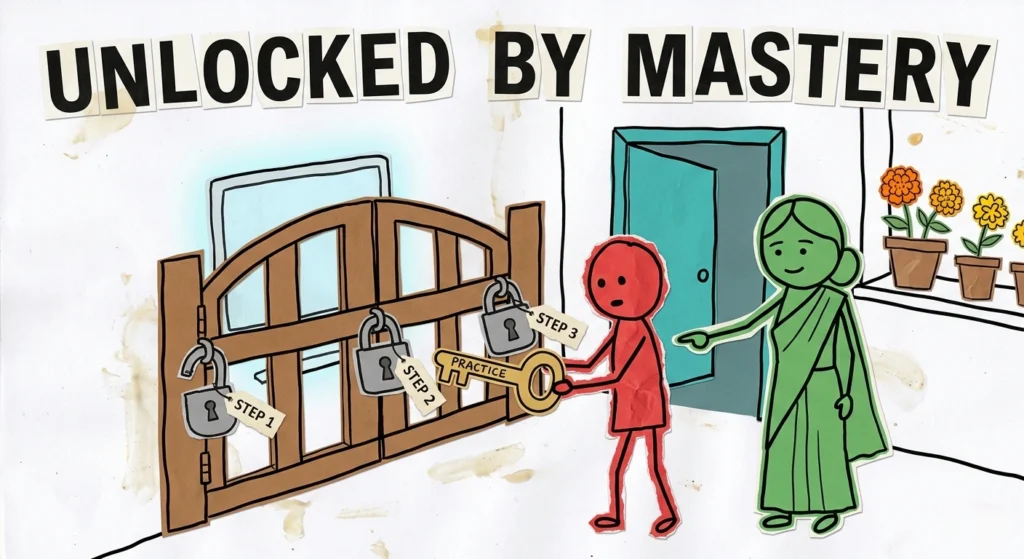
In a game, you cannot skip a level just because it is hard. The game forces you to beat the boss to move forward. This is where the theory meets the dirt.
Look at Patwa Toli in Bihar. It is a dense weavers’ colony. Mechanical power looms roar loudly all day long. The smell of machine oil and dust hangs in the air. Finding a quiet place to focus is almost impossible.
For a long time, students there would just sit on their beds with cracked smartphones. They would passively watch lectures, pretending to study, but actually just hiding from the frustration of doing the math.
Then we dropped an Apni Pathshala POD right in the middle of their neighbourhood.
We took away the open internet. We gave them a quiet room. We sat them in front of locked-down computers running Eklavya AI.
And everything changed.
Inside the POD, Eklavya AI gives them the video game feedback loop. It does not just play a long, passive video. It forces the student to solve a problem step by step.
- If a student makes a mistake on line two of a math problem, the AI stops them instantly.
- It points out the error.
- It makes them fix it right then and there.
They cannot hide. They cannot skip to the end. They get instant, second-by-second feedback on their actual thoughts.
How We Recreated the Video Game Effect in Real Life
We quickly realised that you cannot rely on a student’s willpower. If the work gets hard, their hand automatically reaches for a new tab to watch a video. You have to build a physical environment where hiding is impossible.
This is what healthy monitoring actually looks like.
You do not need to police your child at home. Inside the POD, a local human mentor walks the room. If a student hits that wall of frustration and tries to give up, the mentor taps them on the shoulder.
The mentor pushes them through the pain of learning.
We are moving students from passive screen time to active skill time. They are learning to focus, code, and think clearly.
The traditional system will always be slow. But inside a simple 150-square-foot room, we are giving students the fastest feedback loop in the world.
Partner With Apni Pathshala: The future of education is decentralised, and we are looking for visionary partners to build it. Apni Pathshala is officially open for collaboration with CSR funds, NGOs, and local leaders. Let’s build a POD in your community today. Contact us to start the conversation.
While parents argue about screen time, elite 19-year-olds are quietly using a completely different set of AI tools to build actual businesses from their beds.
Find out what they are secretly using before your kid gets permanently left behind: Beyond ChatGPT: How to Teach Students AI
Frequently Asked Questions
Q1: What are the most important future skills for students?
Ans. The most critical future skills include advanced digital literacy, critical thinking, and the ability to safely handle AI tools. These skills ensure students move from passive digital consumers to secure, future-ready creators.
Q2: How can students use AI tools safely?
Ans. Students can use AI tools safely by learning to protect their digital footprint, identifying AI hallucinations, and never sharing personal data. Safe AI use is best learned in guided environments such as community learning centres.
Q3: Why is internet safety important in digital literacy?
Ans. Internet safety is the foundation of digital literacy because the modern web is filled with manipulated media, deepfakes, and cyberbullying. Without safety protocols, access to educational technology becomes a dangerous liability.
Q4: What is an Apni Pathshala POD?
Ans. A POD is a quiet, distraction-free room in a local neighbourhood. It provides locked-down computers and fast internet access so students can focus solely on self-study and on building real digital skills under the guidance of local mentors.



3 Responses
Loved this idea. Games can teach persistence, problem-solving, and creative thinking in ways we often overlook.
Completely agree! The best games quietly teach skills that textbooks often struggle to.
A fascinating perspective on how games keep learners engaged. Applying these learning principles to education can make studying more effective and enjoyable. Great insights!