A student can learn how to write a good prompt in an afternoon. The harder lesson is knowing whether the answer that comes back deserves to be trusted.
That distinction matters as AI becomes part of how students study, research, and solve problems. The question is no longer simply whether students should learn AI. It is what kind of thinking they need to bring with them.
The Prompt Is Only the Beginning
A good prompt can produce a convincing answer. That is exactly why it can be easy to trust.
If an answer sounds confident, students may assume it is correct. If AI solves a difficult problem in seconds, they may miss the reasoning they were supposed to learn.
Prompting is useful. But it is only one part of AI literacy.
The OECD’s 2026 AI Literacy Framework for primary and secondary education describes AI literacy through the knowledge, skills, and attitudes students need to understand AI, critically evaluate its outputs, and use it ethically and creatively. OECD
That is a much bigger skill than knowing what to type into a chatbot.
Students Are Already Using AI
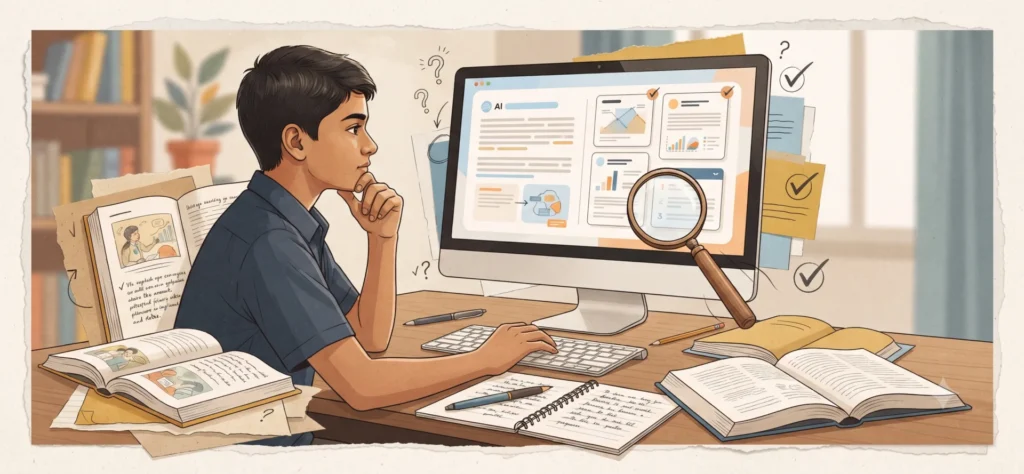
AI is already becoming part of student life.
The latest OECD PISA 2025 results report that 46% of students across OECD countries use AI chatbots weekly or more to help them learn. The report also shows that the relationship between AI use and student performance depends on how the technology is being used. OECD
So telling students simply to “use AI responsibly” is not enough.
They need opportunities to practise asking:
Is this answer correct?
What information is missing?
What could I check before believing this?
Is AI helping me understand, or is it doing the thinking for me?
These are not prompting questions.
They are judgment questions.
The Most Valuable AI Skill May Be Knowing When to Stop and Think
Imagine a student asking AI to solve a mathematics problem.
The answer appears instantly.
One student copies it and moves on.
Another asks why the method works, checks the reasoning, and tries the next problem alone.
The second student is using AI to strengthen learning rather than outsource it.
This is exactly why UNESCO’s AI Competency Framework for Students places critical judgement, human agency, ethics, and responsible use at the centre of AI competency. The framework moves students from understanding to applying to creating. UNESCO
Students should become better at making decisions around AI, not simply better at getting outputs from it.
AI Can Be a Shortcut. Learning Should Still Be the Journey.
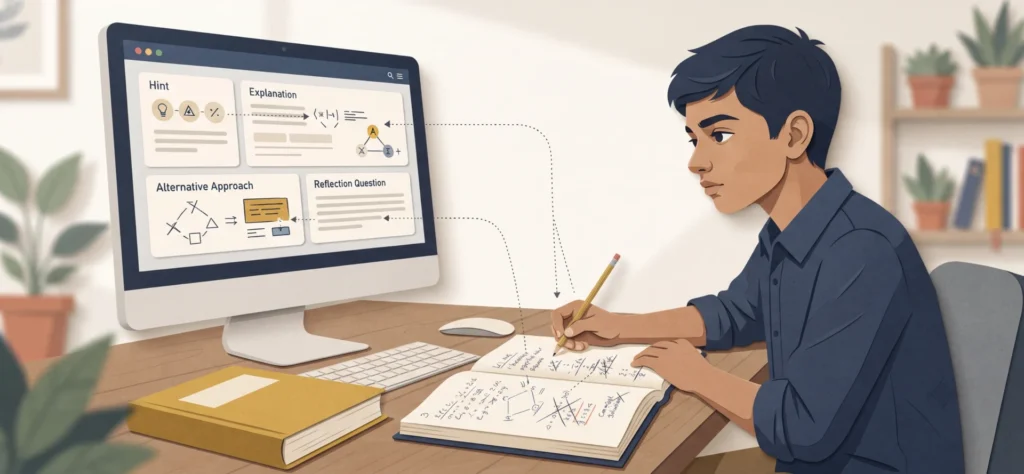
A calculator saves time. A search engine finds information. AI can explain a difficult concept.
The problem begins when the shortcut removes the thinking students are supposed to develop.
Asking AI to write an essay is different from asking it to challenge an argument, identify gaps, or suggest questions.
The second approach keeps the student doing the intellectual work.
That difference will matter more as AI becomes easier to use.
Judgment Does Not Mean Distrusting AI
Teaching students to judge AI does not mean teaching them to reject it.
AI can help students understand, practise, brainstorm, and explore. The skill is using those capabilities without giving up ownership of learning.
UNICEF’s work on preparing children for an AI world connects AI literacy with digital literacy, critical thinking, creativity, and online safety. UNICEF Global
The goal is not:
“AI or no AI.”
It is:
“How do I use AI well?”
This Is Where the Learning Environment Matters
Judgment is easier to develop when students have room to practise it.
They need opportunities to compare answers, question information, explain their reasoning, and try again.
That is where Apni Pathshala’s approach connects with AI. Technology is not meant to become an answer machine. It is part of a learning environment where students are encouraged to figure things out.
Our Eklavya AI learning platform gives students another way to ask questions, understand concepts, and work through difficult topics.
The important part is what happens next.
Can the student explain the idea?
Can they solve another problem?
Can they continue without simply copying the answer?
That is where judgment becomes part of learning.
A Good AI Learning Environment Builds Independence
The same principle appears in our work on Self-Learning Tools That Build Independence, Not Dependency.
The best learning tools should make students think more, not less.
That can mean checking a source, questioning an AI response, or explaining an answer before moving on.
The slight friction is useful.
If AI always makes learning effortless, students may never develop the habits they need when its answer is wrong.
Schools Have a Role Too
Students cannot be expected to develop AI judgment entirely on their own.
Teachers can ask students to compare an AI answer with a textbook, identify missing evidence, or improve an AI-generated explanation.
That turns AI from a shortcut into a classroom conversation.
Teachers do not have to compete with AI.
The teacher can help students understand when to use it, how to question it, and where their own thinking still matters most.
The Goal Is an Independent Learner
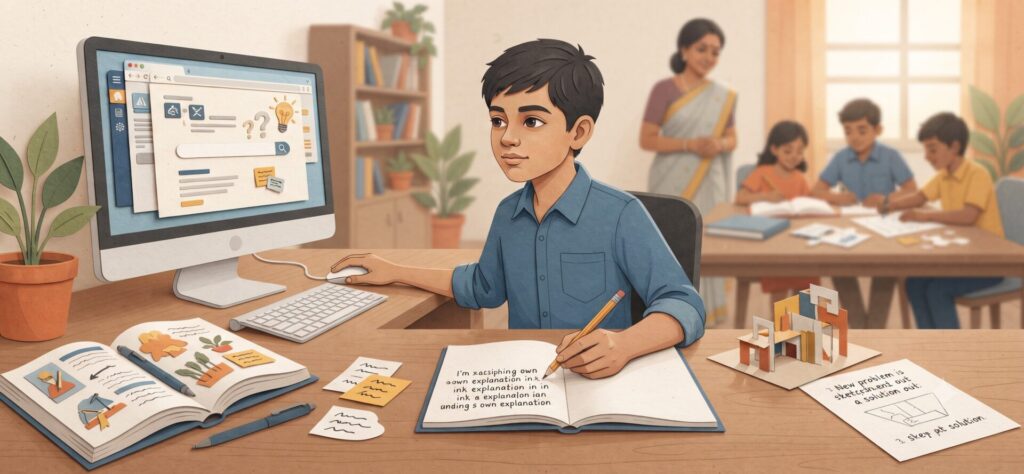
At Apni Pathshala, this connects to a belief bigger than AI: students should become people who can figure things out.
Our Learning PODs create spaces where students can learn with technology, practise independently, ask peers for help, and work through problems.
You can also read What Do We Teach at Apni Pathshala? to understand why confidence, curiosity, and the ability to figure things out sit at the heart of our learning approach.
AI will keep changing. The tools students use five years from now may not even exist today.
Judgment will still matter.
The Skill That Will Outlast the Tool
Prompting will change.
Models will change.
Interfaces will change.
Asking a good question will remain useful. Knowing whether an answer is sensible, whether to trust it, and what to do with it will be even more valuable.
That is the AI skill schools should be building now.
Not students who only know how to make machines speak.
Students who know when to listen, when to question, and when to think for themselves.
The Next AI Skill Is Human
AI can make learning faster.
It can make explanations more accessible.
It can give students another way to practise.
But the most valuable part of learning still belongs to the student.
The decision to question.
The effort to understand.
The ability to recognise when something does not make sense.
And the confidence to try solving a problem without immediately asking a machine to do it.
That is the kind of learner we should be building for an AI-shaped world.
At Apni Pathshala, that is why we look at AI as more than a tool that gives answers. Through Eklavya AI, students get another way to ask questions, understand concepts, and explore what they are learning. Through our Learning PODs, they get spaces to practise, experiment, and learn with others.
The best way to see whether this approach matters is to look at the students themselves.
Explore Apni Pathshala’s Student Stories to see how learners are turning opportunities into skills, projects, and new possibilities.
If you want to see the next step- what students can actually do after learning AI- read What Should Students Build After Taking an AI Course?.
Because the goal is not to create students who know how to ask AI for everything.
It is to create students who know how to use AI, question it, and still think for themselves.
And in a world where AI keeps getting smarter, that may be the skill that matters most.
Frequently Asked Questions
1: What should students do after completing an AI course?
Ans. Students should move beyond tutorials and build real projects using AI. Creating tools, solving practical problems, and experimenting with their own ideas helps turn AI knowledge into practical skills and a strong portfolio.
2: How can NGOs turn student data into real stories of impact?
Ans. Data shows the numbers, but student stories show the change behind them. Real learning journeys, achievements, and outcomes help NGOs demonstrate how their programs are making a difference. Explore real student stories from Apni Pathshala to see what impact looks like beyond the data.
3: How can AI help students learn independently?
Ans. AI can give students instant, personalised learning support, helping them understand concepts, practise independently, and learn at their own pace with platforms like Eklavya AI.
4: What skills do students need to succeed in the age of AI?
Ans. Students need more than the ability to use AI tools. They need AI literacy, critical thinking, creativity, and the ability to learn independently, so they can use AI thoughtfully while remaining active participants in their own learning.