

Headphones on. A 90-minute lecture playing at 2x speed. Dragging a digital highlighter across a PDF.
Parents walk in and beam. They think their kid is a genius, working hard.
But it’s a lie.
Nothing actually sticks.
I failed at this miserably myself back when I was prepping for the JEE. I’d binge Physics Wallah videos for nine hours straight. I felt like a physics god.
Then I took a mock test… and scored a 12 out of 100.
I was confused watching someone else solve a problem with actual skill. I wasn’t studying. I was just hiding.
Watching a teacher solve a complex problem on a screen creates a warm, fuzzy feeling of understanding. It’s an illusion of competence.
If watching videos isn’t building memory, what does biological learning actually look like?
Why Learning Should Feel Terrible
We buy into a garbage myth. If studying feels frustrating, you’re doing it wrong.
Wrong.
If your brain isn’t hurting, you aren’t learning. Period.
When you take a test and bomb it, anxiety spikes. You run back to watching a video because it’s safe. But cognitive friction is the entire point.
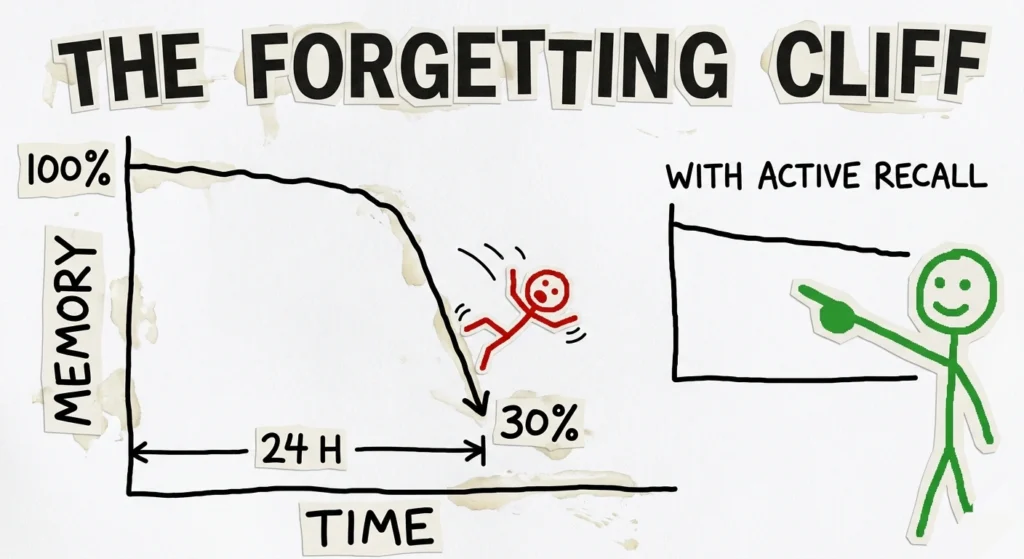
Think about the Ebbinghaus Forgetting Curve from 1885. It was found that we lose 70% of new information within 24 hours unless we actively interrupt the forgetting process.
You don’t build muscle by watching fitness influencers. You tear the tissue. Modern EdTech ruins this. AI summaries hand you the answer. Auto-flashcards do the heavy lifting for you.
Textbooks work because they don’t hold your hand. You have to bleed for the answer.
Because easy in, easy out.
The Sad Truth: You Can’t Hack Biology
So how do you sustain that awful feeling of struggle?
In the Indian pressure cooker, kids try brute force. They buy heavy courses from here and there. They sleep four hours. They drink so much Red Bull that their blood type becomes Taurine-positive.
But you can’t hack biology.
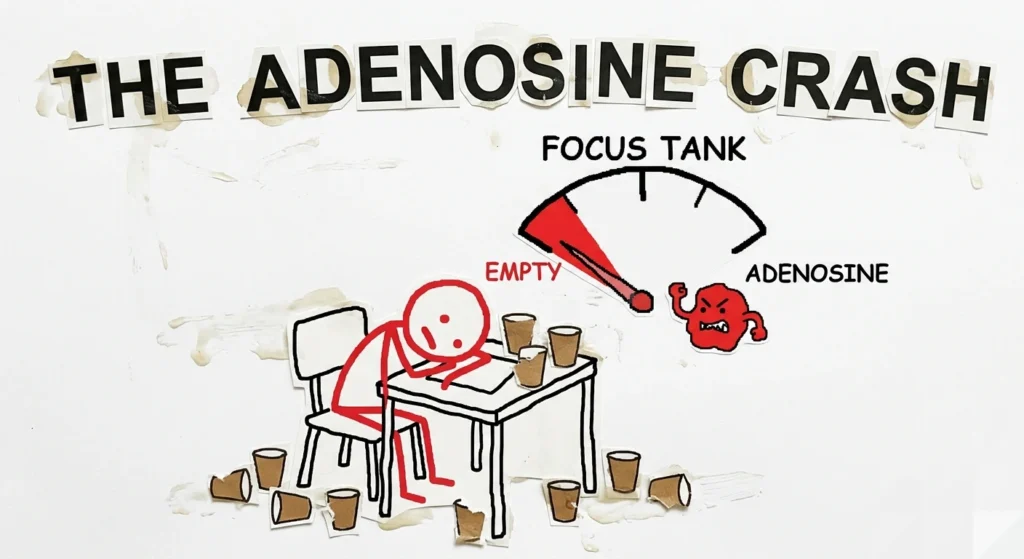
Focus connects directly to the buildup of adenosine in your brain. You can’t grind 14 hours straight. You’ll crash.
Actually, wait. Maybe you can grind for 14 hours. I’ve definitely done it. But the last 8 hours were completely useless, so let’s just agree it doesn’t count.
Instead of cramming, think Kaizen. Small steps. Consistency beats a 14-hour chai binge every single time.
When fatigue hits, motivation won’t save you. You need an anchor.
You have to understand how your success physically alters the arc of your family’s history. That motivation pulls you through the dark days.
The Practical Framework: Stop Reading, Start Doing
You don’t need to study longer. You need to study aggressively.
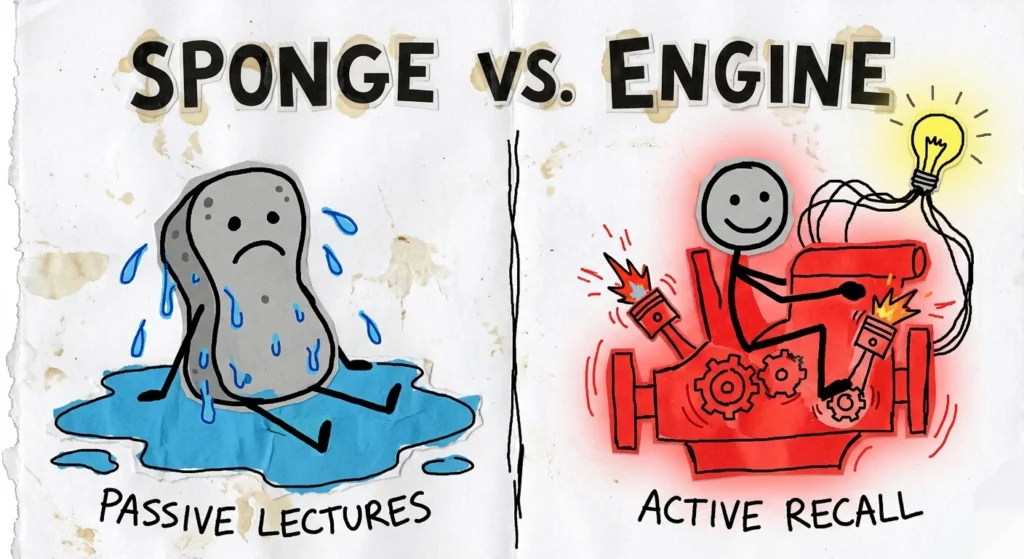
Stop acting like a sponge. Start acting like an engine.
1. Defend the Environment
You can’t make high-level cognitive decisions while your phone buzzes. Schedule strict, solitary study blocks. Map your week on Sunday in Notion. When the block starts, the smartphone leaves the room.
2. The Output Protocol
Spend 20% of your time reading. Spend 80% of the time trying to retrieve it. If you can’t explain a concept to a blank wall, you don’t know it.
3. Tech as a Sparring Partner
Don’t use AI to summarise your notes. Use it to fight you. When I started building my own web apps using Claude, I didn’t know how to code. I still don’t. But I didn’t just ask the AI to build the whole thing while I watched. I wrestled with the logic. I made it test me.
So Why We Built The POD?
Let’s talk about the real world for a second.
Self-discipline is mostly a myth.
You can read this whole blog, get super motivated, and then go right back to binging YouTube the second a math problem gets hard. I do it. You do it. We are biologically wired to avoid pain.
We don’t trust your willpower. And we definitely don’t trust modern EdTech companies.
Their entire business model relies on keeping you on their app as long as possible. They want learning to feel easy, so you keep paying the subscription.
We want you to suffer. Just a little bit.
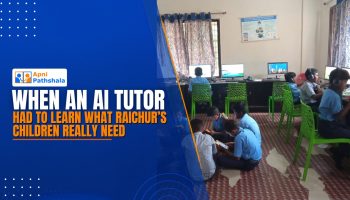
That’s exactly why we built the Apni Pathshala PODs.
Inside a POD in Bareilly or Patwa Toli, there is no access to the internet. You can’t escape social media when you hit a wall.
Instead, you sit in front of Eklavya AI.
It doesn’t spoon-feed you. If you get a question wrong, it stops everything. It forces you to explain why you chose that answer. It acts like a digital sparring partner that refuses to let you cheat yourself.
It generates impossibly difficult practice questions and forces you into high-friction recall.
CONCLUSION
We took the friction most students run from and built an entire room around it.
Stop reading this. Close the tab. Go struggle with something hard.
You just read that learning is supposed to feel like a painful struggle.
So why do students completely shut down when a physics problem gets hard… but happily fail a video game level thirty times in a row without shedding a single tear?
The answer completely changes how we should be teaching.
Find out the exact psychology behind it and how we are stealing it for Apni Pathshala: Why Video Games Feel Better Than School
Partner With Apni Pathshala
We have finalised the framework for our next 200 micro-learning POD deployments. If you direct a CSR fund, lead an NGO, or hold a local public office, the allocation window is open now.
- Skip the generic pitch decks.
- Contact us today
- Claim a POD for your community.
Frequently Asked Questions
Q1: What are the most effective study habits for students?
Ans. Active recall. Period. Stop reading. Start trying to pull the information out of your brain without looking at the book.
Q2: How do I fix my online learning habits?
Ans. Stop watching lectures at 2x speed. Remove your phone from the room. Pause the video every 10 minutes and explain the concept out loud.
Q3: Why is self-learning so hard?
Ans. It lacks built-in friction. Without a teacher forcing a test on you, it’s way too easy to read a summary and trick yourself into thinking you’re a genius.
Q4: How does a POD change digital learning?
Ans. An Apni Pathshala POD physically rips distractions away. We lock down the environment and require students to use tools such as Eklavya AI. It demands active recall and makes them engage in the deep, ugly struggle that actually builds memory.




3 Responses
A refreshing read. Consistency and focused learning will always outperform endless study hours.
True, the goal is to spend better hours actually understanding, applying, and improving
A powerful reminder that quality of learning matters more than the number of study hours. Learning with understanding always beats just studying longer. Excellent article!