


By 8:30 pm, you already know how this is going on.
Your child is sitting at the table with a textbook open, and from across the room you can tell the way you can somehow always tell, that they’re not really reading it.
They’re turning pages and looking in the direction of words.
They’re somewhere else entirely, probably thinking about something that happened at lunch or nothing in particular, which is somehow worse.
You want to help, but the book is Class 9 Science, or something with diagrams you haven’t thought about since 1997.
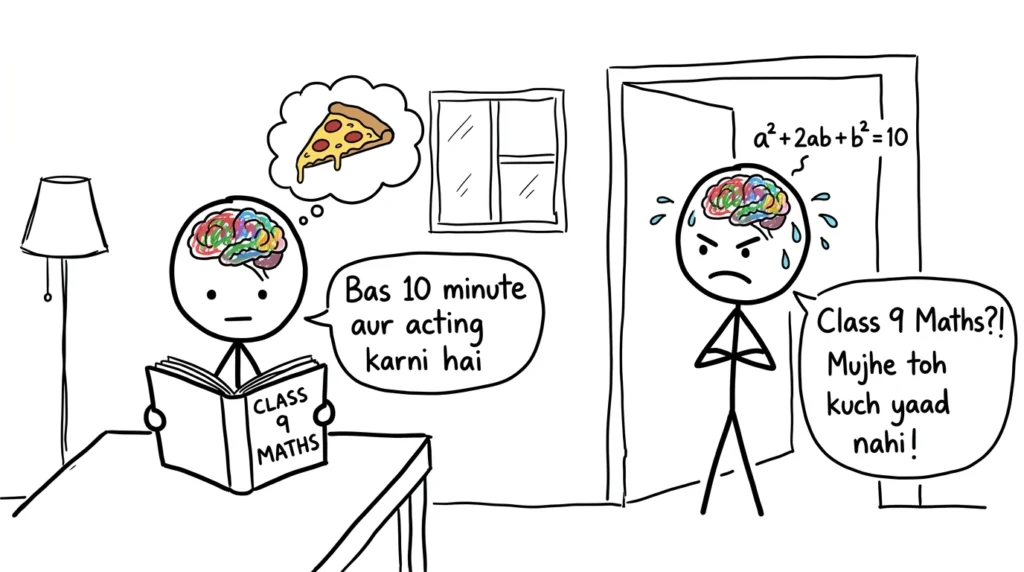
So you say “study properly” from the doorway and walk back to the kitchen, and both of you feel slightly worse than before.
But you know what? You didn’t need to know the chapter, and you sort of never did.
The Coach Who Can’t Play
Ravi Shastri never scored as many runs as Virat Kohli. He was still Virat Kohli’s coach. In fact, he was the favourite of Kohli.
A cricket coach doesn’t need to bat better than the player, because their job is to watch and ask questions.
They hold the player accountable in ways the player can’t hold themselves.
Parents are not teachers, and they were never supposed to be. You are the coach, and coaching, as it turns out, costs absolutely nothing
It’s genuinely hard to be honest with yourself at 9pm when you’re tired, the chapter is long, and the bed is right there.
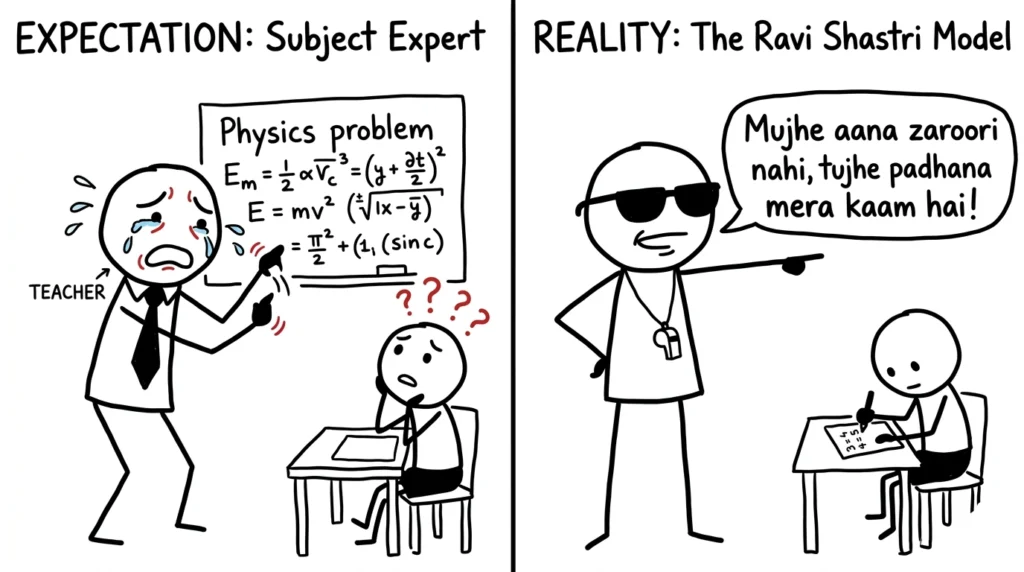
According to the India Human Development Survey (IHDS), children perform significantly better when parents simply attend school meetings and supervise homework.
This is completely true regardless of whether the parent actually understood the subject themselves.
The involvement is what matters. The expertise, interestingly, doesn’t matter at all.
One Question. Every Evening.
Not “did you study?” That’s a yes-or-no question and the answer is always yes even when it isn’t.
Everyone in the room knows this is a lie. The whole exchange is just a small, polite performance that helps nobody
The question is: “What did you learn today? explain it to me like I’m ten years old.”
This feels simple, but it isn’t, not really.
When your child has to explain something out loud (even to a person who doesn’t understand it, maybe especially to a person who doesn’t understand it), their brain has to actually organise the information.
They can’t just recognise it on a page, they have to actively retrieve it. This is retrieval practice, which brain science has been quietly recommending for decades.
Re-reading moves almost nothing to long-term memory, but explaining does. So you’re not just showing interest.
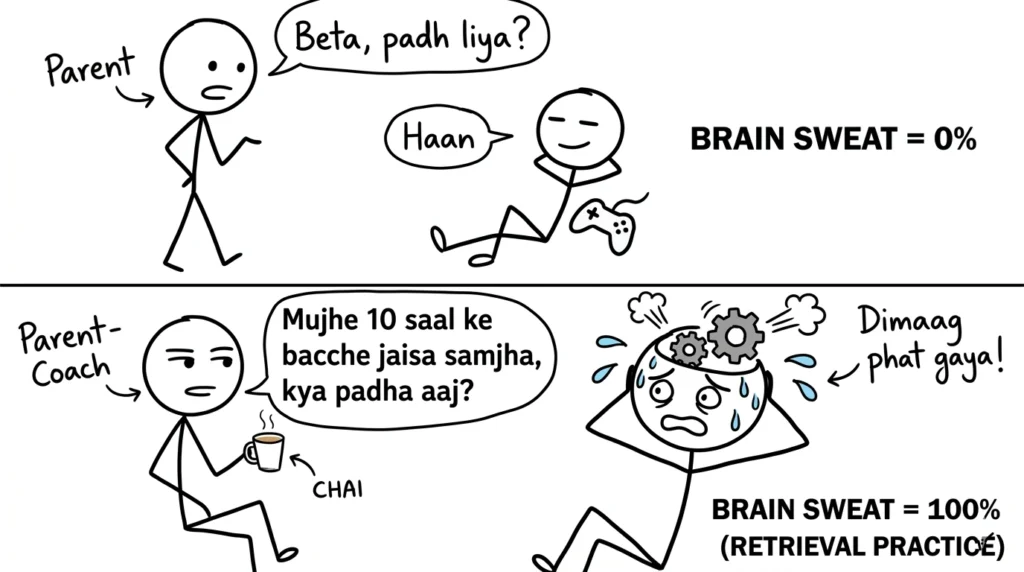
Research consistently shows that parental expectations and communication are among the strongest predictors of academic achievement.
It is stronger than school quality, and sometimes stronger than the child’s own prior performance.
The Part That Breaks Focus Every Single Day
You cannot ask a child to focus in a room with a television on and a phone face-down on the table vibrating every few minutes.
That’s not a discipline problem.
That’s just how brains work. They follow the most interesting stimulus available. A buzzing phone will always, always beat a chapter on the water cycle
The most powerful free thing a parent can do, after the daily question, is design the environment
You don’t need to buy a new desk, you just need to remove what breaks focus.
Start at the same time every day, so the brain stops negotiating with itself about when studying starts.
(This negotiation apparently consumes more mental energy than the studying itself, which explains a lot about certain evenings.)
Keep the phone in a different room not face-down, but in a different room.
A massive University of Texas cognitive study proved that even the mere presence of a phone on a desk reduces concentration when it isn’t being used, which sounds made up but is entirely real.
Forty-five minutes of work, ten minutes of actual rest, and repeat. That’s mostly the whole thing.
A child studying in a consistent, distraction-reduced environment outperforms a child with a tutor in a chaotic one.
Two Letters, Which Sounds Like Nothing
Children perform at the exact level their parents expect them to. Not in a motivational-poster way.
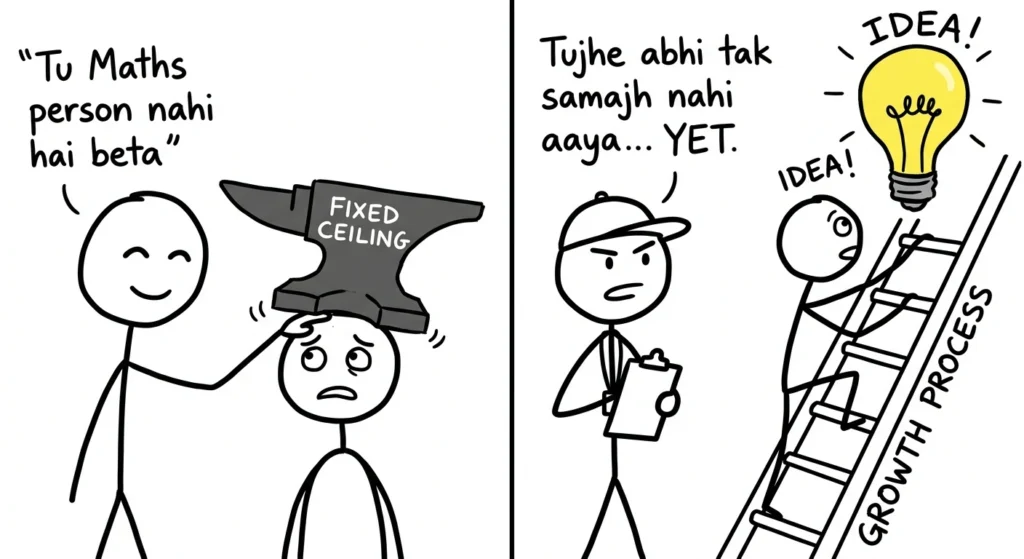
It happens in a documented, measurable, and somewhat uncomfortable way.
”You’re just not a Maths person” said gently, lovingly, trying to reduce pressure, actually setting a permanent ceiling.
The child spends years not exceeding it. They internalise the label before they’ve really had a chance to find out whether it’s true.
This is a quiet kind of damage that’s hard to see until much later. “You haven’t figured this out yet” does something completely different.
Those two extra letters signal that understanding is a process, not a fixed trait you were either born with or weren’t.
It keeps the door open. It costs nothing. And it changes quite a lot, over time.
If you’ve tried all of this and your child still has gaps in foundational learning, there is a structured environment you can use.
Apni Pathshala’s community PODs run across 22 states, completely free of charge.
They use tools like Eklavya AI that work through CBSE content chapter by chapter to catch these exact gaps. It is highly worth checking if one exists near you.
Now, you’ll probably want to read this next:
You might be studying hard but still forgetting, here’s why
You’re not struggling because it’s hard, find out what’s really missing, read more.
Frequently Asked Questions
1. Why does my child study but still forget everything? (From our memorisation article)
Ans: Start smaller. The evening question works better if it doesn’t feel like an interrogation. Ask once, genuinely, and then let it go. Consistency over weeks matters more than any single conversation.
2. What is the best alternative to highlighting while studying?
Ans: Active learning methods like summarizing, self-testing, and spaced repetition are more effective than highlighting for better understanding and retention.
3. How can students stay safe while using technology?
Ans: Students can stay safe by using trusted software, avoiding unknown links, protecting personal information, and learning basic cyber safety practices.
4. How does Apni Prerna keep students safe online?
Ans: Apni Prerna keeps students safe by blocking unsafe websites, tracking online activity, and managing screen time so students use computers only for learning purposes.





2 Responses
Good one !
Thank you, Glad you liked it!