You’ve done this. You sit down at your desk the night before an exam, maybe it’s 9pm.
Maybe it’s closer to 11 and you’re telling yourself that 11 is fine, 11 is still a completely reasonable time to start, other people probably start at 11
and you open the textbook and you read the chapter..then you highlight the important parts. Then you realise you’ve highlighted almost everything, which feels like it defeats the purpose, so you re-read it more carefully this time.
Then you copy the key points into your notebook in your neatest handwriting, which for some reason always feels important even though you’re not entirely sure why.
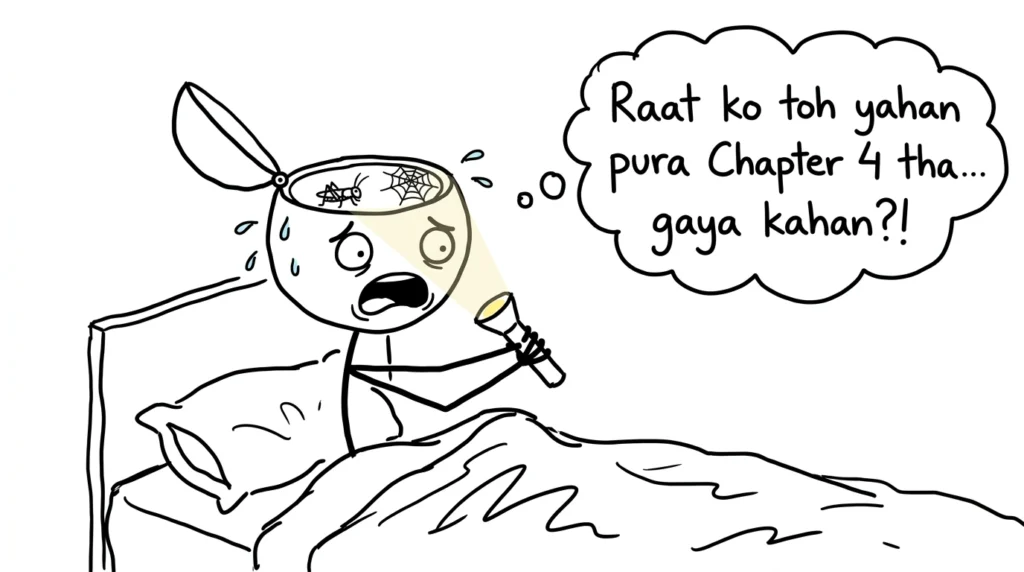
You close the book. You feel okay. Maybe even good Morning comes. Paper goes in front of you
Gone. Not hazy. Not “I sort of remember”. GONE!
Like you’d never read it at all. Like the chapter was something that happened to a person you once heard about at a wedding.
So why is the information just not there? Here’s the answer. It’s not motivational. It’s not a mindset thing. It’s sort of just biology
Your Brain Is Basically Running Out of RAM
Quick computer analogy. Stay with me, it’s actually useful.
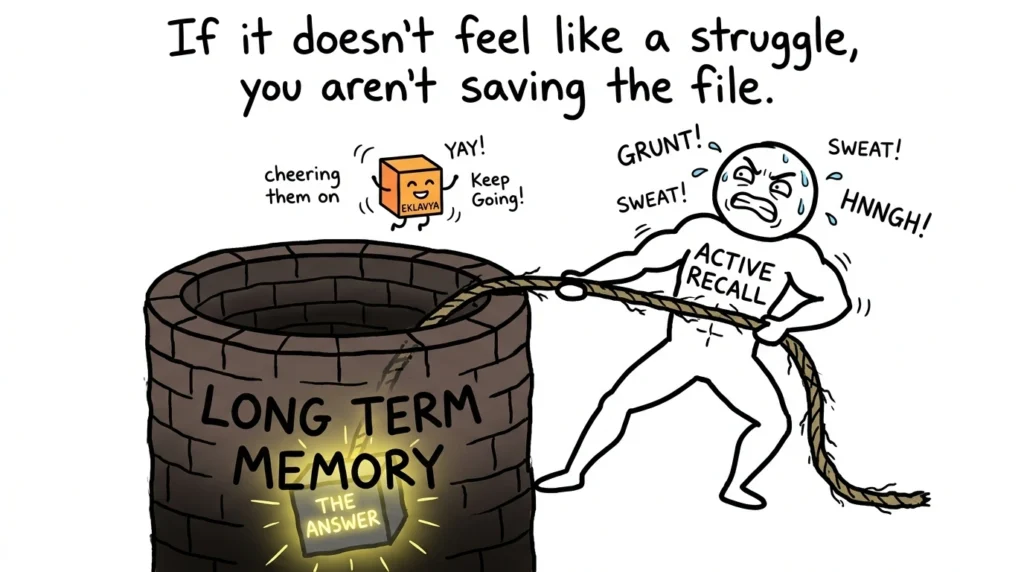
Computers have two types of memory. RAM is the fast, temporary one it holds whatever you’re working on right now and the second you close the program, it’s gone, just completely erased like it never existed
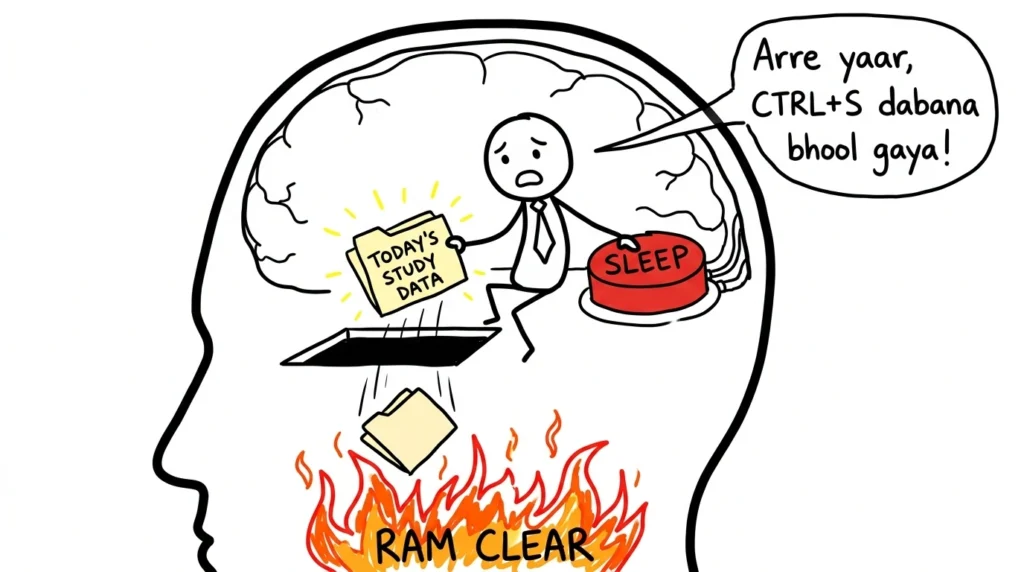
The hard drive is the permanent one. Slower to write to, more effort to get things in, but once something is there, it stays.
When you read passively. Re-reading paragraphs, highlighting three sentences on every page, copying notes in your neatest handwriting into a notebook that you will never open again the information sits in RAM.
It feels like studying. It has all the sensory qualities of a productive evening. Your highlighter is making that satisfying squeak. But your brain never gets the signal to actually save the file.
You sleep feeling prepared and wake up feeling genuinely robbed, which is honestly one of the more disorienting combinations of feelings a person can experience at 7am.
The Three Types of Studiers (You Know All of Them)
You know all of these people. You have probably been all of these people, possibly in the same week.
The Highlighter – Owns an unreasonable number of highlighters and has a colour-coding system that made complete sense when they invented it. Yellow for definitions, pink for important stuff..
Their textbook looks genuinely beautiful by the end. Museum-quality, almost.
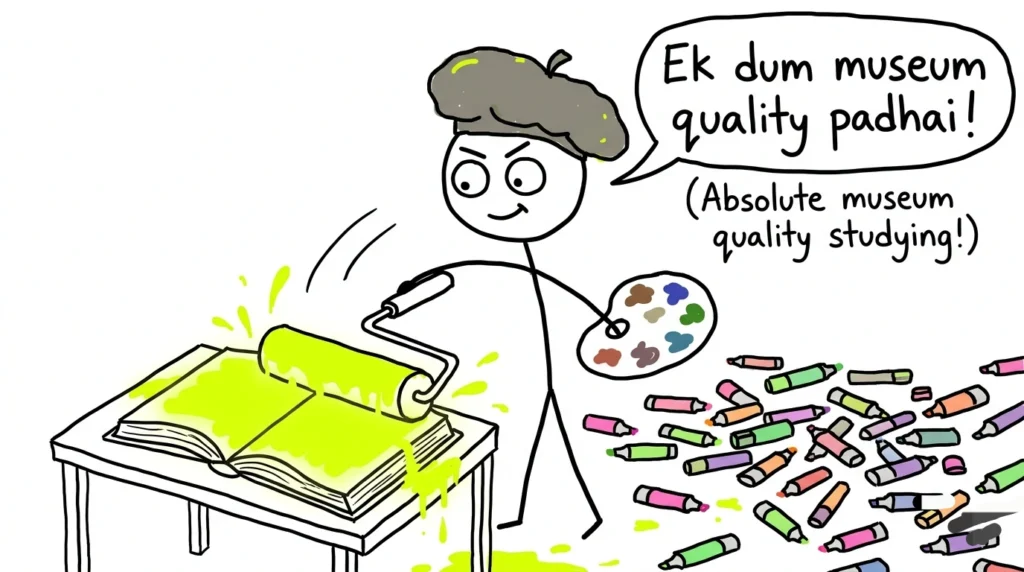
Unfortunately, the brain filed all of it under “seen before” and moved on without saving a single thing
The Re-Reader – Has read Chapter 7 four times. Four complete, full readings. Each one felt clearer than the last. Each one ended with a warm, almost cosy sense of understanding.
The kind that feels very convincing right up until the exam phrases the question 15% differently, at which point they stare at the paper like it has personally let them down
The Night-Before Crammer – Three weeks of nothing, then one completely unhinged evening of consuming an entire subject on two cups of chai and whatever biscuits were in the house. Somehow passes.
This method technically works, in the same way that sprinting the last 200 metres of a marathon technically counts as running
The Parrot Problem
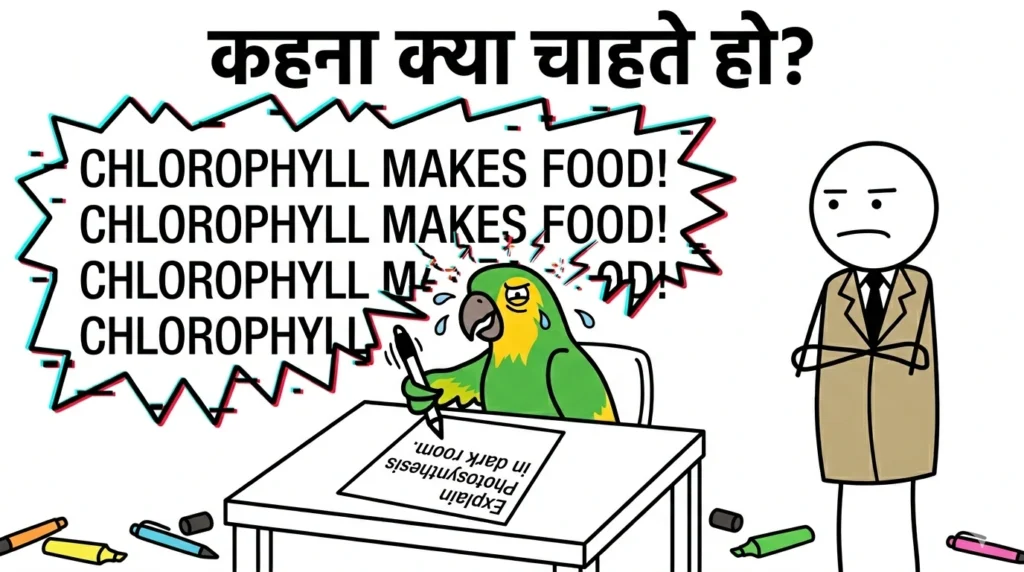
There’s a parrot that says “I’m hungry” in perfect, clear English. It has absolutely no idea what hunger is.
Ask it something slightly different, “are you thirsty?” and it says “I’m hungry” again because it learned the sound, not the meaning behind the sound. A parrot isn’t stupid. It learned the wrong thing efficiently.
This is rote learning. A student memorises the exact definition of photosynthesis, same words, same order, same phrasing as the textbook and gets full marks when the question asks them to define it.
Then the question asks what would happen to a plant kept in a dark room for a week, and there’s just silence. Same concept underneath. Different surface. Complete blank.
What Actually Works (Annoyingly, It’s the Harder Stuff)
The study methods that actually move information from RAM into long term memory all share one quality: They feel significantly worse than re-reading.
More effort. More discomfort. Less of that warm, immediately satisfying sense of progress that re reading gives you after thirty seconds.
Which is, honestly, a design flaw in human psychology. But here we are.
1. Teach it to something. Anything at all.
Close your notes. Explain the chapter out loud to a friend, a sibling, your crush, the wall, whatever is available and try to get through it without looking.
This works because of something called the Protégé Effect, which is a formal name for the fairly intuitive idea that explaining something forces your brain to actually connect ideas rather than just recognise them. Recognition is RAM. Connection is the hard drive.
The moment you get stuck mid explanation and you will that’s the gap
That specific thing, right there, is what needs more work. Everything else, you can probably leave alone.
This is also, incidentally, what tools like Eklavya AI (used in Apni Pathshala’s community learning PODs across India) are doing when they test students chapter by chapter. Forcing retrieval, finding the gaps, building the feedback loop that most students never get at home or in a class of thirty five.
2. Switch subjects every 30 to 40 minutes
Switch topics every half hour or so, and your brain has to reload each subject from scratch every time you return to it.
This is called interleaving, and it increases long term retention by up to 76%, which sounds like a statistic someone invented but is actually from real research
It feels inefficient. It feels slightly chaotic. It is, apparently, much better than the alternative
3. The blank page thing
After finishing a chapter, close everything, put the book face down, take a blank piece of paper and write down everything you can remember.
Not bullet points of what you think you know.
Everything you can actually retrieve right now, from memory, without looking. When you get stuck on something, wait! Ten seconds. Twenty. .
To reach that uncomfortable, slightly embarrassing struggle to pull something back up that’s the safe happening
That’s your brain writing to the hard drive. Re-reading gives your brain nothing to do.
The blank page makes it work. Tonight, maybe try it. One chapter. Book closed. Blank page. See what comes out, see what doesn’t
It’ll probably be a little humbling. Most people find bigger gaps than they expected which is uncomfortable. But also weirdly, kind of useful to know before the exam rather than during it.
if this sounds familiar, you’ll probably want to read this next:
👉 CBSE isn’t the problem. What’s really causing this? find out.
👉 What if NCERT felt simple instead of confusing? Explore.
Frequently Asked Questions
1. Why do students study so much but still struggle?
Ans: Because they are taught to complete, not to understand.
And over time, this creates a gap that makes learning feel harder than it actually is.
2. Why do students depend on tutors for CBSE?
Ans: Because when concepts aren’t clear, students don’t just struggle, they start relying on someone else to understand.
3. Why should students choose skill-based courses after 10th? impossible for so many students?
Ans: Because skill-based courses help students build practical knowledge and become career-ready early, instead of just focusing on theory.
4. What if your career could start right after 12th?
Ans: After 12th, students can start their career early by learning practical skills that open real opportunities, instead of waiting only for degrees.