

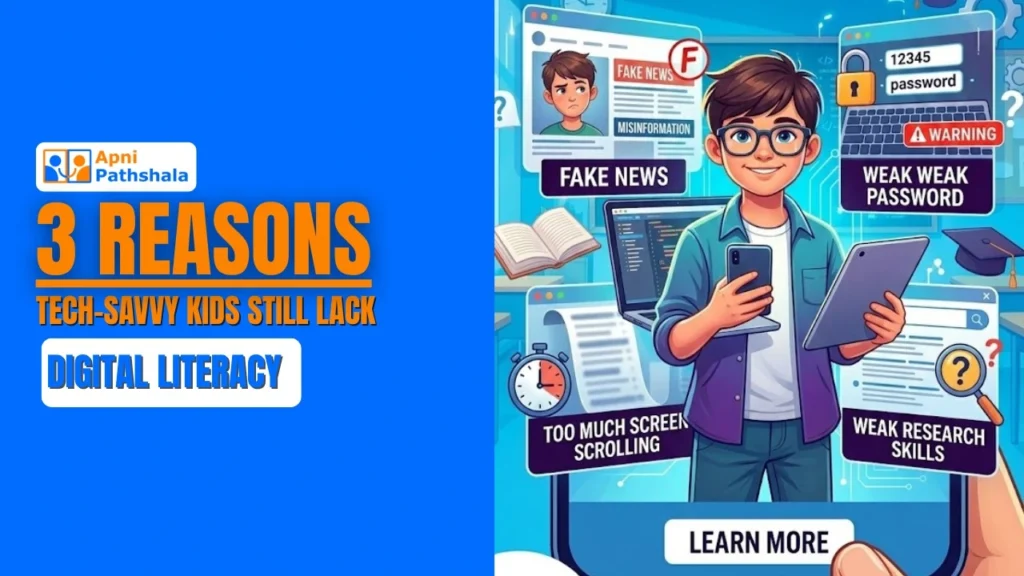
Watch an Indian parent look at their fourteen-year-old kid on a Sunday afternoon.
The kid is effortlessly resetting the home WiFi router, toggling flawlessly between Instagram, WhatsApp, and a heavy PDF document, and editing a 4K video reel with trending music in under thirty seconds.
The parent smiles proudly, thinking, “My kid is an absolute tech genius. They are completely ready for the future.”
But let’s look at what actually happens next.That same “tech genius” sits down at their desk to do fifteen minutes of YouTube research for a school project on the French Revolution.
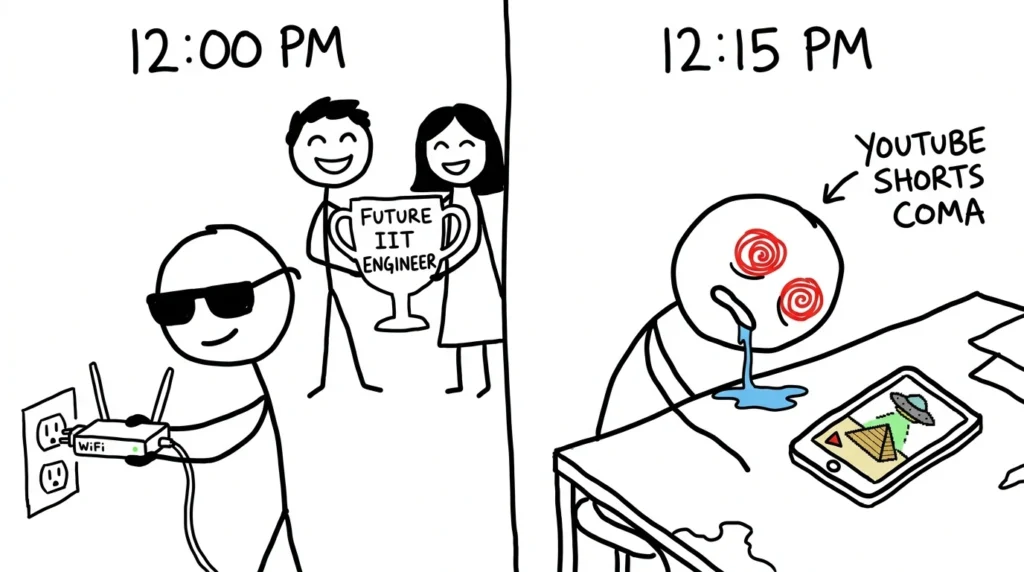
Four hours later, they emerge from a hypnotic, screen-induced trance, having watched thirty-two consecutive YouTube Shorts about how the Egyptian pyramids were actually built by time-travelling aliens.
They didn’t write a single word of their assignment. How does this happen? How is it that the most “tech-connected” generation in human history?
Kids who practically have WiFi running in their veins are so easily paralyzed and distracted by the exact screens they claim to master?
This massive, dangerous gap between using technology and understanding technology is exactly why the importance of digital literacy for students has become the single most critical conversation in education today.
The Library vs. The Casino
We have fundamentally misunderstood what a smartphone actually is.
We handed teenagers supercomputers with access to all human knowledge, and we told them it was a library.
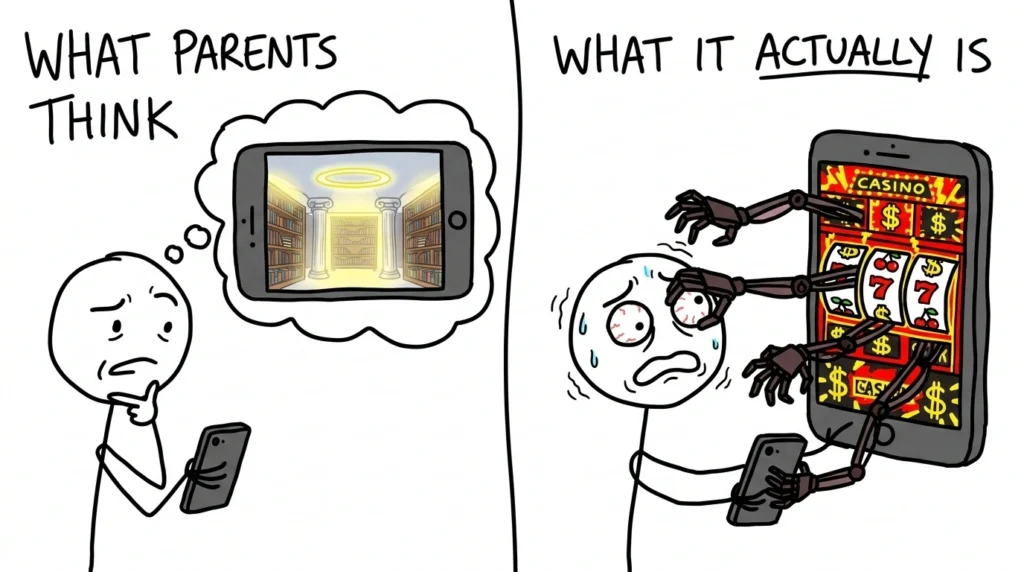
But it’s not a library. It’s a casino.
Every major social media app is engineered by thousands of the smartest behavioral psychologists on the planet. Their only goal is to hijack human dopamine and keep eyes glued to the glass. Studies show the average modern student touches their phone screen over 2,600 times a day.
But scrolling fast doesn’t mean you are digitally literate.
It just means you are a highly efficient consumer.
You know exactly how to pull the lever on the slot machine to get the bright colours and the dopamine hit, but you have absolutely no idea how the casino is making its money.
But wait… hold on.
Didn’t schools already teach us digital literacy? Didn’t we all sit in computer labs for years, learning how to make a PowerPoint transition spin in circles and how to bold text in MS Word?
The 1990s Definition of Digital Literacy is Dead
Yes, schools taught us, but they taught us the 1990s definition.
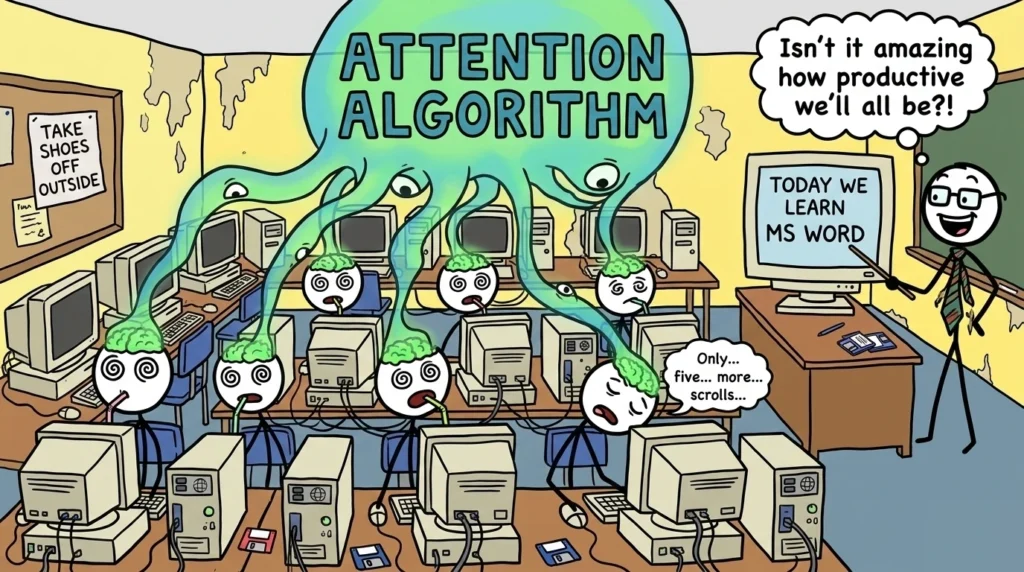
Back then, digital literacy simply meant software operations. It meant knowing how to type on a keyboard, how to attach a file to an email, and how to use Google Search without accidentally breaking the family computer.
That definition is completely dead today.
In 2026, the software operates itself. AI writes the emails. Apps design the presentations. Operating the machine isn’t a rare skill anymore.
Protecting your brain from the machine is a skill.
The Digital Immune System
To survive the modern internet, you don’t need faster typing skills. You need a Digital Immune System.
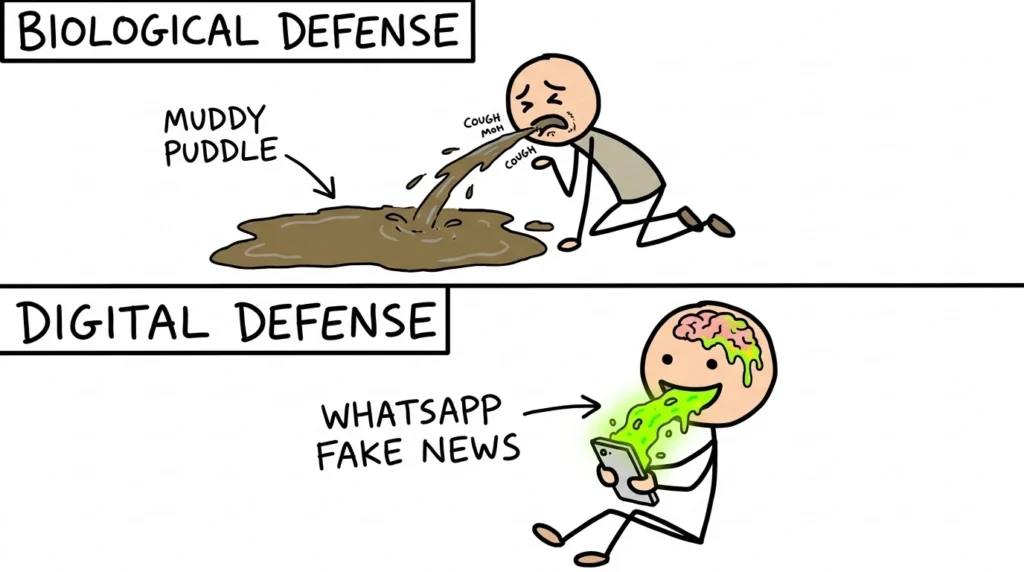
Think about your biological immune system. If you accidentally drink dirty water, your body immediately recognizes the bad bacteria and attacks it. It has a built-in, biological defense mechanism to keep you from getting severely sick.
But your brain has absolutely no built-in defense mechanism for algorithmic garbage.
If a student lacks a digital immune system, they will blindly trust a family WhatsApp forward claiming that “special 432Hz audio frequencies will cure exam anxiety.”
Or worse, they will use a hallucinated AI chatbot that confidently invents a completely fake World War II battle, and they will copy-paste it directly into their board exam prep without a second thought. Without an immune system, you simply believe everything the glowing rectangle tells you.
What Digital Literacy Actually Looks Like Today
So, if it’s not just making PowerPoints and typing fast, what does real digital literacy look like for a modern student?
It breaks down into three core pillars.
1. Attention Architecture (Defense)
A digitally literate student understands that their focus is a highly valuable currency, and every app on their phone is actively trying to steal it.
Real literacy is knowing how to build walls. It’s knowing how to use app blockers during study hours, aggressively turning off non-essential notifications, and recognizing the exact physical feeling of being caught in an infinite scroll loop so you can physically put the phone face down.
2. Algorithmic Awareness (Navigation)
A tech-savvy kid gets mad when they see an annoying or polarizing video on their feed.
A digitally literate kid knows that their feed is not reality. It is just a mirror of their past clicks. They understand that if an app makes them feel angry, insecure, or distracted, it isn’t an accident.
The algorithm is working exactly as intended. They know how to curate their inputs so their timeline feeds their academic goals, not their teenage anxieties.
3. Leverage over Laziness (Creation)
This is the ultimate test in the new age of Artificial Intelligence.
A digitally illiterate student uses AI as a crutch. They ask a chat bot to do their homework for them so they don’t have to think. They trade long-term brain growth for short-term laziness, creating an illusion of competence.
A digitally literate student uses AI as a lever. They use specialized tools like a targeted AI tutor not to cheat, but to have complex, boring textbook concepts explained to them in simpler terms. They use technology to think better, not to avoid thinking altogether.
The Hack: Beating the “Willpower” Joke
Telling a 14-year-old to “just use willpower” to fight an algorithm built by ten thousand Silicon Valley engineers is a hilarious joke. It is the educational equivalent of bringing a wet noodle to a sword fight.
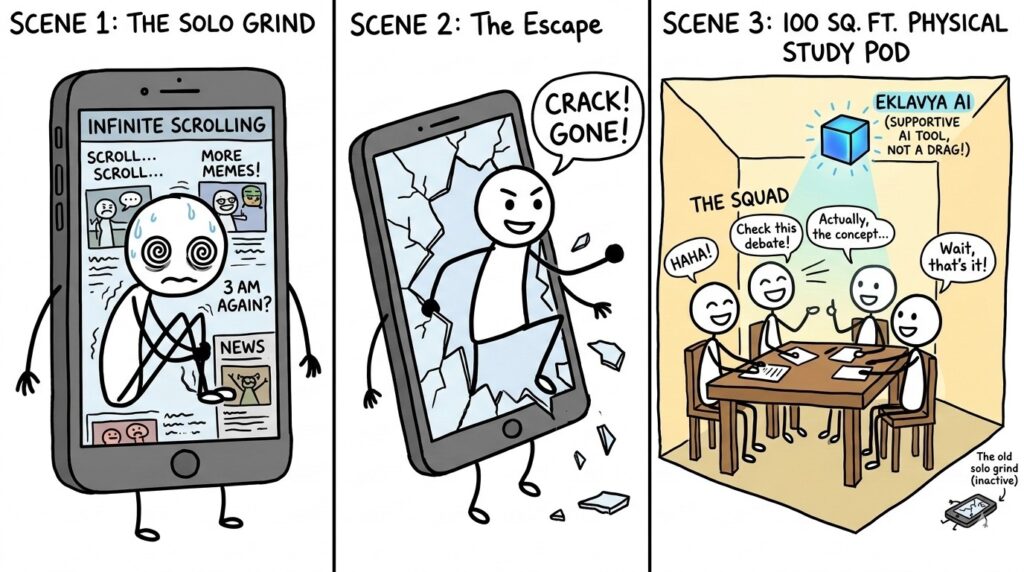
Your willpower is a leaky battery. It dies by 2 PM. You simply cannot out-discipline a supercomputer that knows exactly what color button makes your brain release dopamine.
This is why true digital literacy isn’t about trying really, really hard to focus while sitting inside a Vegas slot machine.
It’s about physically leaving the casino. This exact realization is the beating heart of Apni Pathshala. We knew that handing a kid another screen and whispering “good luck, don’t get distracted” was a structurally broken model. So, we built a hybrid system.
First, you use the tech for a targeted surgical strike.
You open the Eklavya NCERT AI get the exact bite-sized concept you need, take the interactive quiz, and get out. Zero infinite scrolling. Zero three-hour rabbit holes about time-traveling aliens.
But then comes the actual magic trick. You physically close the laptop and walk into an Apni Pathshala Community Centre. You sit at a real table, with real 3D human beings, and you debate the concept you just learned.
You get high-friction, real-world accountability. Because here is the beautiful truth about physical reality: you cannot accidentally doomscroll for three hours when you are sitting in a room arguing with four other kids about Newton’s Third Law.
First, we use technology strictly as a lever. Through tools like this. We strip away the infinite scroll and replace it with structured, bite-sized learning and active feedback loops.
Upgrade Your Learning Engine
We need to stop praising kids just because they know how to operate a touchscreen.
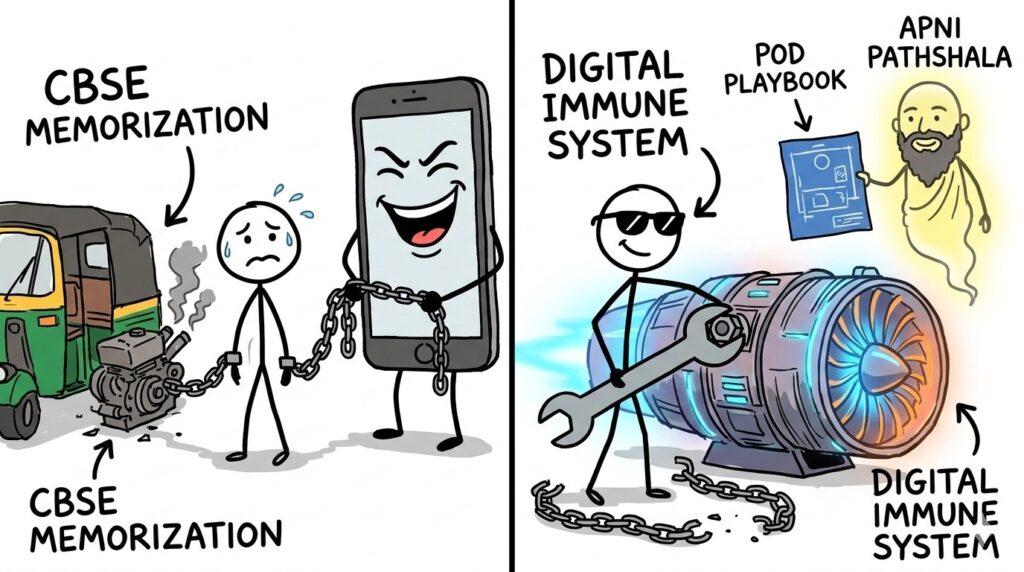
We must upgrade them from passive, manipulated consumers into active architects of their own minds.
Step one is taking back control of the tools you use every single day, rather than letting the tools use you. Technology is a 1000-horsepower engine, and it is time you finally moved over to the driver’s seat.
A tech-savvy student knows how to use an app.
A digitally literate student knows how to use an app to upgrade their real life.
Stop being the product. Start building your digital immune system today with the help of apni pathshala.
If this article made you rethink how students use technology, these guides from Apni Pathshala are the perfect next step.
They break down how modern students can actually learn better in the age of AI and constant digital distraction.
• Still highlighting everything and remembering nothing? Discover a smarter way to study. Read now
• Stop solo grinding. Learn AI with the right system and support. Read now
The future of education isn’t about avoiding technology.
It’s about learning how to think clearly while using it.
Why is the importance of digital literacy for students growing so fast?
Because technology has shifted from a passive tool (like a calculator) to an active, algorithmic environment (like social media and AI). Students need digital literacy to protect their attention spans, verify fake information, and use AI ethically without destroying their own ability to learn.
What is the best way for students to learn AI in 2026?
The best way to learn AI in 2026 is not by studying alone, but by learning with the right support system. This blog explains how community-based learning, peer discussions, and practical use of AI tools help students understand concepts faster, stay consistent, and turn knowledge into real skills.
How is digital literacy different from computer skills?
Computer skills are technical abilities: knowing how to code, edit a video, or format a spreadsheet. Digital literacy is a cognitive skill: it is the critical thinking required to navigate the digital world safely, evaluate the information you find, and understand the psychological design of the apps you use.
Why is ChatGPT not always the best study tool for CBSE students?
ChatGPT is useful for general explanations, but it is not designed around the exact CBSE and NCERT syllabus. It can give broad answers when students need precise, syllabus-based learning. That is why students may finish homework faster with ChatGPT, yet still struggle in tests because they understood the answer superficially instead of building real concepts.



2 Responses
This article hits the nail on the head! The analogy of smartphones being casinos rather than libraries is spot on. As someone working with students, I’ve seen exactly what you describe – kids who can navigate any app effortlessly but get completely lost in algorithmic rabbit holes when trying to research.
The concept of a “Digital Immune System” is brilliant. We definitely need to teach students not just how to use tools, but how to defend their attention against platforms designed to capture it. The three pillars – Attention Architecture, Algorithmic Awareness, and Leverage over Laziness – provide a practical framework.
Community learning centers like Apni Pathshala are doing important work by creating that physical accountability space. It’s much harder to doomscroll when you’re sitting with peers discussing what you just learned!
Thank you for articulating this critical distinction between tech-savvy and digitally literate. More educators and parents need to understand this.
“Thank you for your thoughtful comment! We’re glad the article resonated with you. You’re absolutely right – it’s not just about using apps, but navigating information wisely. At Apni Pathshala, we’re proud to create spaces that foster true digital literacy, helping students defend their attention and engage meaningfully. Together, we can empower the next generation!”