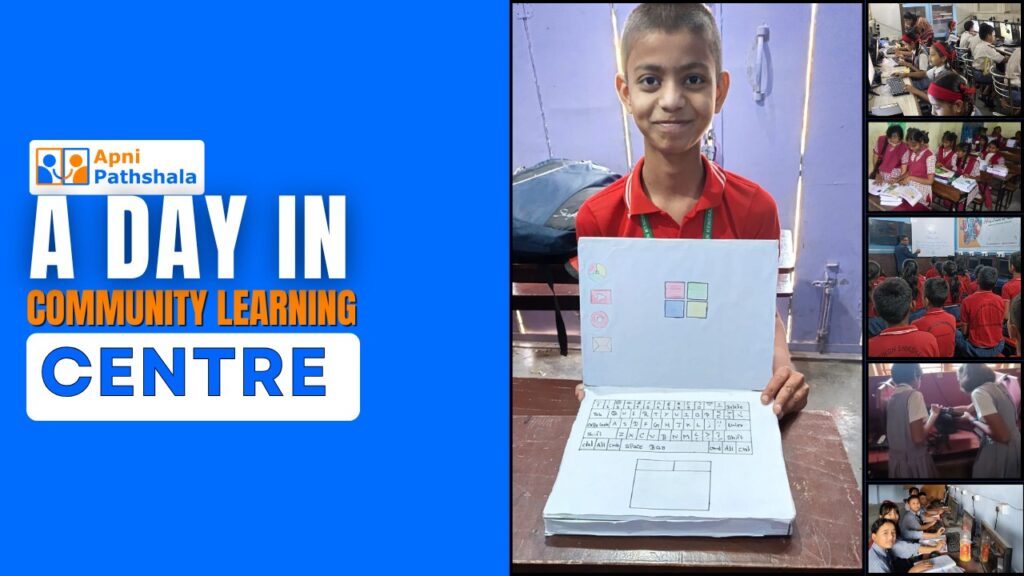
If you walk past a typical tuition centre in India, you know what to expect. You see a room full of students facing forward, absolute silence, and a teacher writing on a whiteboard. It is a familiar sight. But if you walk past an ApniPathshala community learning centre in India (or POD), you might think you have walked into a tiny startup office by mistake.
There are no rows of desks. There is no blackboard. And most shockingly, there is no teacher lecturing at the front. For parents used to the “factory model” of schooling, this can look unstructured. But it isn’t chaos. It is a carefully engineered system designed to turn dependent students into independent creators.
Here is a forensic, hour-by-hour breakdown of what actually happens inside a POD.
How a POD Session Actually Begins
School starts with a bell. A POD session starts with a login. When students enter, they don’t sit on comfortable couches or pull out tablets. Tablets are designed for watching videos and relaxing.
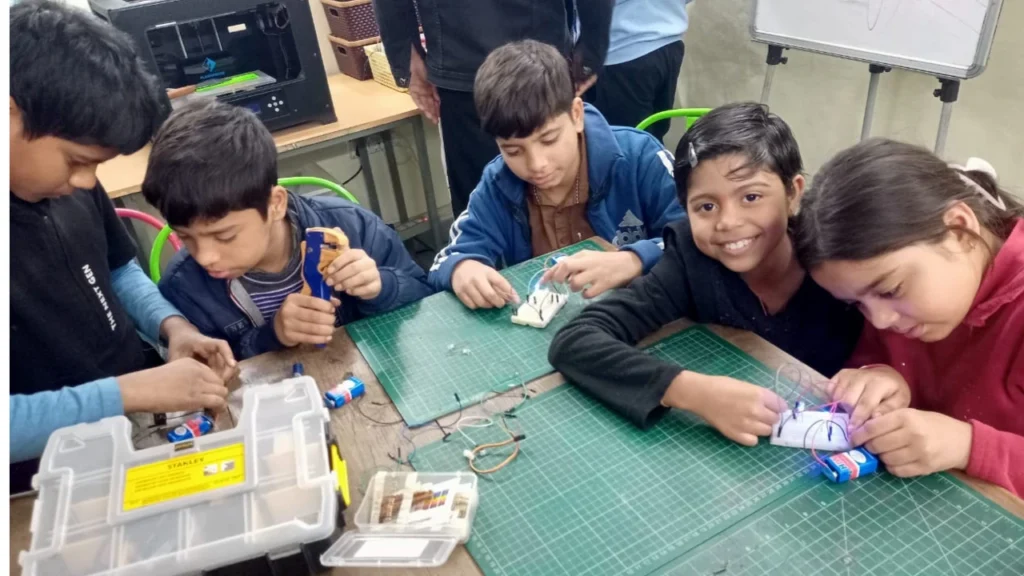
At ApniPathshala, we use Apna PCs tethered to desks.
These are workstations. You have to sit up. You have to use a keyboard and a mouse. You are here to work. There is no roll call. The student sits down and logs into the operating system. The login timestamp serves as their attendance.
The moment they log in, the “walled garden” activates. There is no YouTube algorithm to get lost in. There are no video games. They see only tools for creation, such as coding software and design apps.
The mentor, seated at the back, doesn’t shout for silence. They simply ensure the internet is working and the environment is safe.
Learning Without a Teacher
Parents often ask a valid question.
“If there is no teacher, how do they learn new things?”
Let’s look at a real example from our POD at the NarayanChandra Trust.
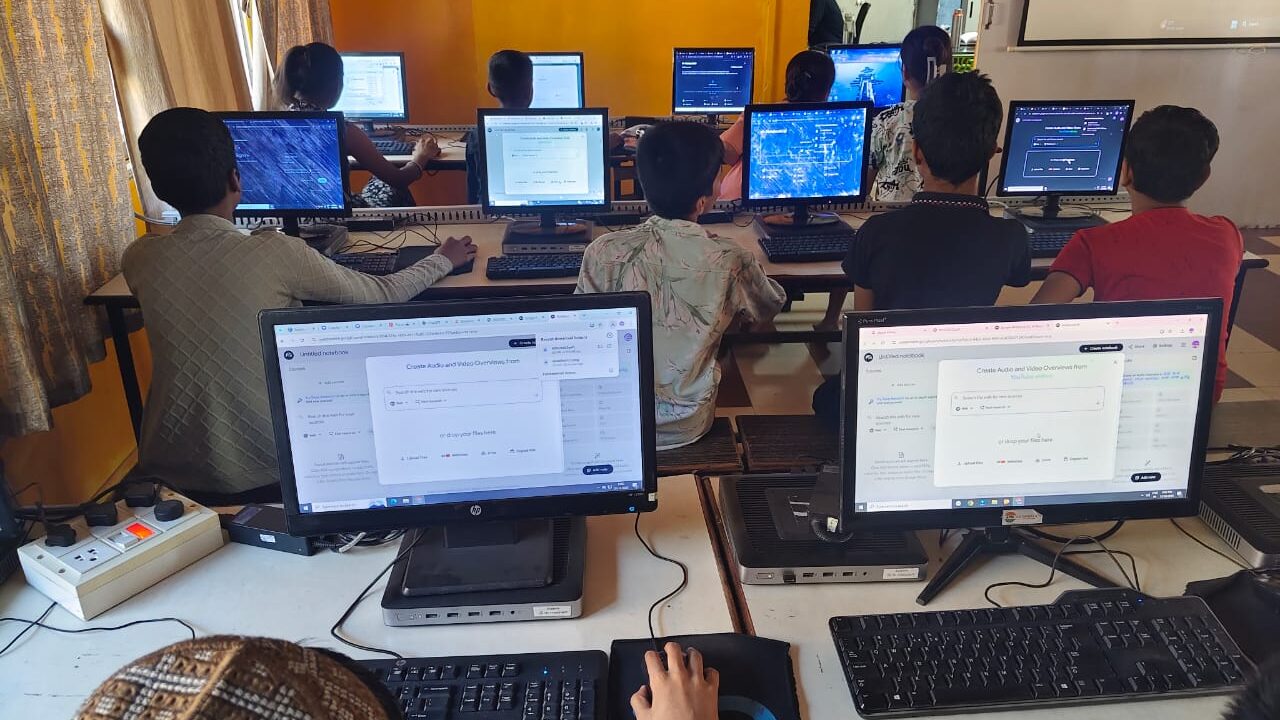
The students are learning web development. Instead of an adult standing up to lecture, a senior student takes the lead. This might be a student just two years older than the rest.
The senior student projects their screen.
They show exactly how to build a website header. They demonstrate which code to write and which tool to click. Then, the senior turns to the group and sets the task.
“Now, build it. But do not copy me. Change the colors. Change the layout. Make it yours.”
This is critical. In a tuition centre, students copy notes. Here, they apply concepts immediately. The “teacher” is a peer who was in their shoes just six months ago.
What Happens When a Student Gets Stuck
Let’s say a Junior student hits a wall. Their code is showing an error. They are stuck. In a school, the student would raise their hand, and the teacher would fix it immediately.
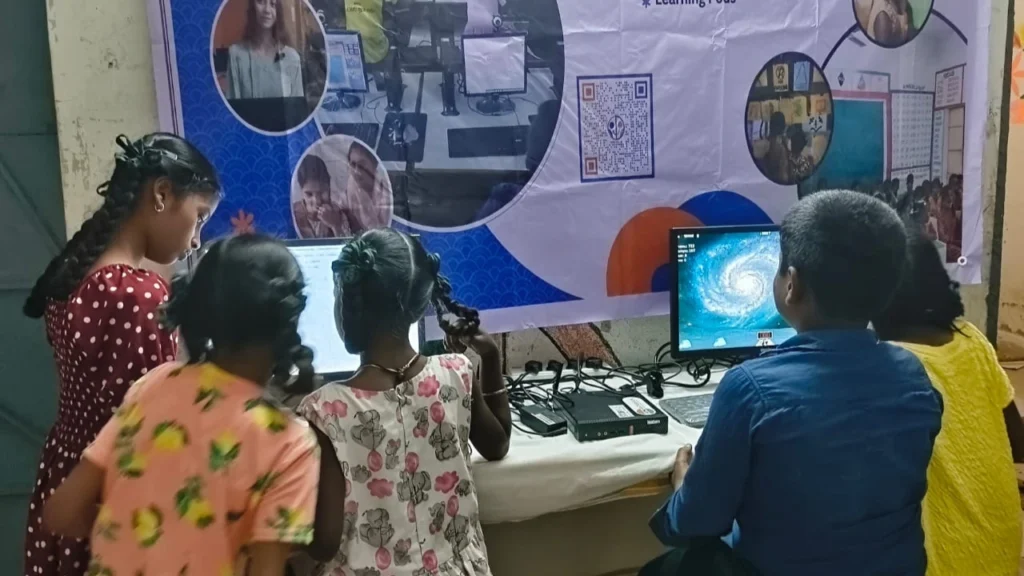
In a community learning centre in India, the protocol is different. The student looks at the adult mentor, but the mentor does not stand up. This is often the hardest part for parents to watch.
You might wonder, “Why isn’t he helping my child?”
The mentor’s job is strictly defined. They manage behavior, ensure physical safety, and keep the energy focused. They do not answer academic questions. Because the mentor stays silent, the student is forced to think.
First, they read the error message again. Then, they open a new tab and search for a solution. Finally, they lean over to the student next to them.
Peer Learning Inside a POD (“Shoulder Surfing”)
This brings us to the room layout. A POD is small, usually packed with 10 workstations. This density is intentional. It allows for something we call “learning by osmosis.”
If students were spread out in cubicles, they would be isolated. But here, screens are visible to neighbours. If a 10-year-old sees a 12-year-old designing a 3D model on the screen next to them, curiosity is triggered.
“How did you do that?”
The 12-year-old explains. This “shoulder surfing” is the engine of the POD. In school, looking at a neighbour’s work is cheating. Here, it is networking. When the junior student with the broken code leans over, the senior doesn’t fix it for them. They give a hint: “You missed a semicolon on line 4. Check the syntax.”
The junior finds it, fixes it, and the code runs. That rush of satisfaction, “I fixed it myself”, is what builds real confidence!
What Students Leave With (No Homework Policy)
The session ends. There is no bell. The students don’t pack up textbooks to take home. ApniPathshala has a strict “No Homework” policy. We believe home time is for play. Instead of homework, the student saves a “commit.”
This is a saved piece of code, a published blog post, or a finished graphic design. They leave the centre not with a filled notebook, but with a digital result they can show on a phone.
Conclusion: It’s Not a Class, It’s a Workspace
When you look inside a community learning centre in India, don’t look for the silence of a library. Look for the hum of a newsroom. It is noisy. It is busy.
Students are arguing about code and pointing at screens. To the untrained eye, it looks like play. But to the future economy, it looks like work. We aren’t training children to sit still and listen. We are training them to log in, struggle, ask for help, and figure it out.
Curious if a Community Learning Centre is right for your child?
👉 Explore how ApniPathshala PODs work
👉 Learn how community microschools are transforming education
Join the movement. Visit ApniPathshala to learn more. Let’s build a digitally literate India, one POD at a time.