

A parent does not search for a coaching centre as a fun alternative. They search when something at home feels off.
The child is going to school. Maybe coaching also. The bag is heavy. Fees are paid. Books are there. Phone is there. Internet is there.
Still, the parent feels a small fear sitting inside their chest.
“Is my child really learning?” Or worse… “Is my child slowly going off track, and I am not able to see it?”
That is the real fear. Not only marks. Safety. Company. Screen use. Pressure. Time waste.
The child who was fine till Class 8 or Class 10 suddenly changes. Less study. More phone. More excuses. More silence. More “haan mummy, ho gaya” when nothing is actually done.
Parents know this pattern. They may not use fancy words for it. They just say, “ab woh bada hogya hai”
That is why coaching centres became so common. Parents wanted extra help. They wanted someone to teach what school could not finish.
And to be fair, many coaching centres do help. This blog is not against coaching centres. That would be lazy.
The real question is sharper:
Does your child need another class, or a safer place where someone actually checks how they are learning?
The problem starts when attendance looks like progress
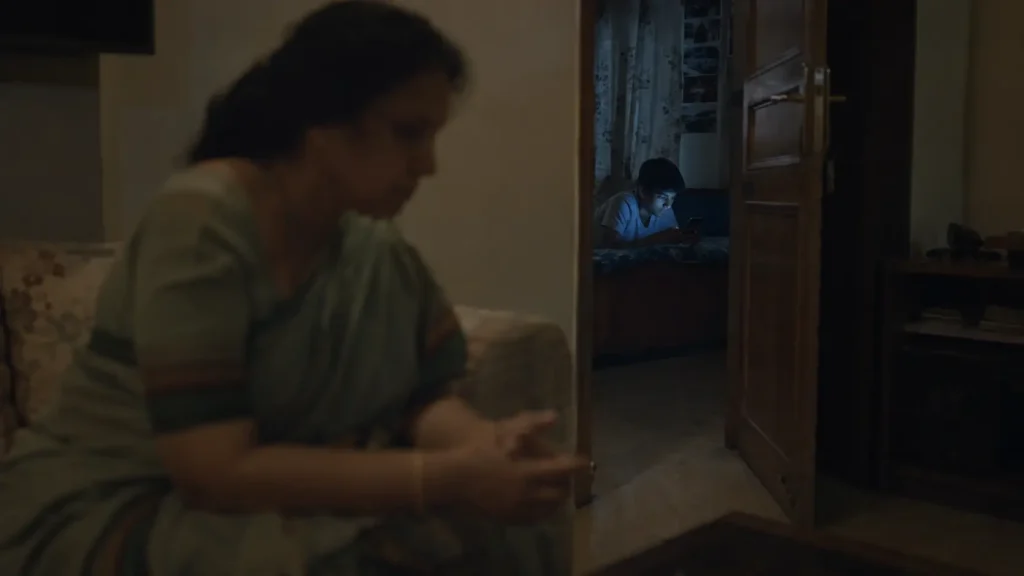
- A child can attend school every day and still not know how to study on their own.
- A child can sit in coaching and still copy without understanding.
- A child can watch learning videos and still fall into games, reels, unsafe websites, or random browsing.
This is where parents get trapped. From the outside, everything looks fine. The child is enrolled. The child is attending. The child has a device.
But access is not guidance. Attendance is not learning.
And a screen without direction is not education. It is a door. It can open into learning, but it can also open into complete distraction.
This is why many parents are looking for peace of mind. They want to know:
- Is my child safe?
- Is someone watching the learning process?
- Is the computer being used to make something, or just to waste time?
These are not small worries. In 2024, the Ministry of Education issued strict guidelines for coaching centres, emphasising counselling systems and age limits.
That does not mean every coaching centre is bad. It means extra classes alone are not enough when children are under pressure.
Little progress is what keeps a child coming back
Look at Kailas Sudheer from Thrissur.
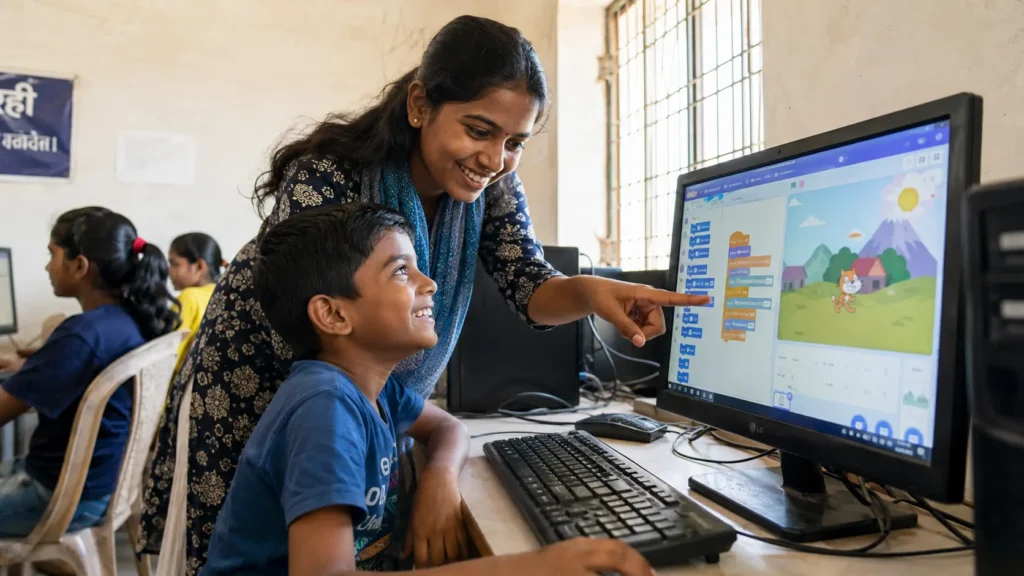
He joined the ATMA Foundation in October 2025. He did not begin with some big speech about coding or his career. He began with basic computer skills.
Small things. Trying. Asking the mentor. Seeing something work on the screen. Then asking one more question.
That part matters. For many children, learning becomes fun only after they get one small win. Not a certificate. Not a rank. Just a moment where they feel, “I can do this much.”
Kailas kept going.
Computer basics became design → Design became Scratch → Canva → Photoshop → basic Python.
He is seven.
But the point is not that every 7-year-old should learn Python. Please no! The point is that curiosity needs a place to survive.
At home, curiosity disappears inside noise, phone use, and homework pressure. In a massive class, curiosity does not get enough time. But in a small learning space, a mentor notices the child is asking again. A computer becomes a tool, not a toy.
Even after school reopened, Kailas’s learning did not stop. He still came back to practice.
That is the part parents should notice. The routine. The return. And most importantly, the child choosing to try again.
Marks show the result but not the wound
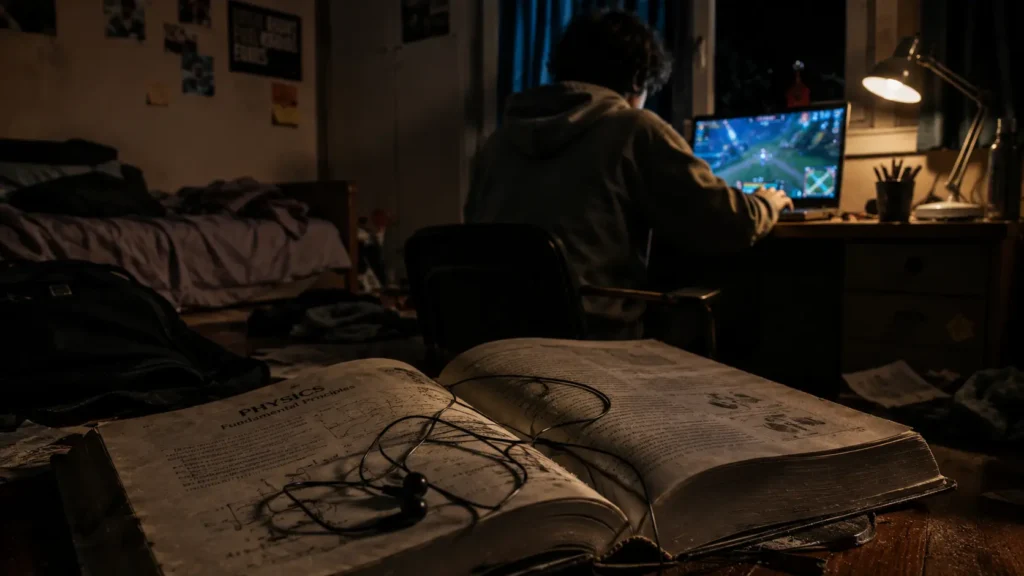
When a child scores low, adults usually ask, “Why did you not study?” Sometimes that is the wrong question.
The better question is: Where did the child stop?
- Did they stop because the topic was hard?
- Because nobody corrected the mistake?
- Because they felt ashamed to ask?
- Because the phone was easier than the book?
Marks show the result. They do not always show the wound that caused it.
A coaching centre may explain the chapter again. That helps.
But what if the child’s real problem is not the chapter? What if the real problem is fear? Or distraction? Or no one checking the child’s screen?
Then more teaching is not enough. The child needs a place where the learning process is visible.
This is what a learning POD changes
An Apni Pathshala POD is not a fancy corporate room. Do not imagine glass walls and shiny branding.
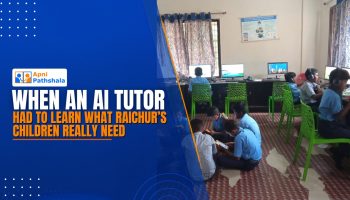
Think of a modest room. Desktop computers. Children asking questions. Screens being shared. A mentor leaning over a keyboard.
Something like this
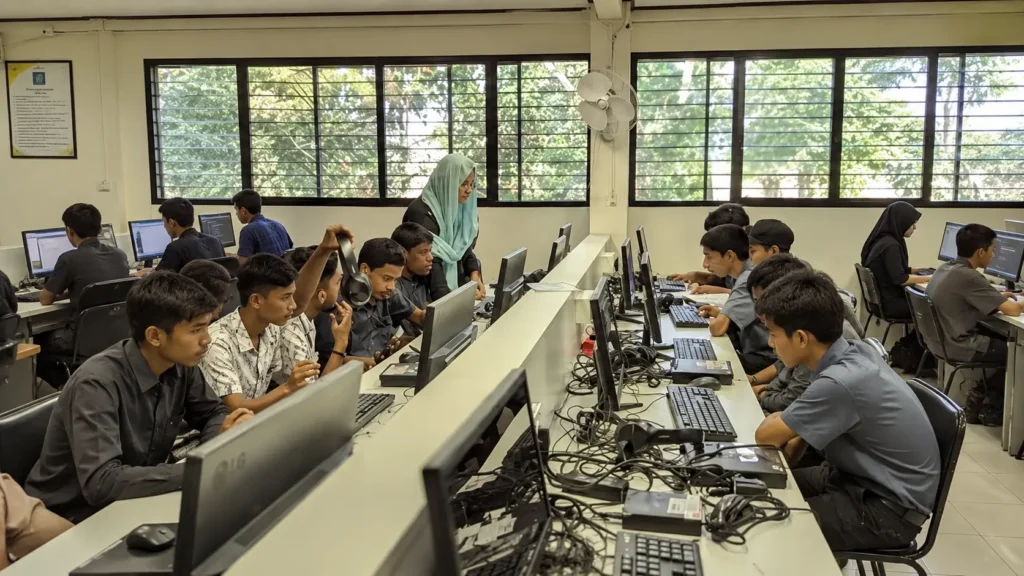
But the real value is not the furniture. The value is what happens inside:
- A fixed time after school.
- A mentor checking the child’s screen.
- A doubt that does not get laughed at.
- A computer used for making, not wasting time
A child who cannot quietly disappear into the back row.
Why Safety is Part of Learning
Many parents worry about safety before they worry about the syllabus. They just don’t say it openly.
A child’s learning can break because of pressure. It can also break due to a lack of routine, a lack of a safe adult, and too much unfiltered screen time.
A study from the National Library of Medicine found that 44.45% of coaching students had high academic stress, fueled by intense parental expectations, social isolation, and weak mental health support.
The enemy is a system in which the child is under pressure but not closely supported.
A POD cannot magically solve every problem. But it can create a safer layer. A known room. Known mentors. Known devices.
Children do not only need freedom. They need guided freedom.
That is why Apni Prerna’s safe digital learning approach matters. Do not just give a child a screen. Give the child a screen with purpose, rules, and someone nearby.
Students Learn When They Use the Skill
Children study many things for years, but still cannot use them.
English is the easiest example. A child may study English for ten years and still freeze while speaking. Why? Because language becomes real only when life demands it.
Learning works like that. If a skill stays only inside a book, it stays weak.
If a child uses it to make, speak, write, solve, design, explain, search, or earn, it becomes stronger.
A good learning centre should not only ask, “Which chapter is complete?”
It should ask these 3 questions.
- Can the child use what they learned?
- Can the child try it without fear?
- Can the child build something from it?
A Small Proof From Another Student
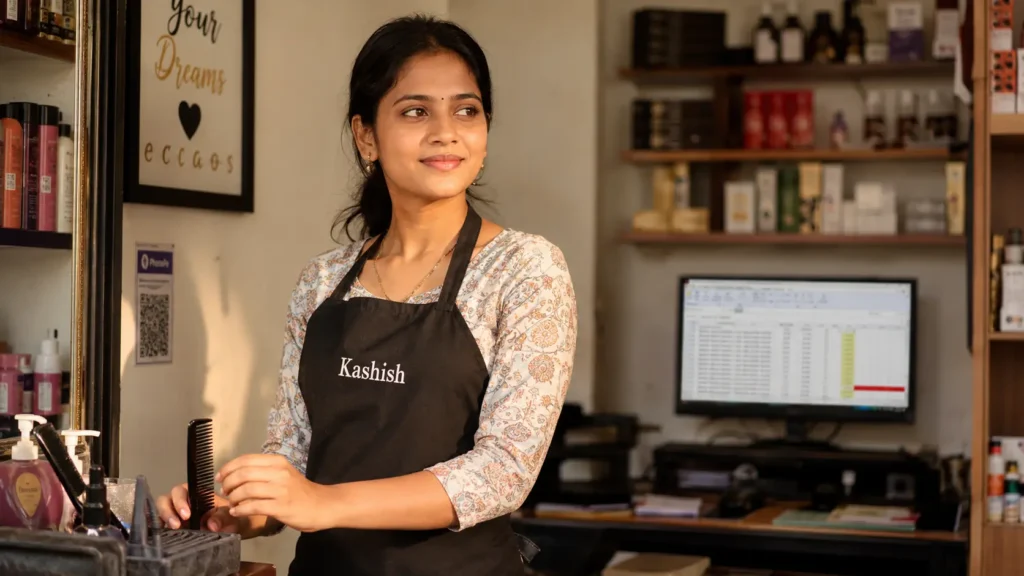
Kashish comes from a rural farming family. She is the eldest, so responsibility came early.
She completed basic computer courses at Chachua Education Point. With those skills, she got a job as a Computer Operator. Then she used her earnings to complete a beautician course. She is now working professionally in the beauty industry.
This matters because it shows the longer path. A child may begin with basic computer learning. A student may later use those skills for work.
Not in one magical jump. Step by step.
And to be honest, that is the only honest way.
What Parents Should Ask Before Choosing a Coaching Centre
Before choosing any centre for your child, ask the real concerns.
Usually, those are the “intrusive thoughts” that manifest as fear, doubt, and a constant need for reassurance.
- Will someone notice if my child is only pretending to understand?
- Is the screen controlled and guided?
- Are other children learning seriously around my child?
- Will mistakes be corrected without shame?
And the biggest question:
Will this place teach my child, or will it also notice my child?
A coaching centre helps when the main need is subject teaching.
But if the problem is screen distraction, low confidence, lack of feedback, or no one closely checking the child… your child needs something more.
A POD is built for that missing model.
The Better Model is Quieter
A better education model does not always look big.
Sometimes it looks like a room after school. A child sitting at a computer. A mentor checking the screen. A safe device.
A small win. Then one more. And one more…
That is how a child comes back on track. Fear and shouting never made someone better. It always makes the situation worse.
If you are a parent looking for an alternative, Apni Pathshala can help you understand what a learning POD could look like for your child.
As a safer room with better routines. And someone who notices before the child slips too far from learning.
Read Next
If this made you think about who is watching your child after school, the next question is just as important:
Are we helping children so much that they never learn to handle life on their own?
Read our previous blog: The Life Skills Indian Students Don’t Learn Until It’s Too Late.
Frequently Asked Questions
1: What are the most important life skills for Indian students?
Ans. Clear communication, digital literacy, problem-solving, and the ability to handle responsibilities without constant adult help are essential for life beyond exams. Learn more about these missing skills.
2: Why do many students lack practical skills?
Ans. The education system heavily rewards marks, and well-meaning parents often step in too quickly. This accidentally steals the “responsibility reps” children need to build true independence.
3: What does real digital literacy look like for students?
Ans. It is more than just using apps. It is knowing how to create documents, write professional emails, verify online sources, use AI responsibly, and make safe, informed decisions online.
4: How do Apni Pathshala PODs help students build life skills?
Ans. PODs provide a guided, safe space to practice independence. Students use computers and AI tools alongside mentors who encourage them to ask questions and solve problems themselves, building real confidence.


4 Responses
nice
Thank you! Glad you liked it.
A thoughtful article that reminds us every child needs attention, guidance, and encouragement—not just another classroom. A valuable read for every parent!
The best learning happens when every child feels seen, supported, and encouraged.