We have all seen the posters.
We have heard slogans like Beti Bachao, Beti Padhao. In India, we say that educating a girl is like educating an entire family. And it is true.
When a girl goes to school, the country’s future changes.
She marries later. She has healthier children. She earns money and invests it back into her community.
But if we all agree that girls’ education is so important, why is India still struggling? Why do so many girls drop out after Class 5 or Class 8?
If you ask a politician, they might talk about “mindset” or “culture.”
They might say parents in villages don’t want to educate their daughters.
But that is a myth. The truth is much simpler, and much more uncomfortable.
The problem isn’t that parents don’t care.
The problem is that our school system was designed for the convenience of the government, not for the safety of the girl child.
Why Do Girls Drop Out of School in India?

It is very easy to print a poster. It is very hard to build a safe world.
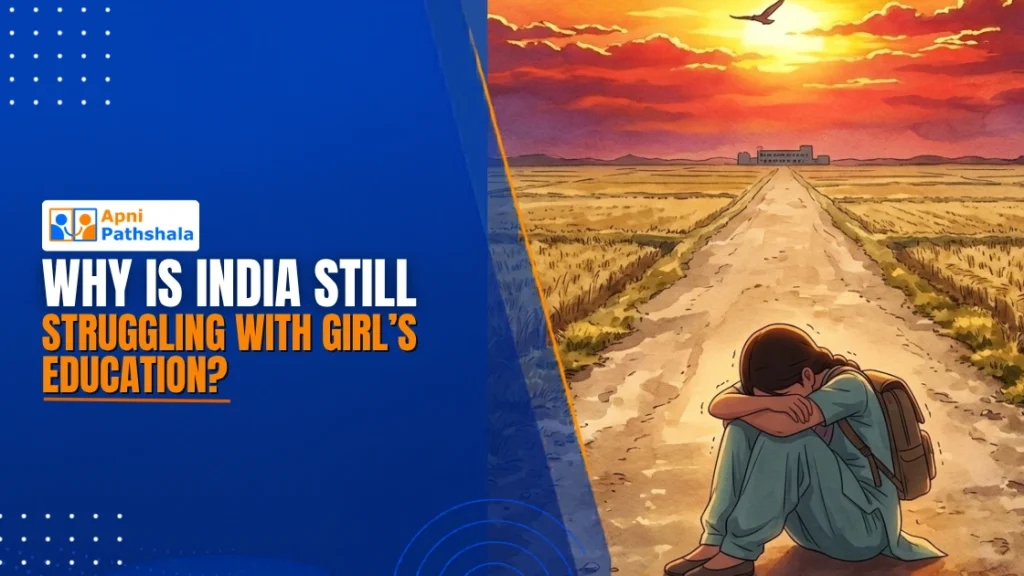
Despite all the government schemes, the ground reality in many parts of India has not changed enough. We focus on “enrollment”, which just means putting a name on a register. But we forget to look at the daily life of a 13-year-old girl.
Here are the real barriers she faces every single day:
- The Distance Trap: In many villages, the primary school is nearby, but the high school is 5 or 10 kilometres away.
- The Safety Fear: A long walk down a lonely road is risky. Parents worry about harassment or “Eve-teasing.”
- The Dignity Gap: If a school lacks a clean, working toilet with water, a girl cannot attend school during her periods. She misses one week every month.
Eventually, she just stops going.
We have a Design Problem.
We built a system that ignores the reality of the people it is supposed to serve.
Why Indian Parents Keep Daughters Home From School?
There is a common story that Indian parents are “anti-education.” This is wrong.
Most parents are actually “Risk Managers.” They are trying to keep their children safe. Think about it.
Would you send your daughter to a faraway building if there is no safe transport, no supervisor, and no toilet?
Of course not. You are not being “traditional”, you are being protective.
Instead of blaming parents for keeping their girls at home, we should ask: Why are we forcing them to choose between safety and education?
Why Are Government Schools Failing Girl Students in India?
We often think that if we build a big concrete structure and call it a school, learning will magically happen.
But a building is just bricks. Real learning is a process.
Government schools are often designed for “Scale.” This means they try to fit thousands of kids into one system. This results in:
- Crowded Classrooms: One teacher trying to manage 60 students. No one gets personal attention.
- Boring Curriculum: Lessons that feel like they have nothing to do with real life.
- The “Attendance” Lie: We celebrate because 90% of kids are in the building, even if 0% of them understand the lesson.
When school feels like a place where you are just a number, and it is hard to get to girls, they quietly exit.
If the system does not respect the student, the student leaves the system.
How Community Schools Are Solving the Girl Education Crisis
If the big school system is broken, we should stop trying to “fix” it with more bricks. We need a better model.
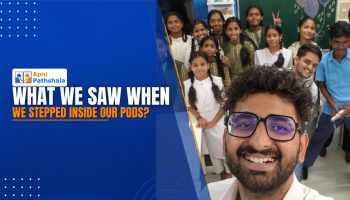
This is where Community Micro-schools come in. At Apni Pathshala, we call these PODs.
A micro-school is not a giant building far away. It is a small, safe learning space right inside the neighbourhood.
It is a “School that fits the child,” instead of forcing the child to fit the school.
How Micro-schools Fix the Problems:
- No Commute: Learning happens within the community. Parents don’t have to worry about the walk.
- Trusted Environment: The POD leader is a local person known to the parents.
- Small Groups: Instead of 60 kids, there are 10 or 15. Every girl is seen and heard.
- Personalised Pace: No one is “left behind” because the teacher moved too fast.
How AI Tools Are Helping Girls Learn Without Judgment
In a traditional classroom, many girls feel shy.
They are afraid to raise their hand and ask a question because they don’t want to look “stupid” in front of the boys or the teacher.
This is where technology like Eklavya AI changes everything.
Eklavya AI currently supports 5 sections: NEET, JEE, Maharashtra Board, CBSE Board, and Karnataka Board.
With an AI tutor:
- Zero Judgment: The AI never gets angry if you ask the same question ten times.
- Adapts to the Learner: If a girl understands Math quickly but struggles with Science, the AI adjusts its pace to match her.
- Active Learning: Instead of just listening to a lecture, the student interacts with the machine.
For a girl who has been told to stay quiet her whole life, having a tool that listens to her and helps her grow is like a friend who understands everyone in the group.
Are Small Schools Better Than Government Schools for Girls?
People often ask: “But how can a small micro-school be as good as a big school?”
The truth is, many big schools have zero quality control.
In a micro-school:
- Standardized Support: Tools like Eklavya AI ensure that every student gets the same high-quality explanations, whether they are in a city or a small village.
- Community Power: Because the school is local, parents can see exactly what is happening every day.
- Real Data: We track actual learning, not just who showed up for roll call.
We don’t need one giant machine. We need a “Network of small nodes.”
Thousands of small, safe, high-quality Apni Pathshala PODs across India can educate more girls than a few giant universities ever could.
The Bigger Vision: Lifelong Learners
Our goal is not just to help a girl “finish school.” A certificate is just a piece of paper.
The real goal is to create Independent Learners.
We want girls who can think for themselves. Girls who know how to search for information. Girls who are curious, not just compliant.
If you design education for the convenience of the government, you get dropouts.
If you design education around a girl’s needs, you get a leader.
Educating a boy helps one person. Educating a girl upgrades an entire ecosystem.
It is time we stop building buildings and start building futures.
Conclusion
The struggle with girls’ education in India isn’t because we lack the money or the slogans. It’s because we lack the right design. By bringing learning into the community and using technology to personalize it, we can finally break the barriers that have held our daughters back for decades.
If you want to see a POD in action or help start one in your area, visit apnipathshala.org.
Frequently Asked Questions (FAQ)
1. Why is a single offline exam like NEET creating so much panic among students?
Ans: A system where a three-hour exam decides your whole life is not a test of intelligence; it is a test of obedience. When paper leaks happen, it destroys the hard work of honest students.
2. How is Apni Pathshala helping students in underserved communities across India?
Ans: Apni Pathshala is building community-based digital learning centres where students can access computers, digital skills, future-ready education, and guided learning opportunities regardless of their background.
3. How can Eklavya help students prepare better for exams?
Ans: Eklavya gives students AI-powered study support for JEE, NEET, NCERT, UP Board, and Maharashtra Board. It helps them understand concepts clearly, revise more effectively, solve doubts faster, and study with proper direction rather than confusion.
4. Why is continuous digital learning safer than one final exam day?
Ans: In a POD, students do not cram for one single day. They learn every day using tools like Eklavya AI that track progress chapter by chapter. If you test continuously, there is no pressure of a single “leak” destroying your life. You build your skills over time.