

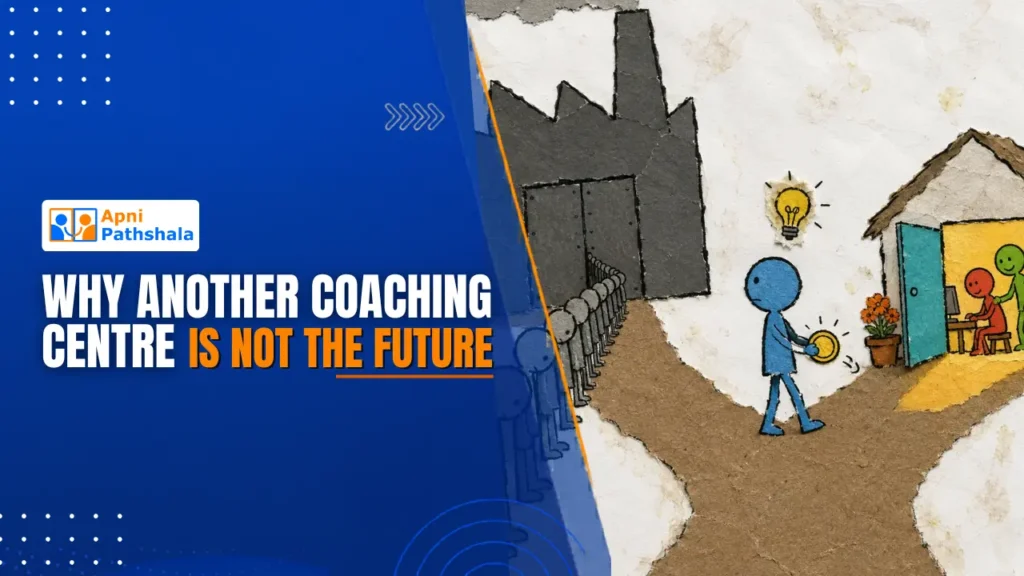
Someone somewhere in India is planning to open an educational business today.
Maybe a tuition class. Maybe a coaching centre. Maybe a computer institute with three banners, two fans, and one chair that has survived many governments.
At first, the plan feels simple.
Find a room. Add a board. Add computers. Print a banner that says “future-ready skills” in bold red letters.
Very official.
But many entrepreneurs feel stuck before they even start.
Big coaching brands already took offline learning. Big edtech apps already took online learning. YouTube is free. Courses are cheap. Parents are careful. Students are distracted.
So what is left?
A lot, actually.
Why the Old Coaching Centre Model Is Getting Tired?
For years, the education business in India had a simple shape.
A classroom. A teacher. A batch. A fee.
This worked because parents had one big worry: marks
So coaching centres grew. Tuition classes grew. Computer institutes grew. Every street slowly became a small education bazaar with motivational posters and confused children.
Some of it helped.
But the market has changed. IBEF says India’s education market may reach US$313 billion by FY30, up from US$117 billion in FY23. So demand is still growing. The shape of demand is changing.
Parents no longer ask only, “Will my child pass?”
They also ask, “Will my child become confident?”
And also, “Will my child use technology properly?”
And also, “Will someone guide them, or will they just watch one more video called ‘Top 7 Study Hacks’ and then forget their own name?”
Tiny disaster.
Meet the Big Giant Shadow
Many new entrepreneurs see giant brands and panic. Let’s call this the Big Giant Shadow.

The Big Giant Shadow has one job: make small people feel late.
It whispers:
“Too late. Market captured. Go sell momos.”
But the shadow is lying a little. Big brands are good at reach. Apps are good at content. Coaching chains are good at scale.
They are not always good at local trust.
And in education, local trust is not a small thing. It is the whole engine hiding under the bonnet.
Parents Buy Relief.
A parent does not wake up thinking, “Today I need a learning centre business with digital infrastructure.”

No. They think:
- “My child is wasting time.”
- “My child has a phone but no direction.”
- “My child knows how to scroll, but can they build anything?”
This is the gap.
A student may have internet access, a school account, YouTube, and apps.
Still, they may not have a place where someone says, “Come here. Sit. Learn this. Finish this. Show me what you made.”
That sentence is simple. It is also a business opp
A Computer Institute Business Needs an Upgrade
A computer institute business can still work.
But the old version is weak now.
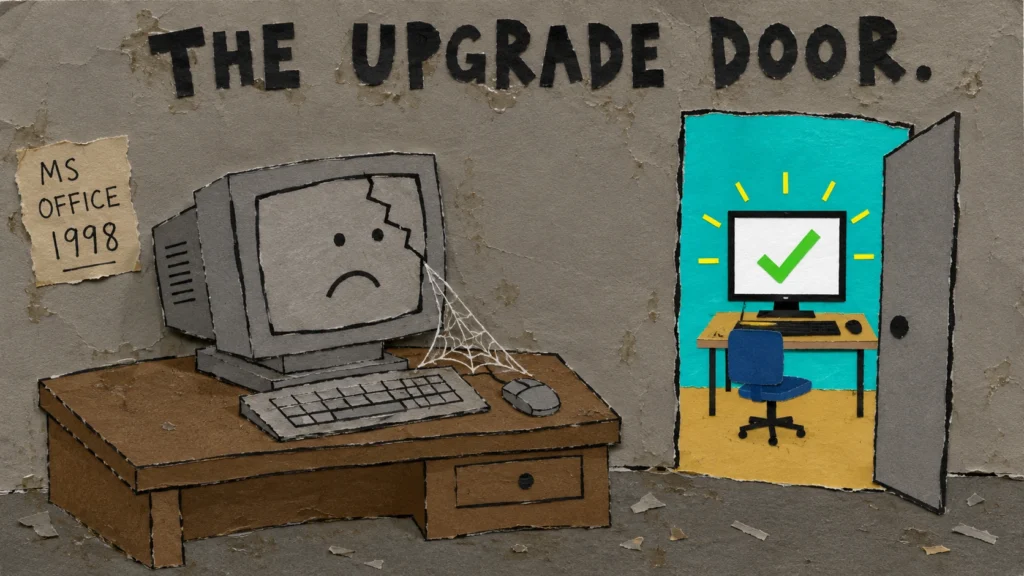
Basic typing, MS Office, and certificates are useful. But students need more.
They need digital confidence. They need communication. They need creativity. They need coding basics. They need safe internet habits. They need guidance from someone who can see when they are lost.
Otherwise, the computer becomes a shiny box for random clicking.
Very modern. Very sad.
The New Model: Local Learning Centres
The future belongs to centres that mix four things:
1. Local trust
Parents trust people they can meet. A local centre has a face, a room, and a person who answers the phone. That matters.
2. Digital tools
Students need computers and guided digital learning. Not random screen time. Guided screen time.
3. Skill-based learning
The National Education Policy brought the 5+3+3+4 structure and pushes more flexible, skill-focused learning. That means parents will slowly expect more than marks.
They will want skills that look useful outside exams.
4. Human guidance
Apps can teach. A mentor can notice.
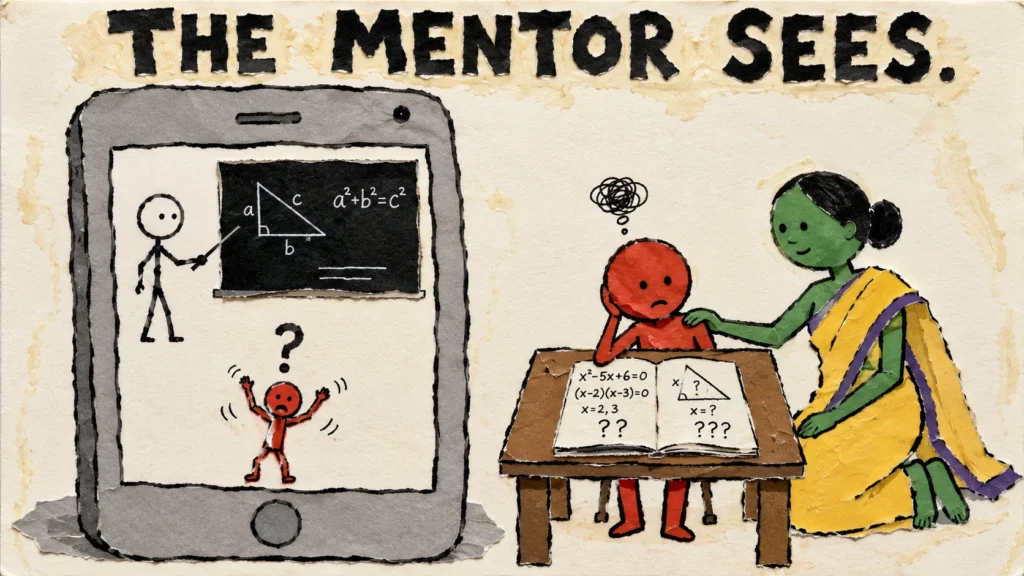
That difference sounds small until a child quietly stops learning for three weeks. Then it becomes the whole movie.
If you don’t understand the importance of a mentor, read how a 7-year-old Kailas learned to do animation in apni pathshala pod.
The Best Education Business Ideas in India Will Feel Smaller
This sounds strange.
But the next strong education business idea may not look like a huge campus. It may look like a small local room with computers, structure, mentors, and clear learning paths.
- A place where students come after school.
- A place where parents can ask questions.
- A place where technology does not run wild like an unsupervised monkey with Wi-Fi.
This is why a learning centre business is interesting.
It can stay local and still be affordable. On top of this, it can build trust faster than an app ad yelling at you on Instagram.
So Where Does Apni Pathshala Fit?
Apni Pathshala helps people start PODs.
Now the obvious question
WHAT IS POD?
A POD is the place parents wish existed after school: safe computers, guided practice, and mentors who notice before their child slips away.
It is a small, local digital learning centre started by individuals, community leaders, or anyone who sees a gap in the current education system.
Students get access to computers, learning tools, mentorship, and digital skills.
That is useful for entrepreneurs who want to enter the education sector without having to build everything themselves. You bring the local space and commitment.
Apni Pathshala brings support, systems, tools, and a learning model.
No giant cape required.
Education Business Ideas in India
What is the future of the education business in India?
The future looks local, digital, skill-based, and trust-driven. Parents want results, but they also want safety and guidance.
Is an education business profitable in India?
Yes, it can be.
But weak centres die fast. Strong centres earn trust first; money then follows more naturally.
Is a learning centre business better than coaching?
It depends on the model.
A learning centre can teach digital skills, creativity, communication, and practical learning. Coaching usually focuses more on exams.
Is a computer institute business still a good idea?
Yes, if it grows beyond basic computer classes. Students need useful digital skills, not only certificates.
Final Takeaway
The future of the education business in India will not belong to the loudest brand.
It will belong to the most trusted local centre.
The centre that helps students use technology well. The centre that gives parents relief.
Still small. Still local. But very much alive.
Keep Reading on Apni Pathshala:
- The Life Skills Indian Students Don’t Learn Until It’s Too Late
- Why Long Study Hours Don’t Guarantee Real Learning?
- 3 Learning Secrets Video Games Know That Schools Don’t
Now, you want to start a learning centre that helps students learn safely, build digital skills, and grow with guidance?
Explore Apni Pathshala’s POD model and start a POD in your community.
Frequently Asked Questions
1: What is the future of the education business in India?
Ans. The future is local, digital, skill-based, and trust-driven. Parents want results, but they also desperately want safety and guidance for their children.
2: Is an education business profitable in India?
Ans. Yes. But weak centres die fast. Strong centres earn trust first, and the revenue naturally follows.
3: Is a learning centre better than a coaching class?
Ans. It depends. Coaching focuses strictly on exams. A learning centre focuses on digital skills, creativity, communication, and practical, real-world learning.
4: Is a computer institute still a good idea?
Ans. Yes, but only if it evolves. Basic typing classes are dead. Students need practical digital literacy, AI tools, and genuine mentorship to succeed.




5 Responses
nice vlog
appreciate your support!
A thoughtful perspective on how education is evolving. Focusing on skills, mentorship, and personalized learning makes this a valuable read. Well explained!
The future belongs to learning communities, not just coaching classrooms. Great perspective!
The best learning happens where students are guided, supported, and inspired not just taught.