A student can hear someone say, “You can do it,” a hundred times.
Sometimes it changes nothing.
Then they see another student: someone their own age, from a similar background, who started with the same doubts: actually doing it.
Suddenly, the sentence feels different.
“If they can do it, maybe I can too.”
That small shift can change how a student thinks about what is possible.
We Often Underestimate the Power of Seeing
Education usually tells students what they should aim for.
A teacher talks about careers. A textbook introduces professions. A counsellor explains different options.
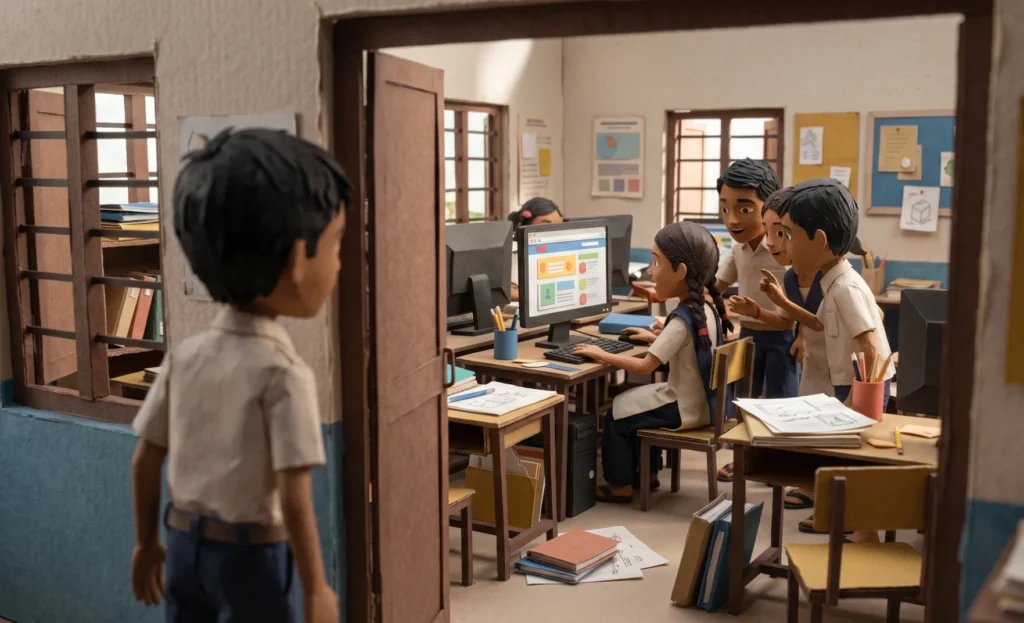
But seeing a real person who has already taken that path feels different.
A student interested in coding may understand programming better after meeting someone who builds websites.
A child who is afraid of speaking may become more confident after seeing another student lead a session.
Someone unsure about continuing their studies may think differently after hearing from a person who faced similar difficulties and still moved forward.
A role model makes an abstract possibility feel real.
Research published in The World Bank Economic Review found that a brief 20-minute interaction with female engineering students serving as role models increased interest in engineering and led to higher application and enrolment rates among some high-school students.
That is a surprisingly powerful result from a very simple intervention.
The Role Model Does Not Have to Be Famous
This is perhaps the most important part.
A role model does not have to be a celebrity, an IIT graduate, or a successful entrepreneur.
Sometimes the most powerful role model is the person sitting at the next computer.
They may be only two years older.
They may live in the same neighbourhood.
They may have struggled with the same subject.
They may have started with almost no experience.
But now they know something you want to learn.
That makes their success easier to imagine.
Apni Pathshala has seen this transformation through students who eventually became mentors themselves. In the Students Who Became Mentors story, students who originally joined to learn gradually started teaching, guiding and supporting other learners.
The interesting part is that they did not join thinking, “I am going to become a role model.”
They simply started learning.
Sometimes the Person Next to You Is the Inspiration You Needed
Consider a student who has never created a website.
They see another learner building one.
The first reaction may be:
“How did they do that?”
Then comes another thought:
“Can I learn it too?”
That second question is important.
The role model has not taught a lesson yet.
They have changed the student’s expectation of themselves.
This is especially valuable for students who have limited exposure to different careers and possibilities.
A 2026 experimental study involving 1,920 students across five middle schools found that different types of role models can affect students differently. Higher-achieving role models improved academic performance, while moderately achieving role models showed benefits for some measures of stress and well-being. Academy of Management Journals
So the answer is not simply “show students the most successful person.”
Show them someone whose journey they can understand.
Inspiration Becomes More Powerful When It Is Followed by Action

Seeing someone succeed is only the beginning.
The student still has to take the next step.
Try the skill.
Ask the question.
Make the first project.
Fail.
Try again.
This is where a learning community becomes important.
At Apni Pathshala, students can learn from people around them, work together and gradually move from being learners to helping others.
One of our older students’ journeys, From Learner to Leader, shows this transition clearly: a student who began with limited digital exposure gradually became confident enough to support other learners.
The story is not really about one student’s achievement.
It is about what happens when one student’s progress becomes another student’s starting point.
Mentoring Is Not Always About Giving Advice
Good mentoring is often much simpler than people imagine.
It can be:
“I struggled with this too.”
“Try it this way.”
“Don’t worry, I made the same mistake.”
“Let me show you what I learned.”
That kind of conversation can make learning feel less intimidating.
A 2026 review of mentoring research found that mentoring can influence educational attitudes and behaviours such as academic engagement, grit and growth mindset. MDPI
The relationship matters because students are not only receiving information.
They are seeing how another person approaches problems.
Students Need People They Can Imagine Becoming
This is particularly important when students are thinking about their future.
If a child has never met a programmer, becoming one can feel distant.
If they meet a student from their own community who is learning to code, the distance becomes smaller.
The same applies to design, teaching, entrepreneurship, research, writing or any other path.
A role model does not guarantee success.
But they can make the first step feel possible.
Research on online role-model mentoring has similarly found improvements in students’ beliefs about the returns to effort, aspirations and school effort among participating middle-school students.
A Learning Community Can Create Its Own Role Models

This is where the idea becomes bigger than one mentor.
Imagine a learning space where older students help younger ones.
A learner who has completed one level supports someone just starting.
Someone who has built a project shows another student how they approached it.
Over time, the community creates its own examples of what is possible.
That is one of the ideas behind Apni Pathshala’s Learning PODs.
A Learning POD can become a place where students see other learners progressing around them, exchange knowledge and gradually take on new responsibilities.
The result is not simply better access to learning.
It is a culture where learning becomes visible.
The Best Role Model Might Be the Student Who Was Struggling Yesterday
We often imagine role models as people who have already reached the finish line.
But students may learn just as much from someone who is still on the journey.
Someone who says:
“I didn’t know this six months ago either.”
That sentence can be more powerful than a success story.
It tells the learner they don’t need to be exceptional to begin.
They just need to begin.
Give Students Someone to Learn From and Become
Education becomes more powerful when students can see knowledge being used, confidence being built, and possibilities becoming real.
A teacher can explain a career.
A textbook can describe it.
But a person who has actually started that journey can make it feel reachable.
At Apni Pathshala, this is one of the ideas behind community-based learning: students should not only receive knowledge. They should have opportunities to see, practise, contribute and eventually guide someone else.
If you are a student, look around your own learning environment. Who is one person whose journey makes you think, “Maybe I can do that too”? Start by asking them how they began.
If you are a parent, teacher, NGO or community leader, think about the students who have never had someone relatable to look up to. Give them that connection.
And if you want to create a learning environment where students can learn alongside people who are a few steps ahead of them, learn more about Apni Pathshala and the communities being built around learning.
Sometimes a student’s biggest breakthrough doesn’t begin with a new lesson.
It begins when they finally see someone like them doing something they once thought was impossible.
Frequently Asked Questions
1. Why are role models important in education?
Ans. Role models can make future possibilities feel more realistic for students. A World Bank Economic Review study found that a brief interaction with relatable engineering role models increased interest and, for some students, later applications and enrolment.
2. Can mentoring improve student motivation?
Ans. Yes. Mentoring can influence academic engagement, attitudes, growth mindset and students’ approach to learning. A 2026 review of mentoring research examined its influence on educational attitudes, beliefs and behaviours.
3. Does a role model need to be highly successful?
Ans. Not necessarily. 2026 experimental research on role models found that different levels of role-model success can produce different effects, suggesting that the right role model depends on the student’s needs and the programme’s purpose.
4. How can students become role models for others?
Ans. Students can start by sharing what they know, helping another learner, explaining a concept or showing how they solved a problem. Apni Pathshala’s student-mentor journey shows how learners can gradually grow into mentors themselves.