Most Indian parents are doing everything “right.”
Good school. Extra tuition. Long study hours.
And yet, thousands of degree-holding students are sitting at home today with no real skills and no clear future.
This is not because parents didn’t try hard enough.
It’s because the old education formula has quietly stopped working.
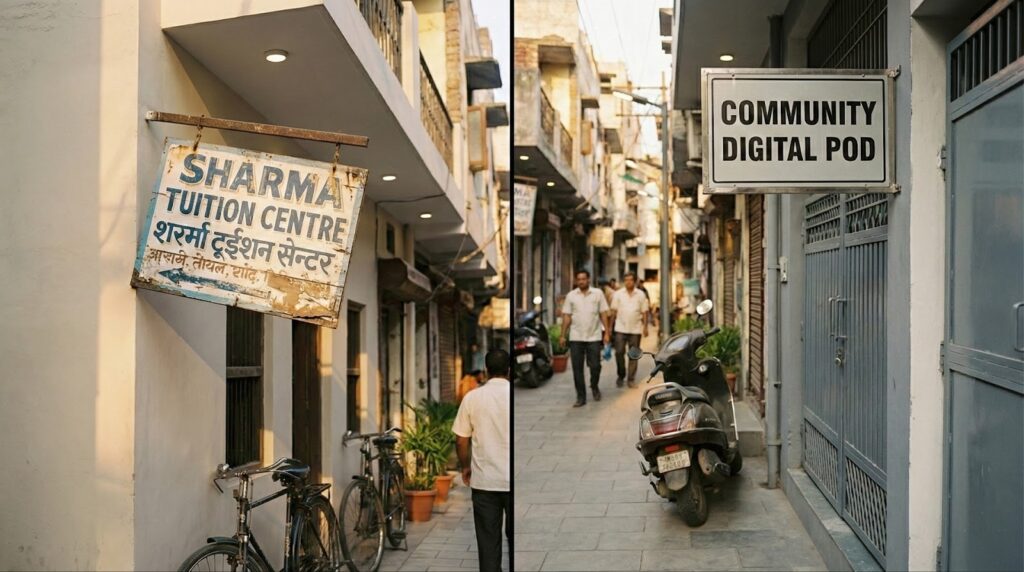
Walk through any neighbourhood in a Tier-2 or Tier-3 city in India today, and you will notice a change. Ten years ago, every second building had a board that said “Coaching Centre” or “Tuition Classes.” Today, new boards are appearing.
They say “Digital Learning POD,” “Self-Study Zone,” “Digital Library,” or “Community Centre.”
You might be seeing them in your own colony. You might be hearing other parents talk about sending their children there instead of to traditional tuition.
This begs a very important question.
Why is this happening?
Is this just a new trend?
Is it a craze?
The short answer is NO.
The rise of the Community Learning Centre (CLC) in India is not a trend. It is a market correction and a much-needed one.
Parents are waking up to a hard reality:
The old formula :- Go to school + Go to tuition = Get a job
This is simply not working anymore. I have articulated four honest reasons why thousands of Indian parents are shifting their trust (and their children) to Community Learning Centres.
1. Why a Degree No Longer Guarantees a Job
In 2010, parents paid for tuition for one reason: To get good marks. We believed that good marks led to a good college, and a good college led to a safe job.
But in 2026, we all know a family with a child who has a B.Tech or a B.A. degree but is sitting at home, unemployed. They have the certificate, but they don’t have the skills to work in a modern company. This has caused a massive shift in mindset.
Parents are realizing that marks are a receipt, but skills are an asset. Tuition centres are designed to produce marks. They teach students how to memorize definitions of HTML or Python.
A Community Learning centre (CLC) is designed to produce skills.

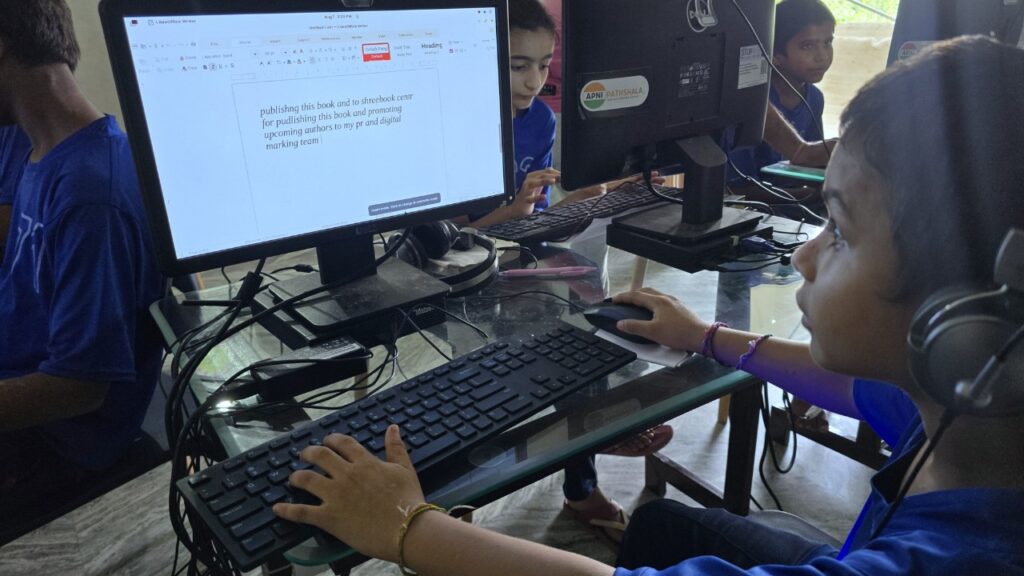
At ApniPathshala, students don’t memorize the definition of a website; they build one. They don’t write essays about technology; they use Apna PC to write code, build skills which are required in the current modern AI era.
Parents are choosing CLCs because they want their children to have a portfolio of work, not just a report card. They want “Employability insurance.”
2. Why “Near” is Better Than “Far”
For a long time, “good education” meant “far away” education.
To learn computers or advanced skills, you had to send your child to a big institute in the city centre, 10 kilometres away. This creates anxiety.
Is the travel safe?
Is the environment safe?
Who are the other kids?
The growth of community learning centres in India is driven by a desire for safety. These centres, often called PODs are part of the “100 sq. ft. Revolution.” They don’t open in big commercial complexes. They open in your lane. They open in the spare room of a trusted neighbour.
This “Hyper-Local” model changes everything.
- The Mentor is Known: The person running the centre isn’t a nameless corporate employee. It is often a “Didi” or “Bhaiya” from the community whom you already know and trust.
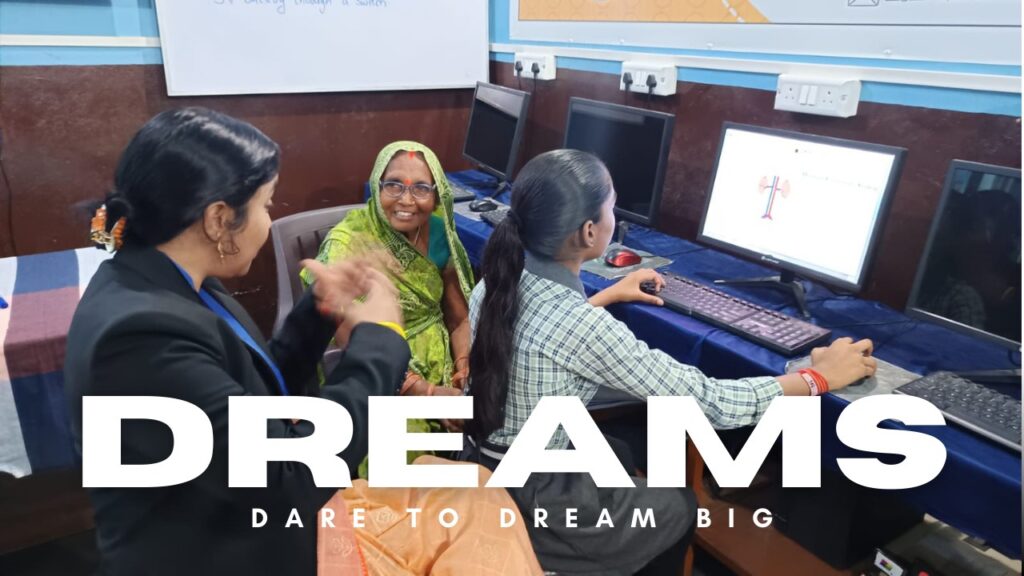
- The Commute is Zero: Your child can walk there.
- The Peer Group is Local: Your child is learning alongside friends they grew up with.
Parents are realizing that learning doesn’t have to happen in a distant ivory tower. It happens best where the child feels safest close to home.
3. Why Education No Longer Depends on Finding the “Perfect Teacher”
This is the most practical reason for the growth. Historically, small towns and villages suffered because the “best teachers” moved to big cities. If you didn’t have a great physics or computer teacher in your village school, your child fell behind.
But technology has levelled the playing field. In an ApniPathshala POD, we don’t rely on finding a “Hero Teacher” who knows everything. We rely on a system.
We use Abacca OS (a specialized operating system) and intelligent platforms like Eklavya AI.
These tools are the “experts.”
- The local mentor provides encouragement and discipline.
- The technology provides a world-class curriculum.
This means a child in a remote village in Nagaland gets the same quality of learning as a child in Mumbai.
Parents are flocking to these centres because they realise they no longer have to wait for a “super teacher” to arrive in their town. The technology is already there; they just need a space to access it.
4. Why Affordable Education Doesn’t Have to Mean Low Quality
Finally, we must talk about money. Quality education has become shockingly expensive. International schools and high-end computer institutes charge fees that eat up a huge chunk of a family’s income.
The community learning centre in India solves this through the “Sharing Economy.” Because the space is local (low rent), and the Mini-PCs are among batches of students, the cost drops dramatically.
At ApniPathshala, there are no fees for learning any skill digitally. But here is the misconception: It is affordable, but it is not “cheap.”
Just like Linux is free. Wikipedia is free. In fact, the most powerful tools in the world are often the most accessible. We have been paying for the packaging( ads), not the product (content)
“Cheap” implies low quality. But because the curriculum comes from the internet and top-tier AI tools, the quality is actually higher than many expensive schools.
Parents are smart. They are realizing that in big institutes, they are paying for the air-conditioning, the glossy brochures, and the reception area. In a CLC, every rupee goes directly into the child’s access to technology.
It is simply a more efficient way to invest in education.
Returning to Village Wisdom
The reason Community Learning Centres are growing isn’t that they are a new, fancy invention. It is because they return to an old, trusted idea: It takes a village to raise a child.
This is not a foreign concept. It is what every Indian grandparent knew: ‘Bachcha akele nahi palta.’ (A child cannot be raised in isolation.)
In the past, the whole Mohalla (neighbourhood) watched over the child. The CLC is just the digital version of that old Choupal (a shared space where the community ensures no one falls behind)
For the last 20 years, we outsourced our children’s future to big, impersonal factories called “schools” and “coaching centres.” We hoped they would handle everything. Now, communities are taking that power back.
By combining the trust of the neighbourhood with the power of modern technology, CLCs offer a path that makes sense for the future. So, if you see a new board go up in your colony, don’t ignore it. It’s not just another class. It’s a sign that education is finally coming home.
Curious what this actually looks like in real?
We’ve explained how a Community Learning centre works, why it’s called the “third space” (after home and school), and why Indian students need it today.
👉Read the full guide to understand how Community Learning Centres are reshaping learning for Indian students.
And you can visit our site to learn how to start or support a POD near you.