There is a fundamental misunderstanding about how trust works in education.
For the last century, we have assumed that trust is tied to scale. We believe that a school with a massive concrete building, a fleet of buses, and a recognizable corporate logo is inherently trustworthy.
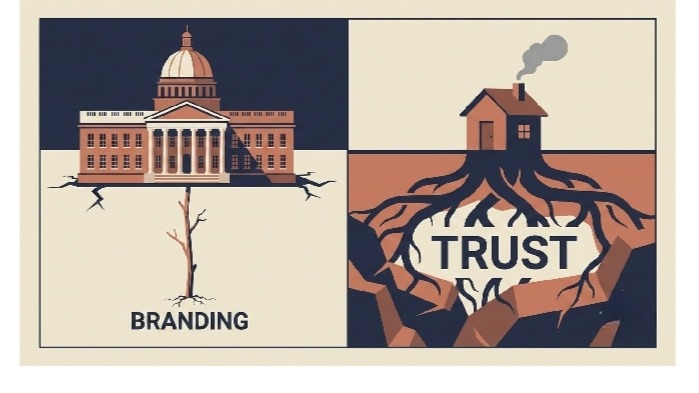
But this is not trust. This is branding.
Institutional branding is a psychological trick designed to mask a massive gap in accountability.
When a parent drops their child off at a sprawling, 2,000-student institution, they cross their fingers and hope for the best. They do not know the teacher. They do not know the principal. The relationship is transactional.
In contrast, community education models do not have the luxury of multi-million dollar marketing budgets. They cannot buy trust. They have to engineer it.
In an Apni Pathshala POD, trust is not a legal contract; it is a biological and social reality. Here is exactly how decentralized learning centres build an unbreakable architecture of accountability.
1. The Geography of Accountability (Proximity is Power)
Trust is inherently spatial. It degrades with distance.
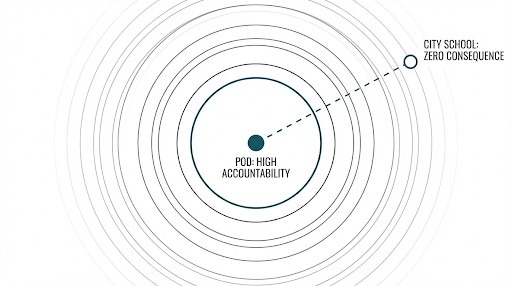
If a teacher lives 20 kilometres away from the school, there is no social consequence if a student fails to grasp a concept. The teacher clocks out at 5:00 PM and goes home to a different world.
A Community Learning centre operates on the principle of Hyper-Proximity.
A POD is located right in the student’s lane or neighborhood. When the learning environment is deeply embedded in the community, the “geography of accountability” shrinks.
If a child skips a session or struggles with a module, the mentor doesn’t send a formal email. They literally walk two doors down and speak to the parents. You cannot hide in your own neighborhood.
2. Skin in the Game (The Local Mentor)
Philosopher Nassim Taleb coined the phrase “Skin in the Game” to describe a simple truth: systems only work when the people running them share the risk of failure.
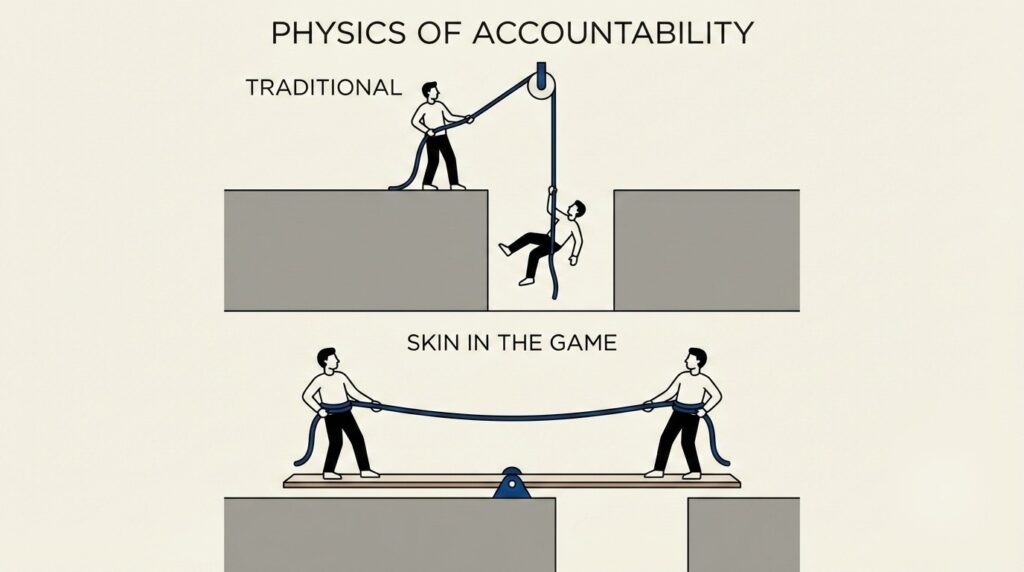
Traditional education lacks skin in the game. A salaried teacher gets paid whether the student becomes an engineer or drops out.
Community education models fix this by replacing the distant “Hero Teacher” with a Local Mentor a young adult (“Didi” or “Bhaiya”) from the exact same community.
This creates a powerful social dynamic. The mentor is not an outsider. Their reputation is directly tied to the success of the students in that 100 sq. ft. room.
If they fail the students, they don’t just face an angry principal; they face the students’ parents at the local grocery store. This shared social fabric creates a level of dedication and care that no corporate salary can ever buy.
3. Engineered Transparency (Systems > Promises)
Trusting “good people” is a fragile strategy. Good people have bad days. Sustainable trust requires Good Systems.
Parents are rightfully terrified of giving their children unsupervised access to computers.
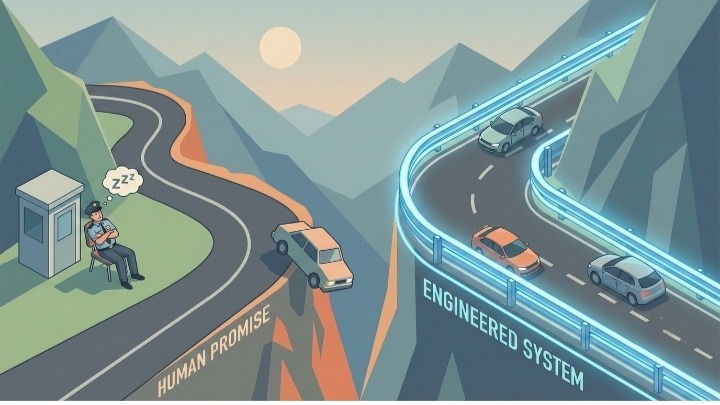
They fear the distractions of the internet. To build trust, Apni Pathshala does not just promise that the mentor will “keep an eye out.” We engineered the trust directly into the hardware.
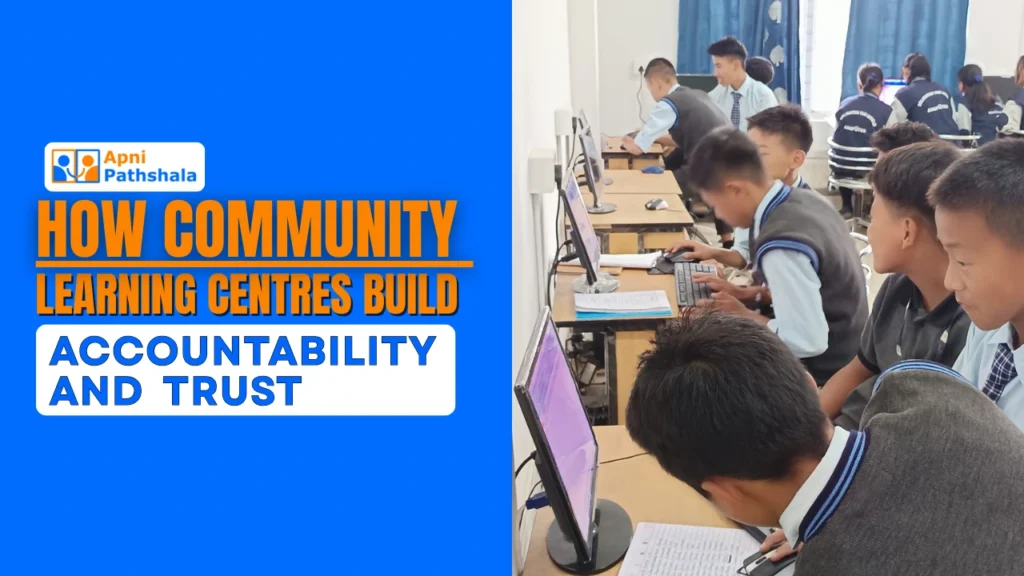
- Physical Transparency: PODs utilize an “Open Screen” layout. There are no cubicles. Every Apna PC screen is visible to the room. Sunlight is the best disinfectant.
- Digital Transparency: Every computer runs on Apni Prerna, our custom digital environment. It acts as a flawless, unbiased digital librarian, blocking distractions and unsafe sites at the root level.
Parents trust the POD because the system physically and digitally makes misconduct nearly impossible.
4. The Currency of Proof (Portfolios over Promises)
Finally, traditional education asks parents to trust a “Report Card”, a piece of paper with arbitrary numbers that means very little in the real world.

A student can score 90/100 in Computer Science and not know how to write a single line of functioning code.
Community learning models build trust through Proof of Work.
When a first-generation learner comes home from an Apni Pathshala POD, they do not bring a report card. They bring a smartphone, open a web browser, and show their parents the actual website they coded that afternoon.
When a parent sees the output. When they see the tangible, undeniable capability of their child, the trust is permanently cemented.
In a POD, when a student stopped attending sessions, the mentor visited the home that evening. The issue was not academic; it was a family health concern. The community adjusted the schedule. Attendance resumed the next week.
Conclusion: The Unscalable Advantage
Venture capitalists and bureaucrats love things that can scale easily. You can scale software. You can scale textbooks. You can even scale massive concrete buildings.
But you cannot scale trust. Trust is a localized, human phenomenon.
If you want to understand how communities are sustaining education without heavy funding, and why decentralized PODs are working where traditional models struggle, explore the model in depth:
• See how a POD operates in just 100 sq. ft.
• Compare Community Learning Centres vs. traditional tuition models
Which is better for long-term growth, tuition or a Community Learning Centre?
If the goal is short-term exam performance, tuition can help. If the goal is long-term capability, digital readiness, and confidence, a Community Learning Centre offers broader development.
How can communities sustain education without heavy funding?
Because Sustainability is not about scale, it’s about structure. When learning is local, costs stay low and accountability stays high. Small spaces, community mentors, and transparent systems make education resilient without needing massive infrastructure or crores of funding.
How can parents keep their children safe while learning online?
Online Safety is not about fear, it’s about structure. Children need guided access, visible screens, filtered digital environments, and regular conversations about what they are learning. When safety is built into both the system and the routine, online learning becomes focused, secure, and productive, not risky.
How does Apna PC help build trust in a Community Learning Centre?
Apna PC creates structured and safe digital access. With open screens and built-in content controls, it reduces misuse and increases transparency, turning technology into a tool of accountability, not distraction.