


Let’s address the nightmare scenario first.
When you hear the words “Computer centre” or “No Teacher,” where does your mind go?
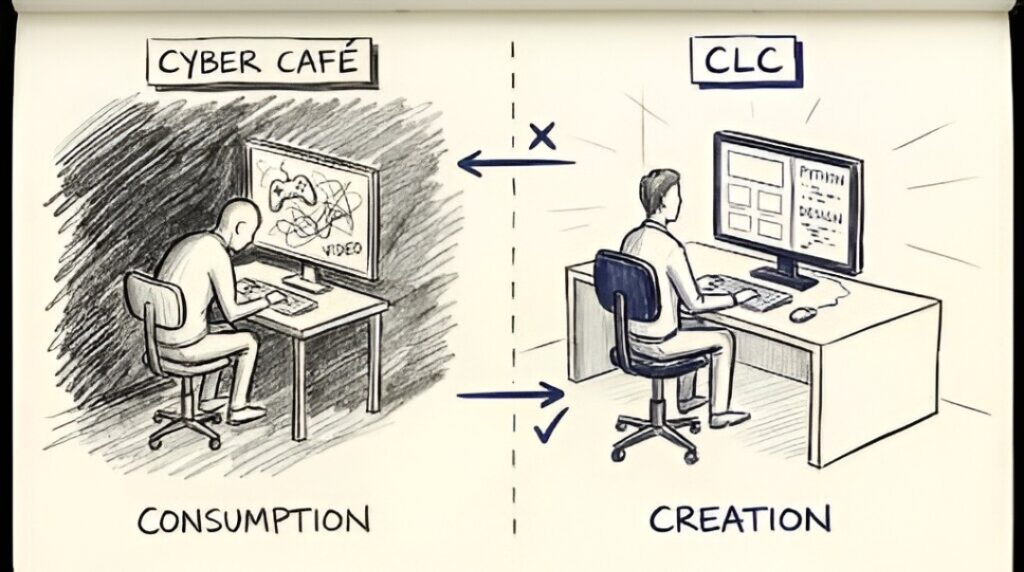
For most parents, it goes to the local market Cyber Cafe. You imagine a dark room. You imagine boys huddled in corners playing violent video games. You imagine unsupervised internet access and zero learning.
If that is what you imagine, you are right to be worried. I wouldn’t send my child there either.
But an ApniPathshala community learning centre in India is not a Cyber Cafe. It is the exact opposite.
(If you’re new to the idea, here’s a simple explanation of what a Community Learning Centre actually is.)
A Cyber Cafe is designed for consumption (games, videos, browsing). A Learning POD is designed for creation (coding, designing, building).
We didn’t just hope for safety. We engineered it.
Here is exactly how we ensure your child is safe, structured, and focused, even without a teacher standing over their shoulder.
1. How Community Learning Centres Block Games, YouTube, and Distractions
The biggest fear parents have is: “If I give my child a computer, they will just watch YouTube or play games.”
This is true for a smartphone. It is true for a normal Windows laptop.
But at our centres, we don’t use normal computers. We use Apna PCs.
These computers run on a special operating system called Abacca OS. Think of this like a “Walled Garden.”
- No Distractions: The system is built to block common distractions at the root level.
- No Games: You cannot install heavy video games like GTA or PubG. The machine simply won’t run them.
- Tools Only: When the student logs in, they see tools for work: Python for coding, GIMP for design, and LibreOffice for writing.
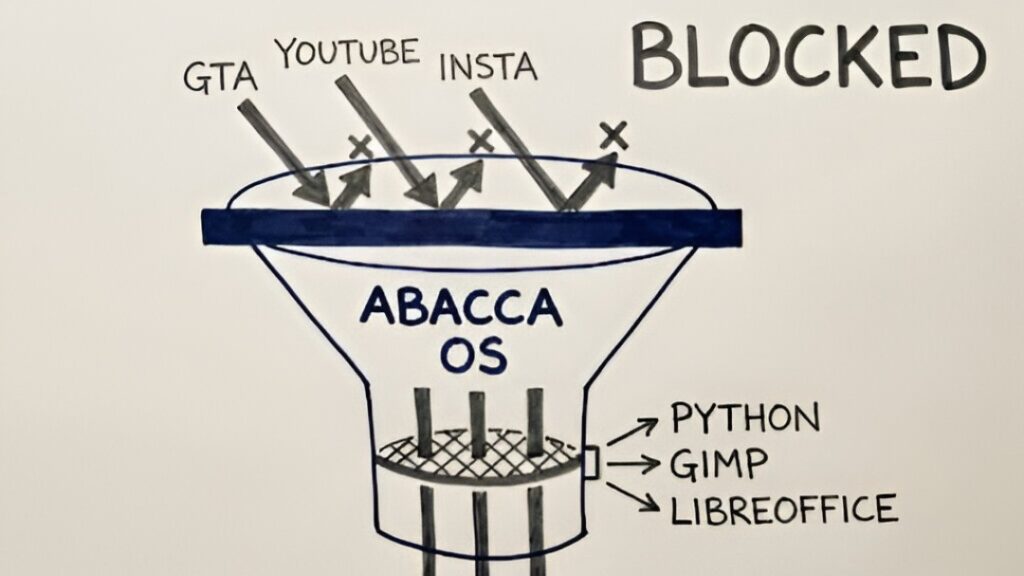
We don’t rely on your child having “willpower.” We rely on the machine being a tool, not a toy. The safety is in the software.
2. The “Open Screen” Policy (Physical Safety)
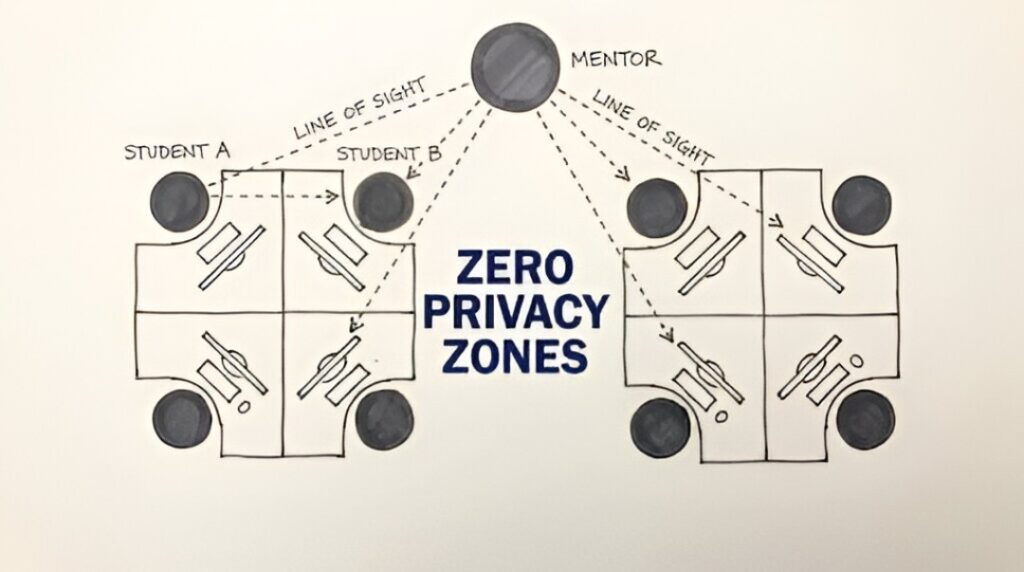
Cyber cafes have high cubicles because people want privacy. ApniPathshala PODs have zero privacy.
This sounds harsh, but it is the key to safety.
Our centres use an “Open Layout.” Every screen is visible to the person sitting next to it and to the mentor sitting behind.
This creates a concept called “Sunlight is the best disinfectant.”
- If a student tries to open a restricted site, three other students will see it immediately.
- The social pressure of the group keeps everyone focused.
Furthermore, these centres are hyper-local. They don’t open in strange industrial areas. They open in your lane, often in the home of a trusted neighbor. The mentor is likely a “Didi” or “Bhaiya” your child already knows.
3. If There’s No Teacher, How Is Discipline Maintained?
The second question parents ask is: “If there is no teacher lecturing, won’t it be chaotic?”
We often confuse “Silence” with “Structure.” A library is silent, but you can sleep there. That isn’t structure.
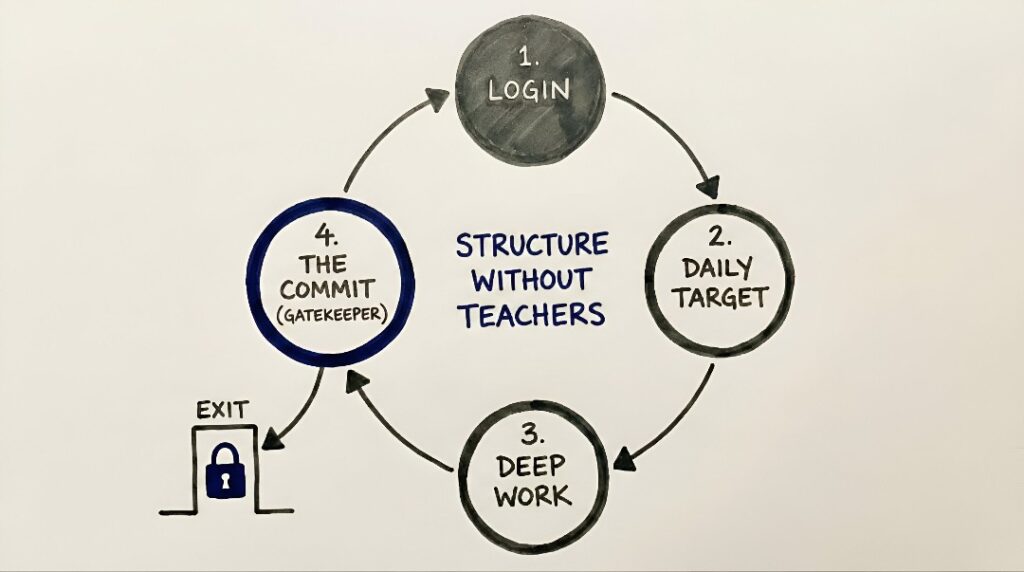
In a community learning centre in India, structure comes from Workflow, not bells.
This is exactly how a real POD functions day-to-day.
- The Login Ritual: The session cannot start until the student logs into their dashboard.
- The Daily Goal: They don’t just “sit.” They have a target (e.g., “Complete Module 3 of Python”).
- The “Commit”: This is the game-changer. You cannot leave the centre until you save your work (a “commit”).
In a tuition class, a student can daydream for an hour and leave. In a POD, if they dream, there is no work to save. The system catches them immediately.
4. What Parents Should Do After Joining a Community Learning Centre
Finally, for this system to work, your role as a parent must change.
When your child comes home from school, you usually act like a Policeman: “Did you finish your homework? Show me your diary.”
When they come home from a Community Learning centre, you need to act like an Audience: “Show me what you built today.”
Don’t ask them what they “studied.” Ask them to open their project on the phone or computer and show you the website, the code, or the design.
- If they show you nothing, ask why.
- If they show you something small, celebrate it.
When a child knows their parent is waiting to see their work, not just check a box, their motivation skyrockets.
Conclusion: Safety is a System
Safety in a Community Learning Centre is not about rules or fear, it’s about design.
At ApniPathshala, technology, space, and structure work together to keep children focused, accountable, and safe.
Keeping children away from computers isn’t the solution. Teaching them to use technology in the right environment is.
👉 Inside a Community Learning Centre: A Real Day Explained
See how safety and learning come together inside a real Learning POD.
What actually happens inside a Community Learning Centre on a real day?
A typical day inside a Learning POD is structured around goals, focused work, and visible outcomes. Children log in, work on real tasks, and leave only after saving their progress.
What is Apni Pathshala’s Super 100 program?
Super 100 is a special initiative that gives deserving JEE aspirants a personal computer + supportive environment + structured accountability so they can study without the struggle of handling mobile phones.
Which one helps my child become more confident and independent?
A Community Learning Centre places emphasis on hands-on learning and self-directed problem solving, helping children build confidence in their own abilities. They learn to research, explore, and solve, instead of waiting for every answer from a tutor.
How is the learning environment different from a tuition class?
In tuition, students usually sit quietly and listen. In a CLC, the environment is more collaborative, students talk, help each other, and learn by doing real work like coding, designing, or exploring tools. It feels more like a teamwork space than a lecture hall.





2 Responses
The content is really interesting, and the visuals are absolutely stunning.
truely agree with you