Students often have ideas but do not always get the opportunity to turn them into something they can create, explain, and share. Introducing artificial intelligence in education can make that experience more interactive, especially when students use their own imagination instead of simply watching demonstrations.
Apni Pathshala explored this through #ChaloBanaye, a six-day, teacher-led AI creation campaign conducted from 5 to 10 October 2026.
With the theme “Don’t Just Imagine It. Create It.”, students explored AI, experimented with prompts, designed visual creations, imagined future careers, and shared their experiences.
The campaign also gave Apni Pathshala an opportunity to observe teacher engagement, student participation, creative outputs, and communication across participating PODs.
AI Activities for Students: Campaign Goal
The objective of #ChaloBanaye was to introduce students to AI through practical, creative activities rather than limiting the experience to theoretical explanations.
The campaign encouraged students to understand basic prompting and use AI tools to turn their ideas into visual creations.
Teachers played an important role by introducing each activity, guiding students, helping them develop prompts, and collecting their work.
Apni Pathshala coordinated the campaign by providing daily instructions, prompt examples, demonstration materials, submission formats, and follow-up support.
The campaign focused on six areas:
- Introducing students to AI.
- Encouraging creative thinking.
- Developing basic prompting skills.
- Connecting imagination with visual creation.
- Improving teacher-student interaction.
- Collecting feedback and recognising active PODs.
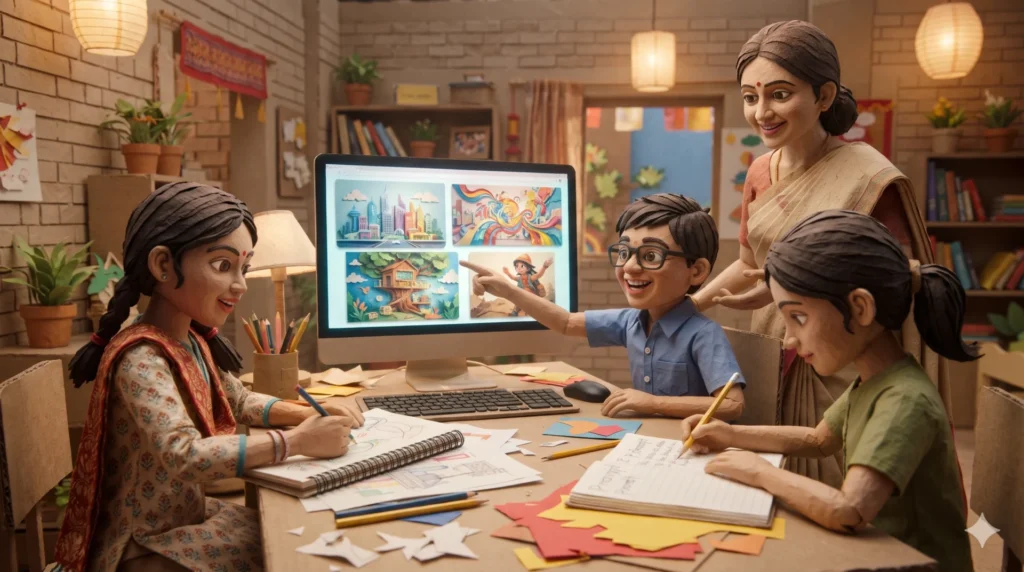
AI Literacy Through Six Creative Missions
The campaign followed a six-day journey: Discover, Imagine, Create, Visualise, Dream, and Share.
Day 1: Meet AI (5 October)
Teachers introduced AI, explained basic prompting, and helped students begin their first activity. The required evidence included a batch photograph and student count.
Day 2: Imagine and Create (6 October)
Students created unique AI-generated images using their own ideas and prompts. They submitted their prompts and generated images.
Day 3: Classroom in the 90s (7 October)
Students used AI to imagine and create their version of a classroom from the 1990s. The activity encouraged them to think creatively about how classrooms looked in the past.
Day 4: Imagine Your POD (8 October)
Students visualised their ideal learning space and used AI to turn their ideas into images. This activity connected technology with their own learning environment.
Day 5: Create Your Future (9 October)
Students imagined their future careers and dreams, then used AI to create visual representations of those aspirations.
Day 6: Student Voice (10 October)
The final activity focused on collecting student feedback about their campaign experience and learning.
Each day had a defined activity, expected output, and submission requirement. This made the campaign easier for teachers to conduct and for the central team to track.
The campaign’s approach also connects with UNESCO’s AI Competency Framework for Students, which identifies understanding, applying, and creating as important stages of AI competency development.
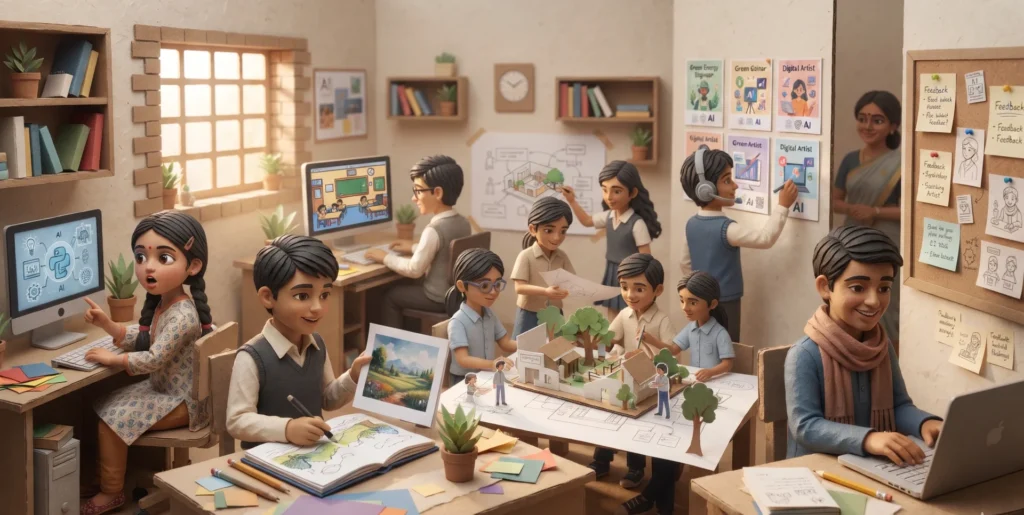
Student Engagement: Campaign Results
The campaign generated measurable participation across its six days.
The final report recorded:
- 34 initial interest-form responses.
- 70 daily form submissions across Days 1–5.
- 17 distinct PODs participating on Day 4, the highest daily count.
- 1,041 combined student attendance entries across Days 2–5.
- 10 named feedback folders on Day 6.
The attendance figure represents summed daily attendance, not 1,041 unique students. Similarly, the 10 feedback folders do not independently confirm that every required video was submitted.
The five strongly participating PODs collectively reported 34 social-media content items. This is reported content volume, not independently verified campaign reach.
These records helped Apni Pathshala understand daily participation, teacher involvement, activity completion, and public campaign visibility.
Campaign Winners: Why They Were Selected
The campaign evaluated participating PODs using consistency, documented participation, content quality, feedback videos, social-media visibility, and communication.
The three selected winners were:
First Place: Makersbox Foundation
Selected for the strongest overall execution. The team submitted daily forms, created six well-planned day-wise social posts with campaign posters, provided three feedback videos, and demonstrated particularly strong spoken communication.
Prize: Brand-new Apna PC
Second Place: Christian Grammar School
Recognised for exceptional content volume and campaign compliance. It submitted daily forms, produced 13 social-media content items, the highest reported posting volume among shortlisted PODs, and provided three feedback videos.
Prize: Wacom Intuos pen tablet
Third Place: USR Indu Samiti
Selected for reliable participation, five strong campaign content items, and three good-quality feedback videos.
Prize: Welcome Kit
Other participating PODs also demonstrated strong efforts. Vriksh Be the Change and Learn From Peers were strong runners-up. Missing campaign hashtags, incomplete feedback sets, or unverified social posts affected some other entries during evaluation.
The winners were therefore recognised for their overall campaign execution, rather than simply the number of submissions.
Creative Learning: What the Campaign Delivered
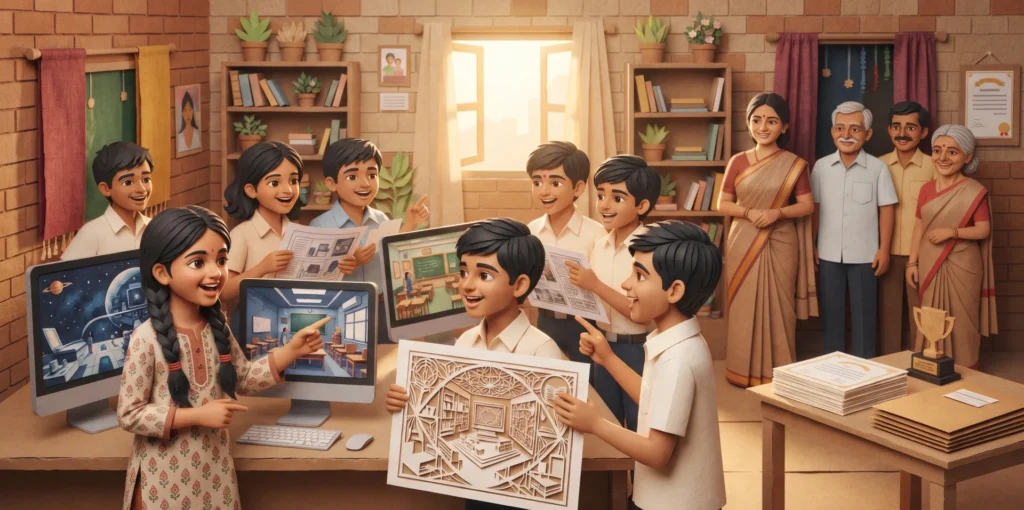
Beyond the winner announcements, #ChaloBanaye created several practical outcomes for Apni Pathshala.
Teacher engagement: Daily activities created regular interaction between teachers and the central team.
Student participation: Students received opportunities to express ideas, experiment with prompts, and create visual outputs.
Content collection: The campaign generated photographs, AI creations, social posts, and feedback material for future communication.
Teacher recognition: Consistent participation helped identify teachers and PODs demonstrating strong engagement.
Operational learning: The campaign highlighted the importance of clear submission rules, evidence verification, and timely communication.
UNESCO’s guidance on generative AI in education supports a human-centred approach to introducing AI into learning.
UNICEF India’s Responsible AI for Children and Young People also highlights the importance of age-appropriate AI literacy, privacy, safety, and human oversight.
AI in Education: Lessons for Future Campaigns
#ChaloBanaye demonstrated how a structured campaign can bring AI awareness and creative activities into community learning environments.
It also highlighted areas for improvement in future campaigns:
- Finalise activity instructions and feedback requirements before launch.
- Use consistent campaign hashtags for better visibility.
- Verify every required submission instead of relying only on folder counts.
- Define evaluation criteria and scoring rules before announcing prizes.
- Track unique participation separately from daily attendance.
- Record verified reach and engagement separately from reported social posts.
These improvements can make future AI activities for students easier to manage, evaluate, and document.
Continue Exploring Creative Learning at Apni Pathshala
#ChaloBanaye is one example of how Apni Pathshala brings practical technology experiences into community learning.
Explore how Apni Pathshala supports digital skills and discover opportunities to start a POD in your community.
Because students should not just learn what technology can do. They should get opportunities to create something with it.
Frequently Asked Questions
1. What was the #ChaloBanaye campaign?
Ans. It was a six-day, teacher-led AI creation campaign where students explored prompting, visual creation, and future aspirations through practical activities.
2. Why is human guidance important when using AI in education?
Ans. Human guidance ensures AI supports learning responsibly while maintaining educational quality, student safety, and meaningful teacher involvement. Read UNESCO’s Guidance on Generative AI.
4. How did the campaign support AI literacy?
Ans. It gave students practical opportunities to experiment with prompts and create visual content. UNESCO’s AI Competency Framework for Students provides further guidance on developing responsible AI skills.
5. Can other communities organise similar AI activities?
Ans. Yes. Schools, educators, and community organisations can explore the Apni Pathshala POD programme to bring structured digital learning opportunities closer to students.