

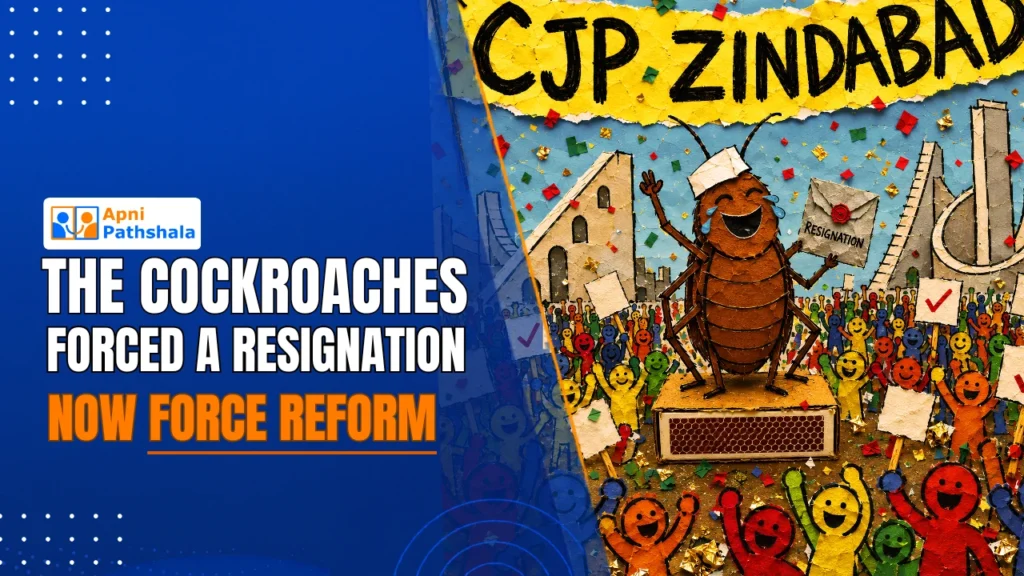
The cockroaches forced a resignation and proved that power can be made to listen. Now students must force reform so the system actually remembers.
We did it!
After weeks of protest, hunger strikes, police force, long nights, and people telling them to go home, India’s education minister announced his resignation.
Students at Jantar Mantar cheered. They sang the national anthem and shared sweets.
Let that moment breathe.
A minister did not suddenly discover accountability inside himself. Students made silence expensive. They kept showing up until ignoring them became harder than answering them.
Reuters called the resignation a major victory for the youth-led movement.
It was. This protest broke the old script. It showed millions of students that power can move.
They Made Power Move
The movement grew after the NEET-UG paper leak. Around two million students had taken the medical entrance exam before it was cancelled and held again.
NEET is the single route into undergraduate medical courses, so one broken paper shook years of work across millions of homes.
Anger alone did not remove a minister.
Students organised. Protesters camped in Delhi. Sonam Wangchuk fasted for 26 days.
When police used batons and tear gas against marchers, the movement grew instead of shrinking.
Then the resignation came. A symbol becomes real when it carries a cost.
The next minister will remember that students forced one of his predecessors to leave.
A Resignation Is Proof
The resignation proves that pressure worked, but it does not tell us whether the next paper will be safe.
The CBI said people connected to the exam process had access to NEET questions before the test.
A chemistry lecturer allegedly dictated matching questions and answers during special coaching classes. A botany teacher appointed as an NTA expert was also arrested over alleged access to biology papers.
Read that again.
The danger did not enter through some movie-style hacker. It walked through an authorised door.
So who can open a paper? Who records that access? Who checks the people handling it? Who notices strange activity before exam day?
A resignation cannot answer those questions, but a safer system can.
Victory Is Where Memory Starts to Fade
The week after a victory can be dangerous.
The crowd goes home, the cameras find a new story, and strong promises become old clips buried under newer anger.
George Orwell understood how power uses memory.
In Nineteen Eighty-Four, Winston changes old records so yesterday always agrees with what the Party says today. People lose power when they lose a clear record of what happened.
Dharmendra Pradhan’s resignation letter said he wanted to stop “anti-national forces” from using the unrest and help students return to study and careers.
Students began with a failed exam system. The official language moves toward order, unity, and returning to normal.
Keep the order clear:
- The paper leaked.
- Students paid the price.
- Students protested.
- The minister resigned.
Memory is part of accountability.
Accountability Must Become a Feature of the System
A fair exam cannot depend on every person being honest.
The system must expect that someone may leak a paper, hide a mistake, or pass blame. Then it must make cheating harder and detection faster.
The government has announced fast-track courts for paper-leak cases.
Faster punishment matters because these cases should not drag for years while students carry the damage. But courts arrive after the leak.
Prevention needs tighter access, digital records, outside checks, safer vendor rules, protection for people who report wrongdoing, and one clear plan when a leak is suspected.
Students should not learn about a broken exam through WhatsApp rumours or chase five departments for one answer.
A system has learned only when students no longer need a national protest to receive basic fairness.
The Next Exam Is the Test
Do not judge reform by speeches. Use this five-part report card.
1. Prevention – What changed in paper storage, access, handling, and staff checks?
2. Detection – Can officials spot a leak before students find it online?
3. Ownership – Does one named body clearly own security, updates, retests, and complaints?
4. Repair – What help reaches students who lose money, time, sleep, or an admission year?
5. Public Proof – Will officials publish what failed, what changed, and whether the new steps worked?
The next press conference proves nothing literally. The next examination does.
One Rank Should Not Own a Life
NEET must be fair.
Students who prepare for years deserve an exam they can trust. But even a perfect exam places a huge part of a young life inside one score.
One bad day can close a door. One leaked paper can shake an entire future. Young people need more doors.
They need computers, mentors, AI support, peers, and real projects.
Apni Pathshala PODs are small community learning centres built around those needs. They give learners access to computers, practical digital skills, local guidance, and tools such as Eklavya AI.
That is also why Apni Pathshala needs to exist at all.
A fair exam protects one chance. A strong learning community creates more chances.
Make the Victory Permanent
Celebrate the resignation.
Then write down the promises. Track the dates. Save official statements. Return to the five questions before the next exam.
Do not let the story shrink into “a minister resigned after unrest.” Students were not the unrest. They were the reason the failure could no longer hide.
They have already passed their test. Now the system sits for its own.
The next exam will show whether power listened for one day, or learned for good.
Continue Reading
Read Why Does Apni Pathshala Need to Exist at All? to see why young people need learning spaces that help them think, build, and create paths beyond one exam.
Help Build More Doors
Have space, devices, skills, funding, or trust inside your community? Start or support an Apni Pathshala POD and help young people build futures that one exam cannot fully control.
Frequently Asked Questions
1. Why did Dharmendra Pradhan resign?
Ans. He announced his resignation after weeks of protests demanding accountability over the NEET-UG paper leak and wider exam failures.
2. Does the resignation mean the exam system has changed?
Ans. No. It shows public pressure worked. Reform still needs safer paper handling, clear responsibility, faster detection, and support for affected students.
3. What has the government announced?
Ans. The government announced fast-track courts and stricter action for paper-leak cases.
4. How can an Apni Pathshala POD help?
Ans. A POD gives learners local access to computers, practical projects, digital skills, mentors, and AI-supported learning beyond one exam.


6 Responses
nice vlog
Thank you, glad you liked it.
nyc blog
Thank you, glad you liked it. This story really shows why awareness and action both matter.
It makes sure that there will be reforms or a more bigger try by the government to stop leaks and would come with reforms as the student shown and if there will be one more leak of any paper the government cant bare the damage therefore they will surely bring reforms….
Thank you for adding this perspective. True, one more leak can damage public trust deeply, so stronger reforms and better exam security are now very important for students.