

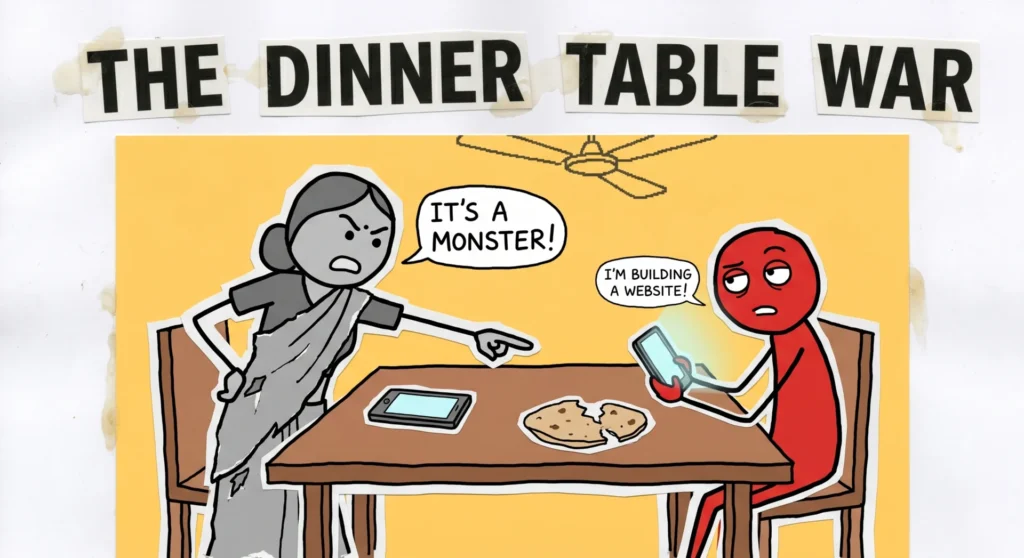
There is a quiet argument over AI literacy happening at the dinner table in millions of Indian homes.
On one side sits a parent. They look at their college-going child who cannot seem to put down their smartphone. To the parent, this technology looks like a monster that is killing human creativity.
They do not use artificial intelligence at their daily job, so they worry their child is becoming lazy and losing the ability to think.
On the other side sits a 19-year-old student. They belong to the 17-to-24 age group, which uses AI tools more than anyone else today. They use it for every single small thing.
- They use it to write simple WhatsApp texts,
- plan their daily schedules,
- and clear their doubts.
But this student is not just wasting time.
While the parent worries, the student is using an advanced AI model like Claude to build a fully working website for a local business. They are learning how to create a digital business before they even graduate.
This is the massive invisible wall inside Indian families. Parents do not understand the tech, and children are using it without a safety net.
Both sides are completely misunderstood. One side hates it, and the other side depends on it too much.
To build real future skills for students, we have to stop picking sides. We have to learn how to guide them.
The Two Types of Students Who Will Struggle in the AI Age
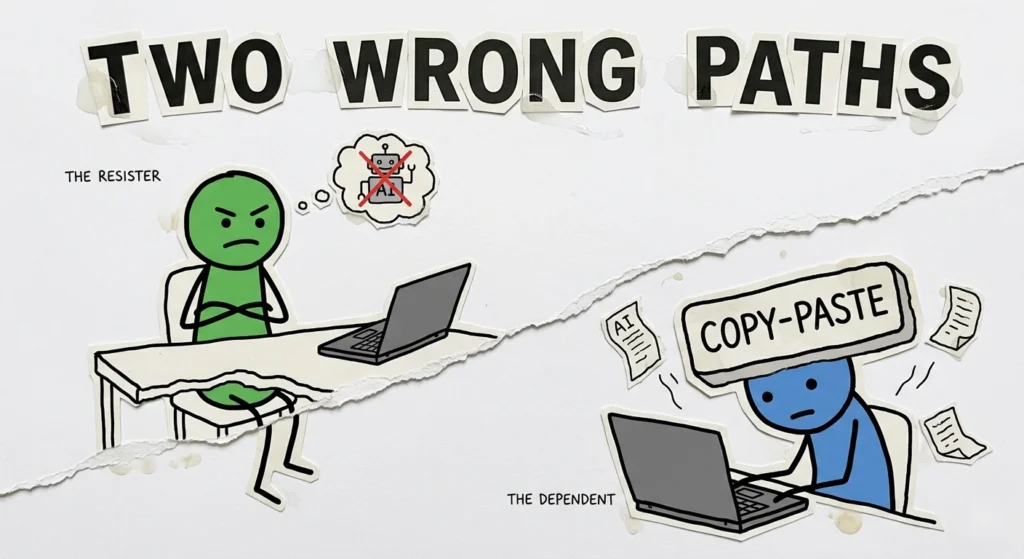
We have divided young people into two wrong groups today.
- The Resisters: These are people who reject AI completely. They claim it ruins original thought and makes students lazy.
- The Dependents: These are students who use AI blindly for everything. They copy and paste essay answers without reading them.
They have lost their own voice because they let a machine do the heavy lifting.
Both of these groups are losing the game.
The NIIT India Skills Gap Report highlights a massive confidence gap in practical digital and data skills among students. Just knowing how to open an app or click buttons does not make a student “tech-savvy” anymore.
If a student depends on AI too heavily, they become weak. If they ignore AI entirely, they get left behind by students in Tier 1 cities who are using these tools to run circles around them.
True digital literacy for students is about finding the middle ground. It is about using the machine to sharpen your mind, not replace it.
Top 3 AI Tools for Students (And How to Use Them)
The future is moving incredibly fast. Students who want to excel are moving far beyond simple search engines.
They are using advanced AI tools for students to become creators:
- Claude: Elite students are using this tool to build clean logical frameworks, analyze complex documents, and turn their creative ideas into real digital products.
- Eklavya AI: This is the ultimate digital tutor. Unlike chatbots that just give away the final answer, Eklavya AI is designed to act like a strict personal teacher. It forces students to think critically by breaking down math and science problems step-by-step.
- Vibe Coding Platforms: Students do not need to spend four years learning complex coding languages anymore. With new platforms, they can practice “vibe coding“ building real software apps simply by typing out clear instructions in normal language.
These tools teach students the most important skills that traditional schools ignore: persuasion, critical thinking, problem solving.
They learn how to take an idea, build it, and clearly share it with the world so people care about it.
The Dark Side of Innovation: Internet Safety for Students
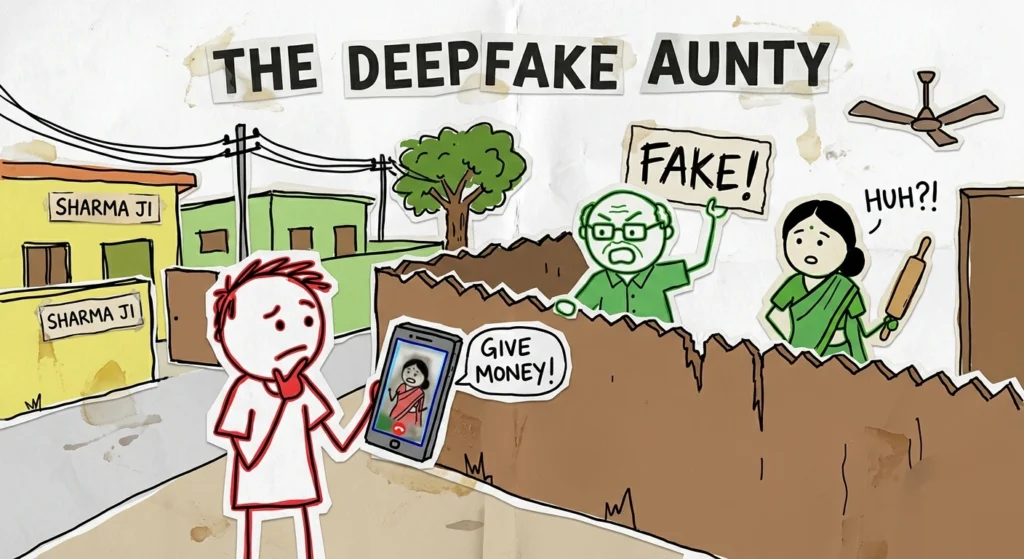
But we cannot talk about the power of AI without talking about the hidden traps. The internet has become a beautiful but highly dangerous playground.
This is why internet safety for students is no longer just a small topic, it is a survival skill.
Today, anyone can use AI tools to create hyper-realistic deepfakes, fake news, and manipulated media in less than ten seconds.
If a student does not have critical thinking skills, they will believe every single lie they see on their screen.
Furthermore, AI models frequently suffer from “hallucinations” they confidently make up false facts and present them as truth. If a student blindly copies an AI without double-checking the facts, they lose their ability to evaluate credible information. Read more about Ai Hallucinations here .
They become a slave to algorithmic bias. If you want to see ai bias…try GROK.
The POD Solution: Building Safe, Future-Ready Leaders
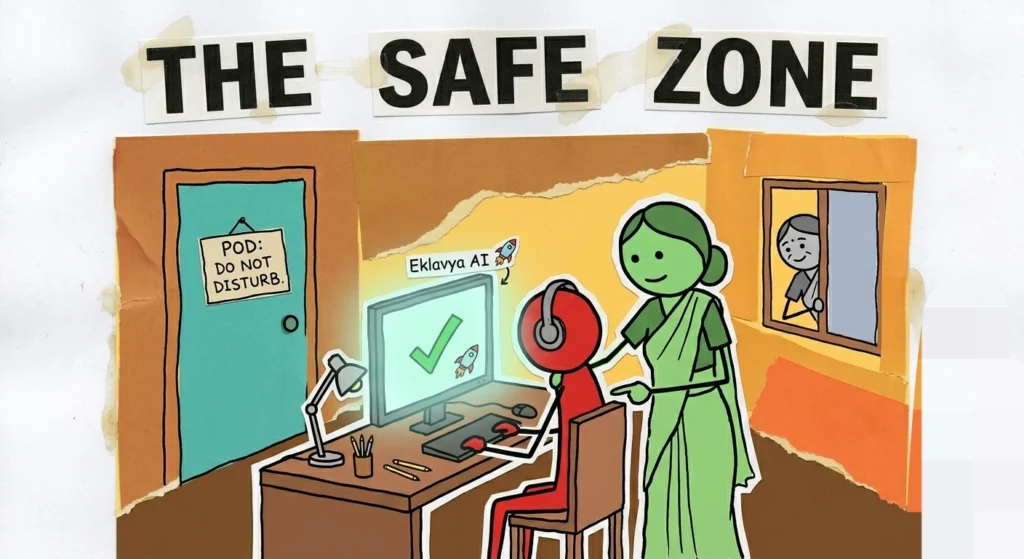
You cannot build a brilliant mind on an open, unmoderated internet connection. If you hand a child a smartphone in a noisy room, they will naturally default to low-tier entertainment and distraction.
To build true digital confidence, students need a structured environment. This is why we built the Apni Pathshala PODs.
A POD is a physical, community-based micro-learning space. It provides:
- a quiet room,
- fast internet,
- and locked-down computers.
Inside a POD, a student is completely shielded from the toxic, addictive loops of social media. They are placed in a safe zone where they can focus entirely on deep work, vibe coding, and high-level digital skills.
Most importantly, the POD combines adaptive tools like Eklavya AI with local human mentors. These mentors handle the discipline and guide the student, ensuring they use technology safely to solve real-world problems.
They turn passive screen time into active human greatness.
Why Students Learn Faster in Distraction-Free Spaces
When you give a child an open internet connection, they find entertainment.
But when you send them in a room with a single, highly specialized software environment, something bizarre happens to their focus levels. We tracked the data across dozens of micro-centres to see why removing digital freedom actually unlocks human potential.
If you want to see the exact blueprint of how structural isolation creates genius, read what happened next: The Silent Accelerator: Why Some Students Grow Faster With Online Learning.
Note to Capital Allocators & Builders:
Apni Pathshala has finalized the core framework for our next 200 micro-learning infrastructure deployments.
If you direct a CSR fund, lead an institutional NGO, or hold local public office and want to claim an active territory before the allocation window closes, let’s skip the pitch decks. Reach out directly to audit our ground operations.
Frequently Asked Questions (FAQs)
Q1: What are the most important future skills for students?
The most critical future skills include advanced digital literacy, critical thinking, and the ability to safely handle AI tools. These skills ensure students move from passive digital consumers to secure, future-ready creators.
Q2: How can students use AI tools safely?
Students can use AI tools safely by learning to protect their digital footprint, identifying AI hallucinations, and never sharing personal data. Safe AI usage is best learned in guided environments like community learning centers.
Q3: Why is internet safety important in digital literacy?
Internet safety is the foundation of digital literacy because the modern web is filled with manipulated media, deepfakes, and cyberbullying. Without safety protocols, access to educational technology becomes a dangerous liability.
Q4: What is an Apni Pathshala POD?
A POD is a quiet, distraction-free room in a local neighborhood. It provides locked-down computers and fast internet so students can focus purely on self-study and building real digital skills under the guidance of local mentors.
4 Responses
True, learning with AI is what students must do nowadays to learn efficiently
Thank you for sharing your thoughts. Absolutely, learning with AI can help students become more confident, curious, and efficient when guided in the right way.
Excellent perspective. AI literacy and internet safety should go hand in hand in every child’s education.
Kids should learn AI and internet safety together…. one without the other is incomplete