Millions of students across India enroll in universities, following an economic script written in the 1990s: Get good grades, earn a degree, and a stable job will be waiting for you.
For previous generations, this was entirely true. A college degree was rare, and because it was rare, it held massive value.
Today, the numbers tell a very different story. The International Labour Organization (ILO) 2024 The report highlights a staggering reality: youths account for nearly 83% of India’s unemployed workforce. Even more concerning, graduates experience an unemployment rate nine times higher than those without formal education.
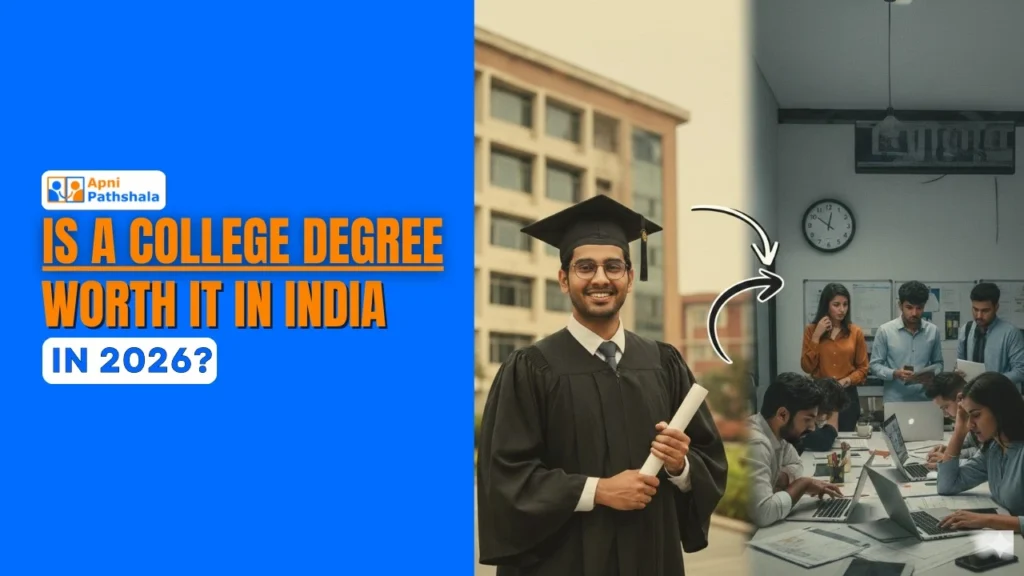
This data creates a serious, unavoidable question: Is a college degree worth it in India in 2026?
We are not experiencing a lack of jobs; we are experiencing the hyperinflation of degrees. Let’s examine the “skills vs degree in India” debate using cold economics, the impact of artificial intelligence, and a strategic framework for how modern students must adapt.
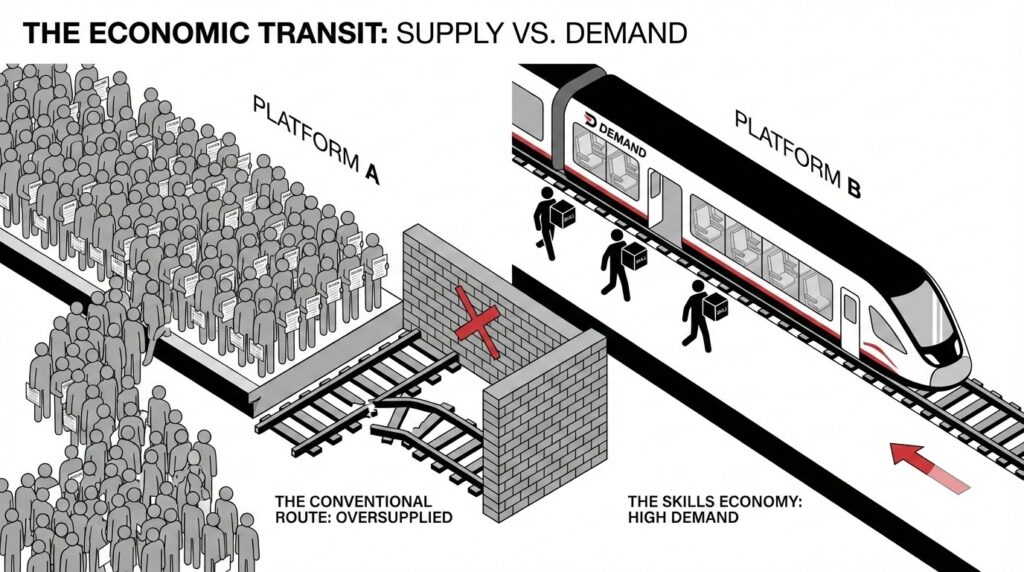
The Economics of “Signalling” and Graduate Unemployment in India 2026
To understand the rise in graduate unemployment, you have to understand an economic concept called Signalling Theory.
Most standard colleges do not teach the exact, cutting-edge skills needed to train machine learning models or build modern tech infrastructure.
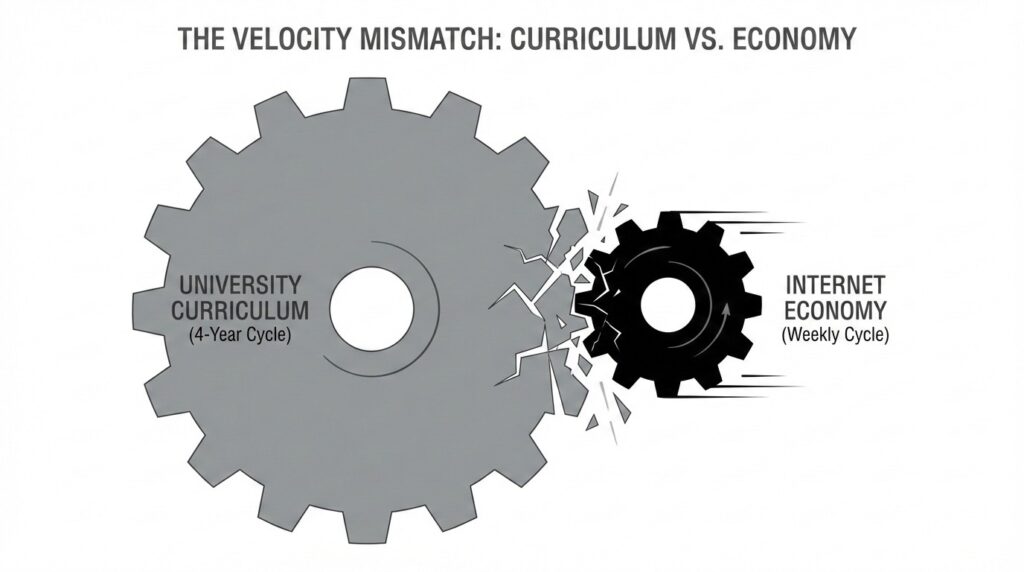
University syllabuses can take years to update, while the internet economy updates every single week. As a result, recent skills indices such as the Mercer-Mettl 2024/2025 report reveals that only 55% of Indian graduates are deemed employable for modern industry roles.
So, what are you actually paying for when you go to college? You are paying for a “Signal.”
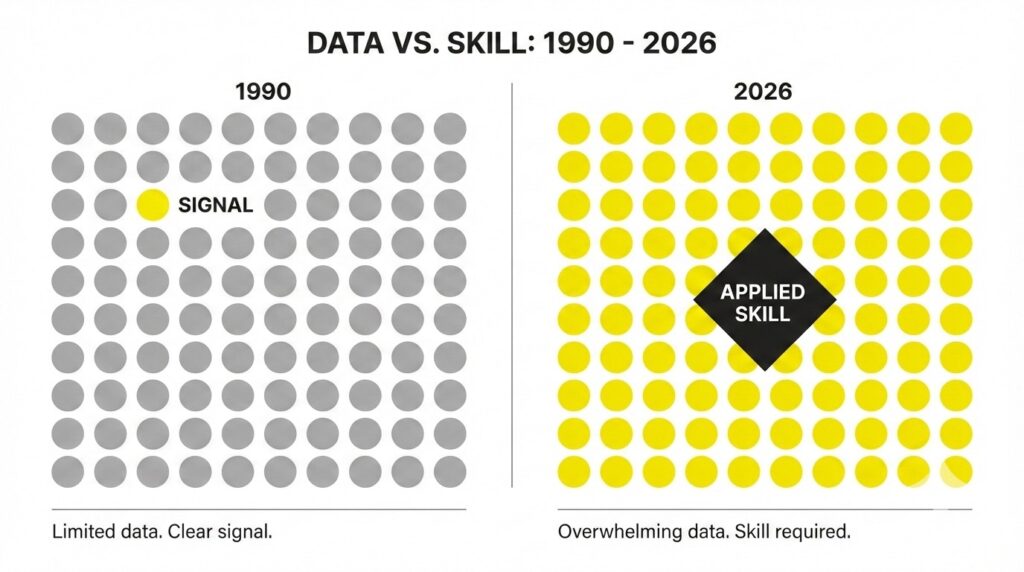
In the past, having a degree was a powerful signal to employers. It proved you were disciplined and capable. Today, because millions of students graduate with the same qualifications every year, the value of that signal has diluted.
Unless you are graduating from a top-tier elite institute, a standard degree now primarily signals one thing: Compliance. It proves you can sit in a chair for four years and submit assignments on time.
But in a fast-moving digital economy, compliance is no longer a high-paying skill. The market does not pay for people who just follow the rules; it pays for people who can solve complex problems.
Is College Worth It After AI? The Collapse of Generic Work
We have entered a new era of human history. Artificial Intelligence has fundamentally changed the economic value of basic knowledge.
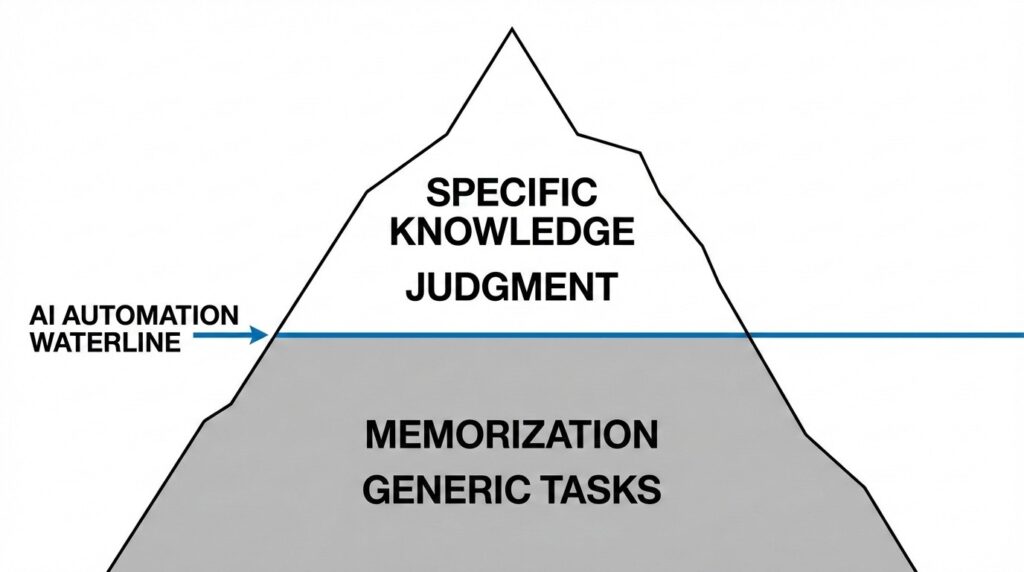
If a college degree only trains a student to write basic code, memorize historical facts, or draft generic reports, that training is rapidly losing its utility. An AI program can execute those tasks in three seconds for a fraction of a penny.
The modern market will no longer pay you just for what you know, because AI already has access to the textbooks. The market will pay for your Specific Knowledge, your human judgment, and your ability to synthesize information to build real things.
For example, industry projections by Nasscom indicate that India will need over one million specialized AI professionals by 2026 to bridge the current talent gap. You cannot learn this specific knowledge just by reading outdated presentations.
You learn it by practicing and building in the real world. This is the core of the debate: the degree provides the theory, but the modern economy exclusively compensates applied skills.
Skills vs Degree in India: Why Proof of Work Beats Proof of Attendance
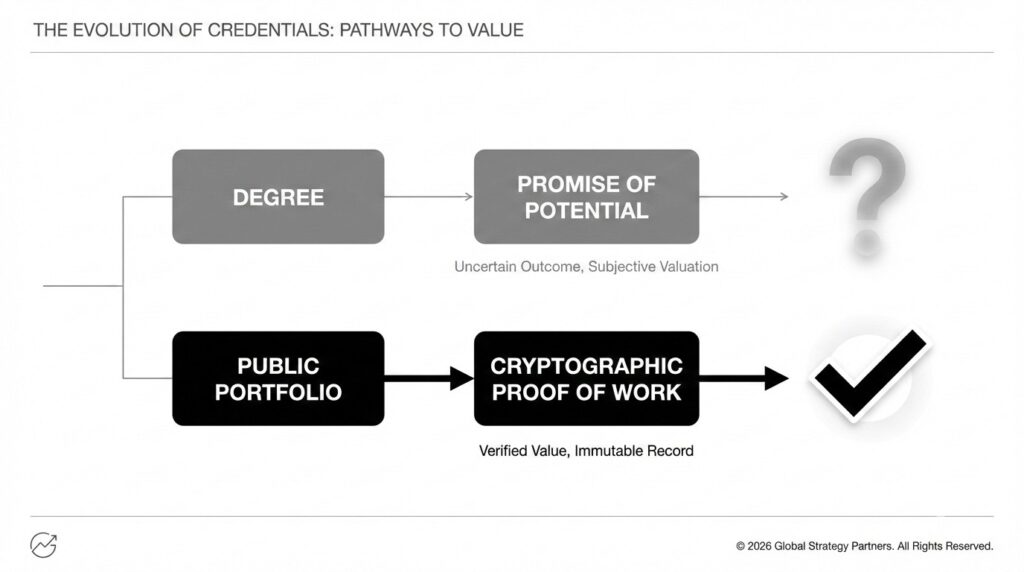
The internet is a strict meritocracy. It does not care about your age, your location, or the stamp on your college transcript. When a client or a modern technology company wants to hire you, they only ask one question: “Can you actually do the work?”
If you want to earn an independent income, no one will ask to see your college attendance sheet. They will ask for your Proof of Work.
- If you want to be an AI engineer, they want to see the active projects on your GitHub.
- If you want to be a digital writer or marketer, they want to see your actual audience, your published articles, or your digital portfolio.
A college degree is simply a promise of potential. A public portfolio is undeniable proof of your capability.
The Parallel System: How Community Learning centres Bridge the Gap
So, where do students actually build this “Proof of Work”?
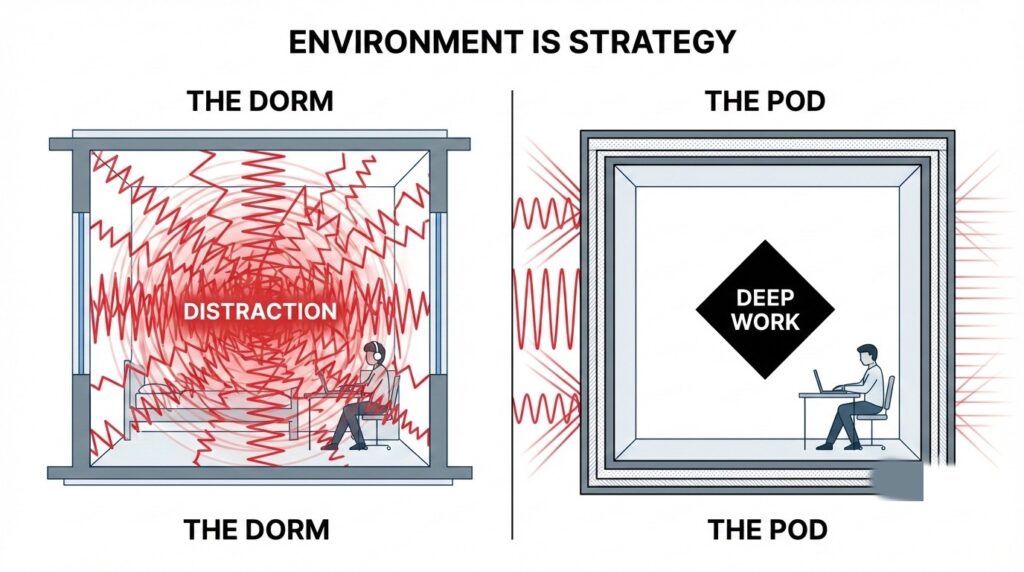
It is often difficult to build specialized skills in a crowded college dorm, and it is equally hard to focus in a distracting home environment. To build high-income skills, students require a quiet, focused environment equipped with the right technological tools. They need a gym for the mind.
This is the systemic reason why decentralized models, like Apni Pathshala Community Learning centres (PODs), are emerging as a vital trend across India.
These centres do not aim to replace traditional colleges. Instead, they establish a Parallel Infrastructure. Real, high-value education often begins after the college gates close for the day.
When a student walks into a local POD, they are not there to memorize theory for a mid-semester exam. They sit at a secure, high-speed PC, protected by distraction-blocking software like Apni Prerna, and they enter a state of deep work. They learn to code, utilize AI tools, and build the exact portfolios that the modern economy demands.
The college provides the baseline foundation. The community learning centre provides the physical and digital environment to actually build wealth-generating skills.
Conclusion: The Barbell Strategy for Modern Students
Does this mean students should drop out of college, burn their textbooks, and reject the formal education system entirely?
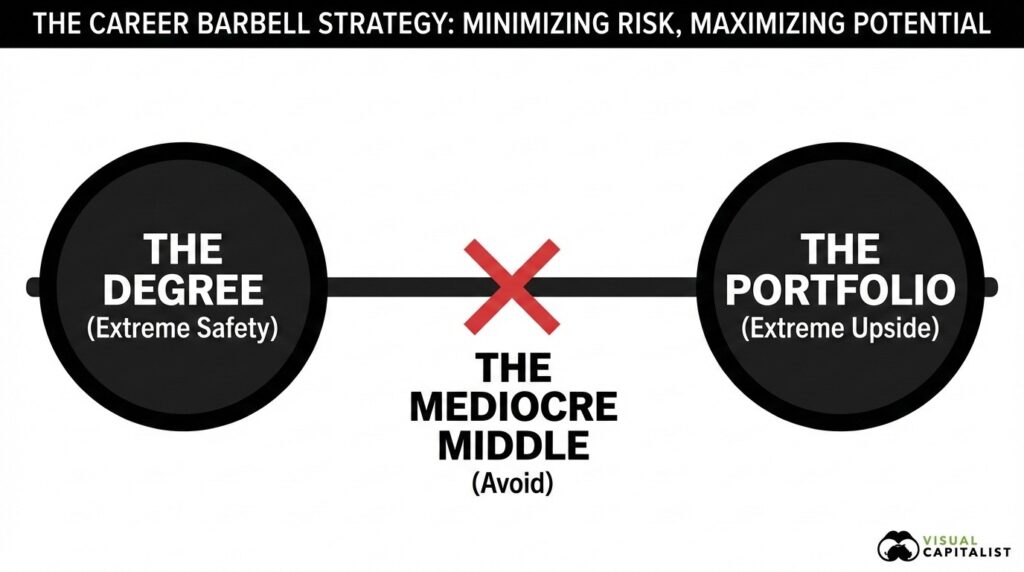
No. That is an emotional reaction, not a smart strategy. Instead, students should adopt what is known as the Barbell Strategy, an approach where you play it extremely safe on one extreme, and take massive growth risks on the other.
The Safe Side (The Degree): Keep going to college. Pass your exams and earn your degree. It acts as a social safety net, satisfies familial expectations, and prevents you from being automatically filtered out by traditional HR departments. Treat your college years as a safe, four-year sandbox to figure out your life.
The Risk Side (The Skills): In your free time, build your real empire. Step away from the college crowd. Go to a local learning centre or set up a quiet desk. Learn high-value digital skills, build your portfolio, and test your ideas in the real world.
Society wants young people to rely entirely on a piece of paper. But the goal of a modern student shouldn’t just be to “get a job.” The goal is to build true independence.
Is a college degree still worth it? Yes, as a backup plan. But your skills are your actual currency. The gatekeepers are gone, your degree will get you in the room, but only your proof of work will keep you there.
If this article made you question the traditional path, don’t stop here. The shift from degrees to skills isn’t theory , it’s already happening.
Here are optimized versions:
👉 Preparing for competitive exams? Read How to Get 99 Percentile in JEE in One Month.
👉 Want to understand how decentralized education works? Read more.
👉 Curious how this model works without massive funding? Explore
What does the ILO report reveal about unemployment in India?
The ILO’s India Employment Report 2024 states that nearly 83% of the unemployed population in India are youth. The report also highlights a troubling trend, educated young people now face higher unemployment rates, showing a growing gap between degrees and job opportunities.
What is the most important strategy to score 99 percentile in JEE in one month?
The most important strategy is relentless focus on high-impact practice. In one month, you cannot relearn everything, so you must prioritize high-weightage chapters, solve previous year questions daily, analyze every mistake carefully, and revise repeatedly. Success in 30 days depends less on covering the full syllabus and more on disciplined execution, deep revision, and eliminating distractions completely.
How does decentralized learning make education more effective?
Decentralized learning makes education more effective by shifting control to local learning centres, allowing faster decisions and real-time support. Unlike slow centralized systems, community-based models adapt quickly to student needs, helping learners build practical skills more efficiently.
Why are local learning centres important in decentralized education?
Local learning centres create focused environments where students can practice, collaborate, and build real-world capabilities without depending entirely on traditional classroom structures.