Meet the “Topper.”
Every class has one.
Let’s call him Vikram.
Vikram plays football in the evening. He watches movies on weekends. He doesn’t carry heavy books or highlight every line in neon yellow.
Yet, when the results come out, Vikram scores 98%.
Then there is the “Grinder.”
Let’s call him Rahul.
Rahul studies 12 hours a day. He quits social media. He stops playing sports. He memorises the textbook until the pages fall apart.
But in the exam, Rahul scores 85%.
Why?
We usually say, “Oh, Vikram is just gifted.”
That is a lie we tell ourselves to feel better.
The truth is simpler: Rahul is working hard, but he is working against his brain.
He is treating his brain like a hard drive, trying to “save” data by repeating it.
Vikram is treating his brain like a muscle.

He isn’t studying longer; he is studying differently. He is using specific protocols that trick the brain into learning faster.
We usually call these “Smart Study Tips.”
But actually, they are Science-Backed Protocols.
Here are the 5 underrated methods to stop rote learning and start actually learning.
1. Teach the Wall (The Protégé Effect)
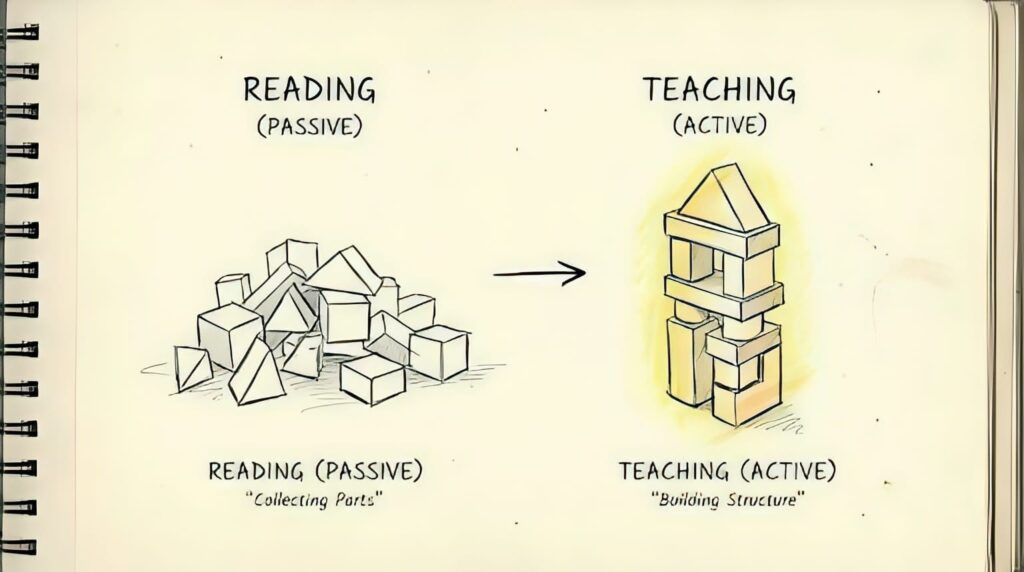
This feels silly at first.
Most students think “Reading = Learning.”
This is false. Reading is passive. It is comfortable. It creates an Illusion of Competence.
You read a page, your brain nods, and you think you know it. But in the exam, you blank out.
The Hack:
Stop reading silently.
After you finish a topic, close the book. Stand up.
And teach it to the wall.
If you don’t have a study partner, teach your plant. Teach your pillow.
Imagine you are the professor. Use your voice. Explain why the concept happens.
Research shows…
This is called the Protégé Effect.
When you just read, you only use your visual memory.
When you teach, you are forced to organize the chaos in your head. You have to use logic to connect the dots.
If you stumble while speaking, that is your brain telling you: “You don’t know this yet.”
2. Move Your Hands While Memorizing
Most students avoid this..
Have you noticed how great speakers move their hands while talking?
That isn’t just for style! No Bro.
When you are memorizing a formula, a history timeline, or a biology process, act it out.
- If the graph goes up, move your hand up.
- If the electron spins, spin your finger.
- If the empire expanded, spread your arms.
Research shows…
that using hand gestures activates the Motor Cortex of the brain.
We are connecting “Physical Movement” with “Intellectual Memory.”
This creates a dual-pathway in your brain, improving recall by up to 25%.
So Don’t sit like a statue.
Physicality triggers memory alot
3. Stop “Block” Studying (Use Interleaving)
Most Indian students study like this:
- Monday: Math, Math, Math (3 hours).
- Tuesday: Physics, Physics, Physics (3 hours).
This is called Block Practice.
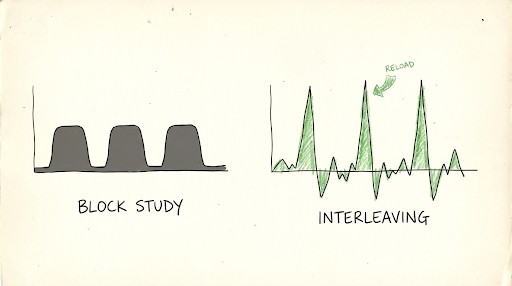
It feels productive but leads to autopilot learning and poor long-term retention.
Instead of this..
Use Interleaving.
Switch topics before you get too comfortable.
New Pattern
- Chemistry – 30 minutes
- Maths – 30 minutes
- Physics – 30 minutes
It has to struggle to recall the new rules.
That struggle prevents autopilot. It keeps the brain awake.
It feels harder and more frustrating than doing one subject.
But remember: Confusion is the only time you are learning.
4. Use a “Pacer” to Read Faster
Our eyes are lazy.
When you read a textbook, your eyes naturally jump back (back-skipping) or wander around the page.
This kills your focus and slows down your input speed.
The Practical Hack
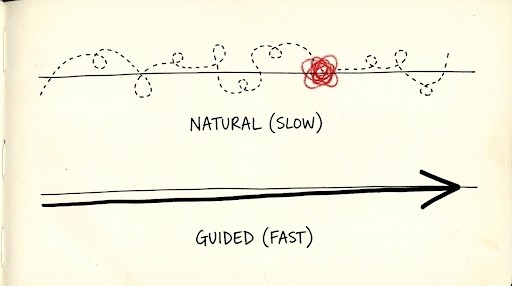
Use a pen (or your finger) as a Pacer.
Move the pen under the line you are reading. Keep it moving steadily
Force your eyes to follow the pen tip.
Why this works:
This simple physical guide smooths out your eye movements.
- You stop back-skipping unconsciously.
- You increase reading speed by 10-20% instantly.
- Your focus locks in because your eyes have a moving target.
5. Make Weird Associations (The Stadium Hack)
Why can you remember the plot of a weird movie you saw 5 years ago, but forget the definition you read yesterday?
Because the brain loves Novelty. It hates “Boring“.
The Simple method to Counter this.
Stop trying to memorize dry facts. Map them to something wild.
- Learning Cell Structure?
Visualize a Cricket Stadium.- The VIP Box is the Nucleus.
- The Security Guards are the Protein Receptors.
- The Concession Stand is the Mitochondria (Powerhouse).
Research shows…
The brain creates stronger neural pathways for Visual + Spatial + Weird information.
If it’s boring, you will forget it.
If it’s weird, it sticks.
The Vision: Why This Matters More Than Marks
We are entering a new world.
The future doesn’t belong to the students who can memorize the textbook.
It belongs to the students who can learn how to learn.
If you are a “Passive Learner” (waiting for instructions), you will struggle in the age of AI.
If you are an “Active Learner” (using these hacks), you will be unstoppable.
The Vision of Apni Pathshala
We are not just here to help you pass an exam.
We are here to help you build the muscle to figure things out.
Our goal is to build a generation of Problem Solvers, not just hard workers.
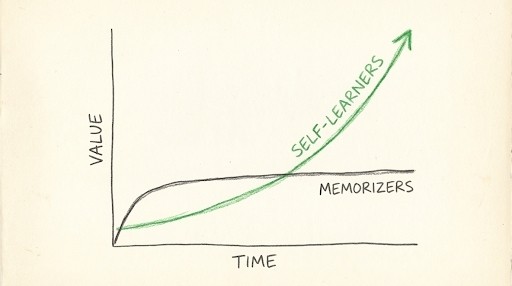
Conclusion
The future of education in India cannot be built on marks alone. True success comes from developing the ability to think, question, and learn independently. Self-learning in India is the key to breaking free from rote memorization and building confident, capable learners who are prepared for real-world challenges.
When students shift their focus from how much they study to how they learn, results improve naturally and learning becomes meaningful and lasting.
The Final Challenge:
Tonight, pick ONE of these hacks.
Just one.
Try the “Teach The Wall” Method for 10 minutes.
👉 Want to become a confident self-learner? click here
👉 Join Apni Pathshala and start building skills that last beyond exams.