AI and coding are no longer topics that schools can keep for “later”.
The change is already visible. Students are growing up around AI-powered tools, while school education itself is beginning to introduce computational thinking, artificial intelligence and digital skills at earlier stages.
The question now is not whether schools should prepare for AI.
The real question is: What should a school actually do to prepare?
The answer is not to buy expensive software or turn every teacher into a programmer. Schools need the right curriculum, trained teachers, suitable devices, enough practice time and a clear approach to responsible technology use.
AI and Coding Are Entering the Curriculum
Coding and AI are often discussed together, but they are not the same thing.
Coding teaches students how to give computers structured instructions and solve problems step by step. AI education goes further by helping students understand how machines can recognise patterns, work with data, make predictions and support decisions.
This is why computational thinking matters.
CBSE has introduced a Computational Thinking and Artificial Intelligence curriculum for Classes III–VIII from the 2026–27 academic session. The framework focuses on logical reasoning, problem-solving, pattern recognition, algorithmic thinking, digital literacy and responsible use of technology.
For schools, this means AI education should not simply become another “computer period”.
It should gradually become part of how students learn to solve problems.
A Class 3 student does not need to build an advanced AI model. They can learn to recognise patterns, break a problem into smaller parts and understand simple examples of how technology works.
An older student can gradually move towards algorithms, data, coding and AI applications.
That progression is much more useful than introducing complicated tools too early.
What Boards and Policy Currently Say
Schools need to distinguish between what is officially part of the curriculum and what is simply a useful technology activity.
For CBSE schools, the current position is particularly important.
CBSE’s 1 April 2026 Circular No. Acad-15/2026 formally launched the CT & AI curriculum framework for Classes III–VIII for 2026–27.
CBSE then issued Circular No. Acad-18/2026 on 9 April 2026, covering student and teacher resource books for CT & AI for Classes III–VIII. The circular also explains that computational thinking is intended to provide a broader foundation for AI learning and highlights areas such as data-driven decision-making, AI project thinking, bias and fairness.
This is an important distinction for school leaders.
The goal is not simply “teach students AI”.
The goal is to build students who can think computationally, understand technology and use it responsibly.
Schools can therefore start preparing even before every part of implementation feels routine.
What Schools Need
Trained teachers
The first requirement is not software.
It is teacher confidence.
A teacher does not need to be an AI engineer to introduce AI concepts. But they should understand the basics well enough to explain them, identify mistakes and guide students.
Teachers should be comfortable with questions such as:
- What is AI?
- What is an algorithm?
- How does data influence AI?
- Why can AI make mistakes?
- What is bias?
- When should students use AI?
- When should they work without it?
CBSE has also issued guidance around teacher and student resources and conducted capacity-building activities around the CT & AI curriculum.
Schools should therefore treat teacher training as part of curriculum implementation, not as an optional extra.
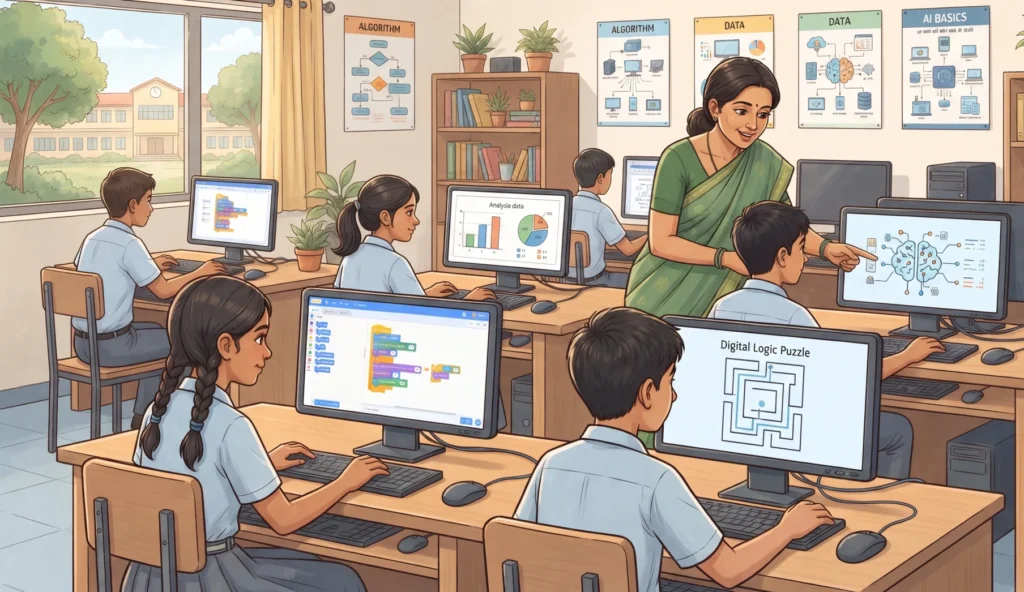
Lab time and devices
A curriculum cannot work if students only read about computers.
They need time to experiment.
Schools should first check what they already have:
- How many working computers are available?
- Can students practise individually or in small groups?
- Is internet access reliable?
- Can teachers demonstrate tools on a shared screen?
- Is there enough lab time every week?
A school does not necessarily need the newest devices.
It needs reliable access and meaningful practice.
For planning the broader computer-learning journey, schools can also refer to this guide on the computer syllabus for school students.
Age-appropriate content
This is where many AI programmes go wrong.
Students should not receive the same AI lesson at every age.
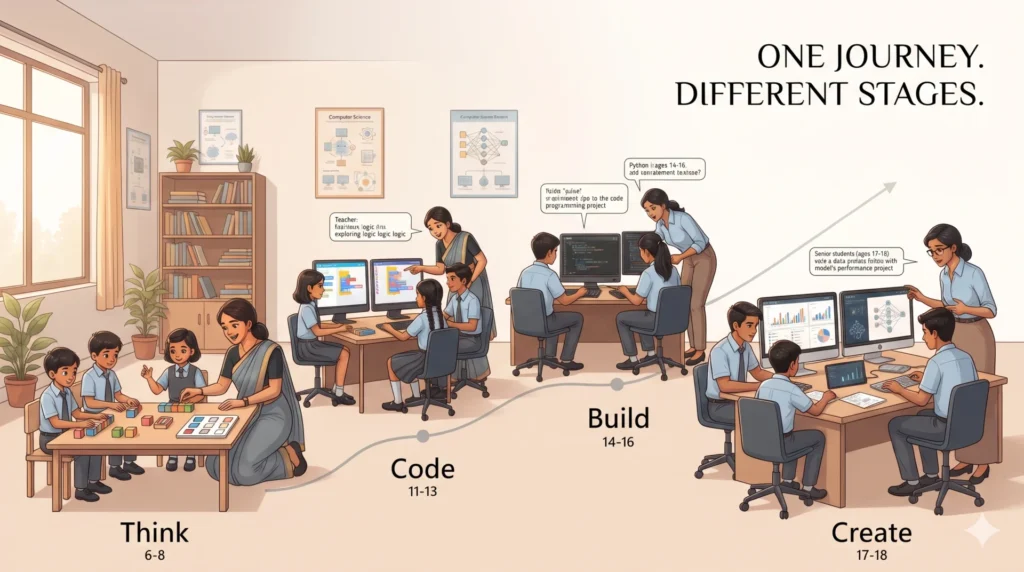
For younger students, focus on:
- Patterns
- Logical thinking
- Simple algorithms
- Everyday examples of AI
- Safe technology habits
For middle-school students:
- Data
- Basic coding
- Algorithms
- AI applications
- Problem-solving projects
- Responsible AI use
For older students:
- Python or other programming
- Data analysis
- AI concepts
- Automation
- Projects
- AI ethics and real-world applications
The progression should feel natural.
The objective is not to make every student an AI specialist. It is to make students comfortable understanding and using technology thoughtfully.
A Class-Wise AI and Coding Starter Plan
A simple starting framework can look like this:
| Classes | Focus | Example Activities |
| 3–5 | Computational thinking | Patterns, sequencing, puzzles, simple algorithms |
| 6–8 | Coding + AI basics | Scratch, block coding, data and AI examples |
| 9–10 | Applied coding | Python basics, problem-solving and small projects |
| 11–12 | Advanced applications | AI, data, programming, projects and career exploration |
The exact curriculum should always follow the applicable board and school requirements.
The important thing is progression.
A student should not jump from “What is a computer?” to “Build an AI application.”
There should be a learning path in between.
Tools and Free Resources
Schools do not need to purchase a large collection of AI tools immediately.
Start with tools that help students understand concepts through experimentation.
For younger students, block-based coding platforms can make programming less intimidating. For older students, schools can introduce programming environments and carefully selected AI learning resources.
Teachers should also make use of official curriculum material before searching for dozens of external platforms.
The current CBSE CT & AI curriculum itself provides a useful foundation for Classes III–VIII.
The bigger question is not “How many AI tools does our school have?”
It is:
“What can students actually learn by using this tool?”
That question keeps technology connected to education.
Teachers who want to strengthen their own digital skills can also explore free online courses for teachers with certificate.
Teaching AI Ethics and Judgement
This may become one of the most important parts of a school AI curriculum.
Students should not only learn what AI can do.
They should also learn when to question it.
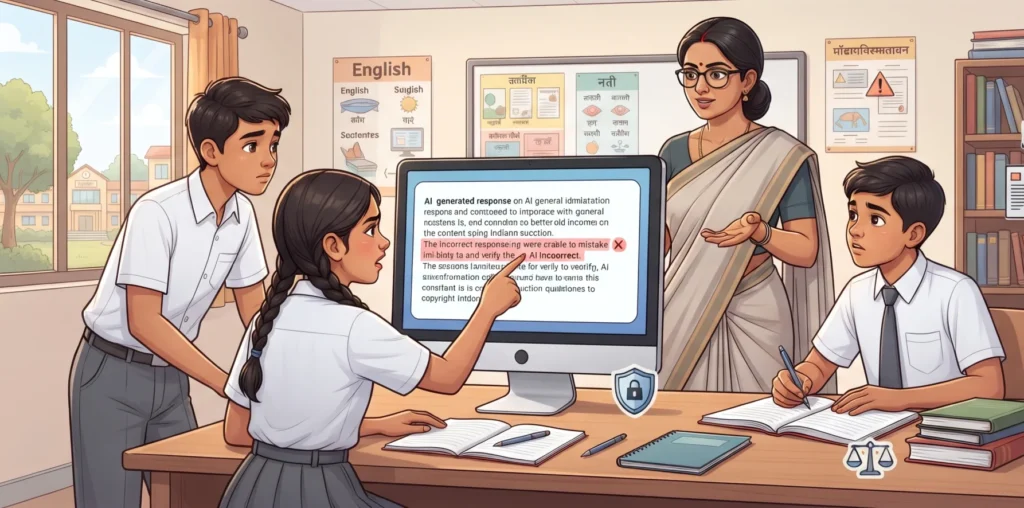
For example, a teacher can show students an AI-generated answer containing a mistake and ask them to find it.
Another activity can compare two AI-generated answers and ask:
“Which one would you trust, and why?”
Students can also discuss:
- Privacy
- Bias
- Fake information
- Copyright
- Over-dependence
- Human judgement
These conversations make AI education practical.
The message should be simple:
AI is a tool. The student is still responsible for the thinking.
How Apni Pathshala Can Support Schools
Apni Pathshala approaches AI and coding through practical learning rather than treating them as isolated subjects.
Saturday AI sessions can give students dedicated time to explore AI concepts, ask questions and work on activities beyond routine classroom learning.
Project Narayan provides another practical direction, using Eklavya AI in government-school learning, with the focus on students’ learning needs rather than simply introducing technology.
Schools can also use guided AI learning alongside computer practice so students gradually move from basic digital skills towards coding, problem-solving and independent learning.
The aim is not to make technology the centre of education.
It is to make technology useful enough that students can learn with greater confidence and independence.
A Simple Preparation Plan for Schools
A school preparing for AI and coding does not need to change everything in one month.
Start with five steps:
1. Check your current position
Review devices, lab time, internet, teacher skills and existing computer classes.
2. Understand the curriculum
Map the relevant board requirements to the skills students already learn.
3. Train a small teacher group
Start with interested teachers and gradually build wider capacity.
4. Begin with small projects
Let students solve simple problems before introducing complicated AI tools.
5. Review before expanding
Ask what students actually learned, what teachers found difficult and what needs improvement.
This makes AI adoption much more practical.
The Goal Is Not More Technology
Schools sometimes measure digital readiness by the number of computers, applications, or smart screens they have.
That is not enough.
A school is better prepared when students can use technology to solve problems, teachers know how to guide them, and leadership understands where technology should and should not be used.
AI and coding should therefore be treated as part of a larger learning journey.
Students start by learning how to think.
Then how to solve.
Then how to code.
Then how technology works.
And eventually, how to use AI responsibly.
That is the kind of preparation that will matter long after today’s AI tools have changed.
Frequently Asked Questions
1. Is AI part of the CBSE curriculum?
Ans. Yes. CBSE introduced the Computational Thinking and Artificial Intelligence curriculum for Classes III–VIII from the 2026–27 academic session.
2. At what age should students learn coding?
Ans. Students can start with simple computational thinking and coding activities in the primary years, then gradually move towards more advanced programming as they grow.
3. What do schools need to teach AI?
Ans. Schools should cover computational thinking, coding, data, AI concepts, problem-solving and responsible technology use through age-appropriate activities. Schools can also explore an AI curriculum for schools to understand how these skills can be introduced systematically.
4. Which free tools can teach AI to students?
Ans. Schools can start with curriculum-aligned resources and accessible coding platforms, choosing tools according to student age, learning goals, privacy and teacher supervision. Teachers can also explore free online courses for teachers with certificate to build their own digital skills.