

You probably think the main risk in starting an education centre is money.
Rent. Computers. Staff. Marketing. Setup cost.
That is the visible risk.
The more dangerous risk appears after launch, when parents send their child for one month and wait for a reason to trust you.
If they see progress, they stay. If they see nothing, they disappear.
No fight. No warning. No angry review with three skull emojis. Just one less student. Then five less. Then ten less.
Then the owner says, “Market is bad”
Maybe.
Or maybe the centre was cheap to start and expensive to trust.
People Don’t Search “Low Investment” Because They Are Lazy
Most people searching for a low investment education business are not trying to avoid work.
They are trying to avoid blind risk.
They want a business in education, but they do not want to walk into the market with a plastic sword and a dream.
They want what any normal beginner wants:
- Brand.
- Curriculum.
- Marketing.
- Launch support.
- Lower risk.
Fair. Nobody wants to open “Future Skills Academy” and then learn the future skill of explaining losses to relatives.
Support matters. A map matters. A known system matters. But the map should lead somewhere.
In education, that “somewhere” is student progress.
The Franchise Promise Sells Relief
Franchise-style models work because they understand fear.
A beginner wants someone to say: Teach this. Use this brand. Market like this. Follow this system. Avoid this mistake.
That feels safe. It gives the owner a plan before panic starts chewing the furniture.
And to be clear, support is useful. A good system can save time, reduce waste, and stop a new centre owner from inventing everything from zero while also fixing the printer.
But opening the centre is only round one. The business survives when parents believe their child is improving.
That is the part many low-cost models treat like decoration.
Bad idea.
Parents Are Buying Proof
Parents are not paying for chairs. They are not paying for a whiteboard.
They are not paying for a logo. They are paying for a change they can notice.
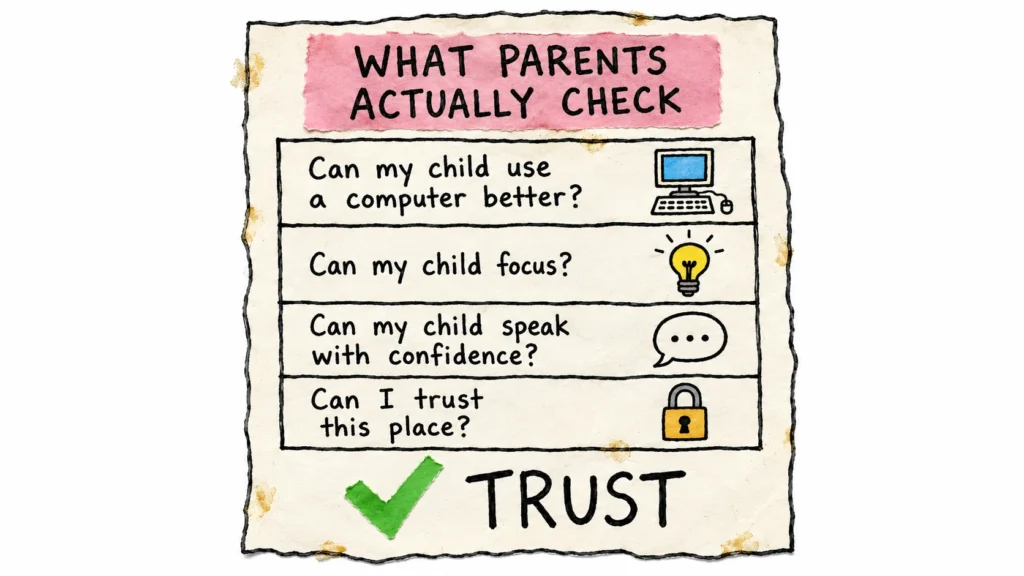
That is the deal. Money follows trust.
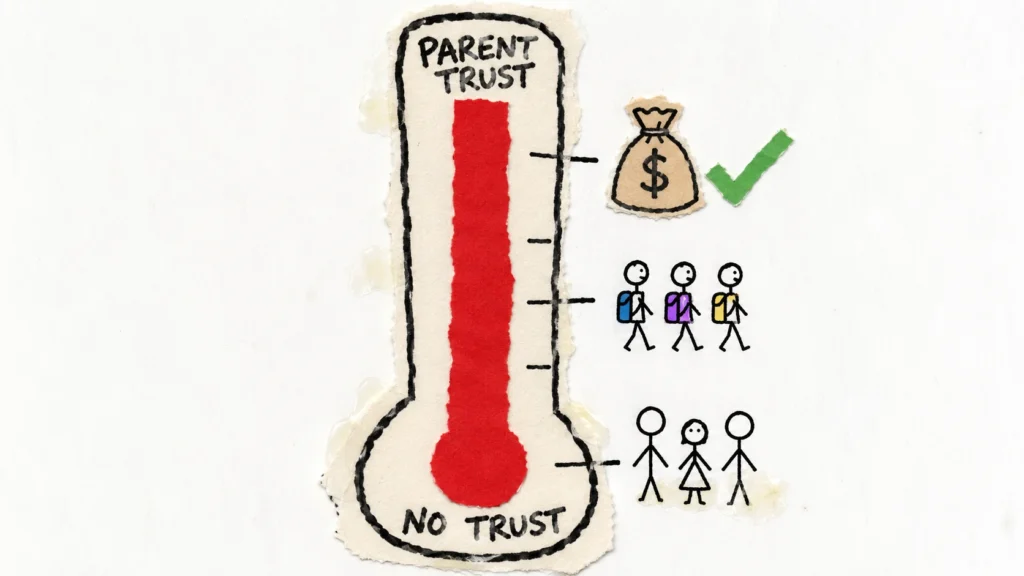
In a local education business, trust is oxygen. No trust, no retention. No retention, no referrals. No referrals, no business.
Very simple. Very brutal.
The Small Thinking Trap
The Small Thinking Trap starts with good advice: “Start small.” Good.
Then it slowly becomes bad advice: “Think small.”
Bad.
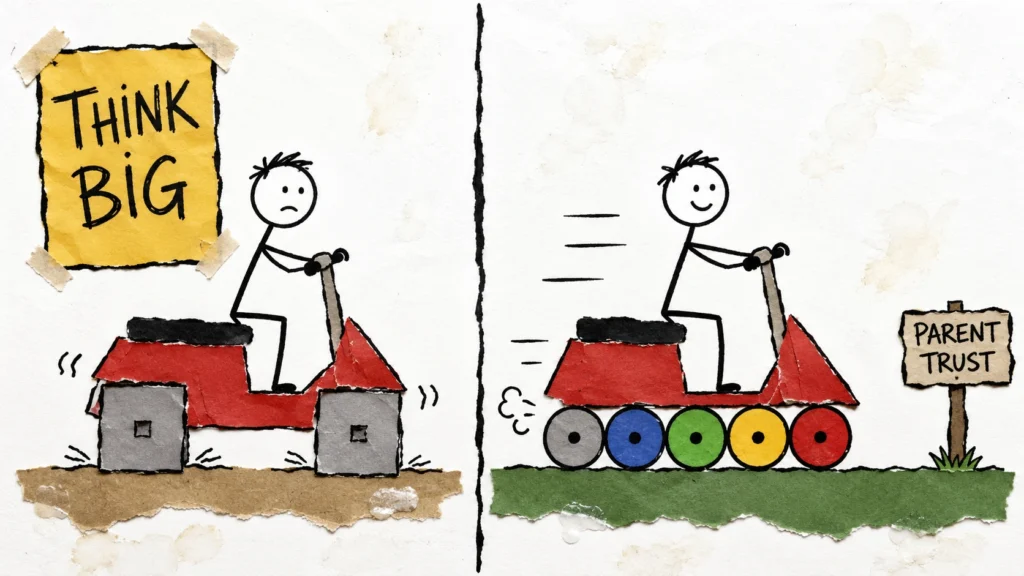
So the owner rents a room. Adds a whiteboard. Adds a few computers. Prints “future skills” on a banner. Takes photos. Posts them online. Everything looks ready.
Inside, the engine is missing.
No clear learning path. No safe digital system. No mentor support. No progress tracking. No parent visibility.
Then students stop coming. Parents stop asking. The owner says, “Competition zyada hai.”
Maybe…or maybe the centre was built like a scooter with no wheels and a motivational quote.
A Serious Low-Cost Education Model Needs 5 Engines
A low-cost education model should reduce waste. It should not reduce learning quality.
To start an education centre work with low cost, these five engines matter.
1. Local trust
Parents trust people they can meet. A local centre has a face, a room, and a phone number that gets answered. Trust lowers marketing cost.
2. Structured learning
Students need a path. Without a path, computer time becomes supervised clicking. Clicking is not learning. It is finger exercise. Structure creates progress. Progress keeps parents interested.
3. Safe technology
Screens can teach. Screens can also kidnap attention and run away laughing. A good centre needs control, blocking, monitoring, and clean digital use. Safety removes parent fear.
4. Mentorship
Content teaches. A mentor notices. The fake “haan sir, samajh gaya” has a face. A good mentor learns to catch it. Mentorship reduces dropouts.
5. Visible progress
Parents need proof. Students need proof. The operator needs proof. Hope is cute. Proof pays rent.
Apni Pathshala’s POD Model Gives You the Missing System
Apni Pathshala helps people start PODs (Points of Digital Learning).
It is a small digital learning centre started in a local community by individuals, schools, or NGOs with support from Apni Pathshala. Each POD gets Apna PC computers and learning tools for computer basics, creativity, communication, and coding. Apni Pathshala also gives POD leaders training, technology, and continuous guidance.
For a local entrepreneur, teacher or NGO, this matters.
You do not need a giant building. You absolutely do not need to design everything on your own. You get a model built around tools, structure, support, and local learning.
That gives you the useful parts people want from a franchise:
Support. Tools. Structure. Guidance. Credibility.
But the centre points toward student growth, not admission numbers alone. A POD helps you start small without looking random, weak, or unprepared.
Apni Pathshala also says POD leaders receive 10 fully equipped computers, and the organisation does not charge anything to run a POD, even if the POD starts earning money. The PCs are given on a 15-month lease through an MoU.
That lowers the starting pressure.
Small setup. Serious system. Better chance of trust.
Apni Prerna Handles the Screen-Time Fear
A centre with computers sounds modern..but it can also scare parents.
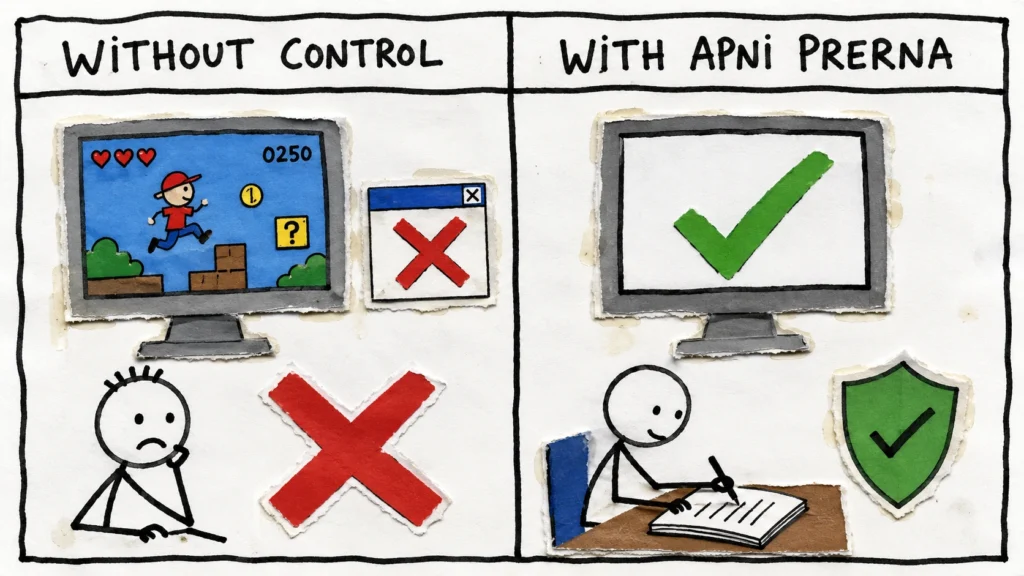
Because parents know screens. Screens can become learning. Screens can also become games, random videos, unsafe sites, and one mysterious tab nobody wants to explain.
Apni Prerna helps make digital learning safer and more focused. It supports custom website blocking, dashboard-based insights, OS-level control, system health monitoring, USB and network control, and remote troubleshooting.
It also supports digital discipline by blocking distractions and shows real-time student learning activity through a dashboard.
That helps answer the parent’s silent fear:
“Will my child learn here, or waste time as always”
A computer without control is a distraction box with a keyboard
Patwa Toli Shows Small Can Still Be Serious
Every education model sounds good in a brochure, but proof matters.
Apni Pathshala shared the story of 10 students from Patwa Toli who cracked IIT JEE Advanced without big coaching support. They did not have expensive coaching, private tutors, or air-conditioned classrooms. They had a quiet room, a computer, and discipline.
That story matters for anyone exploring education business ideas in India.
It shows that a small local learning space can produce significant outcomes when students have access, focus, structure, and a place to work.
A small room was never the danger. It was always a weak system.
But Small room. Strong system. Serious result.
That is the model worth noticing.
Read Next: Why Another Coaching Centre Is Not the Future
Before choosing from random education business ideas in India, understand the bigger shift.
Read next: Education Business Ideas in India: Why Another Coaching Centre Is Not the Future
That blog explains why parents are moving away from “more classes” and toward better learning spaces.
And at last..
Start Small, But Build Something Parents Trust
A low-investment education business can work. But cheap alone will not save it.
It works when parents trust it. It works when students improve. It works when the centre can show progress.
Wonder why these coaching institutes survive? Its not just marketing. Rankers attract everyone. In every field.
Low investment is smart, but Low design kills the business.
If you are ready, this is how we can help you – Start A Pod Today
FAQ: Low Investment Education Business
1: Is a low investment education business profitable?
Ans. Yes, it can be profitable when parents trust the centre, and students keep improving. Quick launch promises are not enough. Retention matters more.
2: What are good education business ideas in India?
Ans. Local digital learning centres, skill centres, after-school learning spaces, computer centres, and POD-based learning spaces are strong options. The better idea depends on your local needs.
3: How can I start an education centre work with low cost?
Ans. Start with a small trusted space, a clear learning system, digital tools, mentorship, and parent-visible progress. Low cost should reduce waste, not quality.
4: What is a low-cost education model?
Ans. A low cost education model lowers setup cost without lowering safety, structure, learning quality, or student outcomes.



8 Responses
Nice infomation, I was thinking to open a pod so their is specific page where i can see the detials or can you share me phone no. to connect and solve my query?
Sure! Check Contact Us or the Start a POD tab.
nice vlog
Thank you for reading!
nice blog
Thank you!!
A practical and motivating guide for anyone looking to start an education business with limited investment. The focus on quality, trust, and long-term impact is truly valuable. Great read!
Well written! Sustainable education businesses are built on student progress and parent trust.