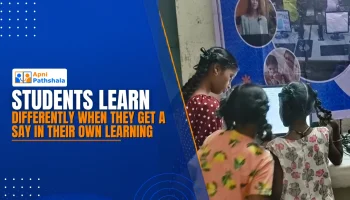
A student can remember an exam answer and forget it a week later.
But a good question can stay with them for years.
Why does this work?
What would happen if I changed this?
Is there another way?
How do we know this is true?
These questions are easy to overlook because schools naturally focus on answers. But some of the strongest learning begins when a student becomes curious enough to ask something that was never written in the textbook.
Education Is More Than Getting the Right Answer
A correct answer tells us that a student knows something.
A good question can tell us that they are thinking about it.
That difference matters.
A student who asks why the sky changes colour is doing something different from a student memorising the explanation.
A student who asks why one solution works better than another is already moving towards deeper understanding.
Recent research on question-asking found that students’ domain-specific question-asking improved over a semester, and stronger question-asking ability was positively associated with performance on open-ended projects. PubMed
The interesting part is that questions were not simply a sign of curiosity.
They were part of the learning process itself.
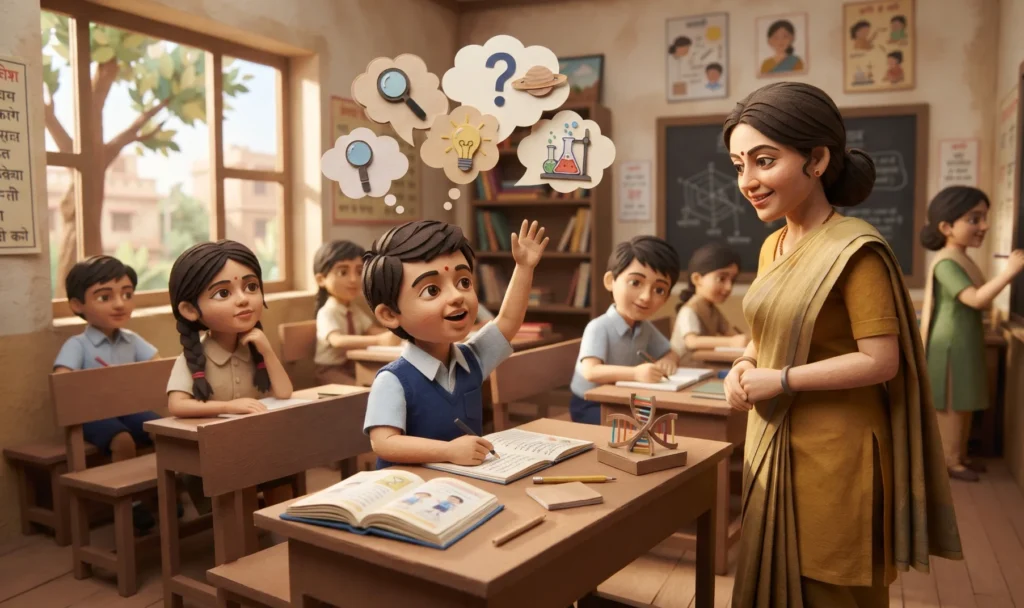
Education Needs Better Questions, Not Just More Content
Students already have access to an enormous amount of information.
The harder skill is deciding what is worth understanding.
That means education has an opportunity to move from:
“Here is the information. Remember it.”
towards:
“Here is the information. What do you notice?”
That small change can alter the entire learning experience.
Instead of asking students to repeat what they have read, teachers can ask them to compare, investigate, predict, challenge and explain.
That is where critical thinking begins.
Education Can Make Curiosity Part of the Lesson
Curiosity is not just a personality trait that some students naturally have and others do not.
It can be encouraged.
A 2026 experiment with young children found that encouraging them to ask questions during science lessons increased some curiosity-related behaviours and their interest in new information. Nature
That does not mean every lesson needs to become an open-ended discussion.
Sometimes one question is enough.
Instead of beginning with the explanation, begin with the puzzle.
Instead of giving students the result, ask them to predict it.
Instead of telling them what went wrong, ask them where they think the mistake happened.
The student now has a reason to find out.
Education Works Differently When Students Investigate
This is the basic idea behind inquiry-based learning.
Students are not simply given information. They investigate a question, collect information, test an idea and form a conclusion.
A 2026 meta-analysis of 51 studies found a significant positive effect of inquiry-based learning on students’ critical thinking, although the researchers also noted substantial variation across contexts. PubMed
That qualification matters.
Inquiry is not a magic teaching method.
It works best when students have the right knowledge, guidance and structure around the investigation.
The teacher still matters.
In fact, good inquiry often requires more thoughtful teaching, not less.
Education Should Give Students Something Worth Investigating
A question becomes powerful when there is something behind it.
“Why is this important?”
“What would happen if we changed one part?”
“Can we prove it?”
“Does this work outside the textbook?”
These questions can turn a normal lesson into an investigation.
A science student can test an idea.
A mathematics student can find more than one solution.
A history student can compare different accounts.
A student learning computers can build something and then figure out why it works.
This is where project-based learning can become useful: the student has a question, and the project becomes a way to explore it.
Education Should Not Punish Students for Being Curious
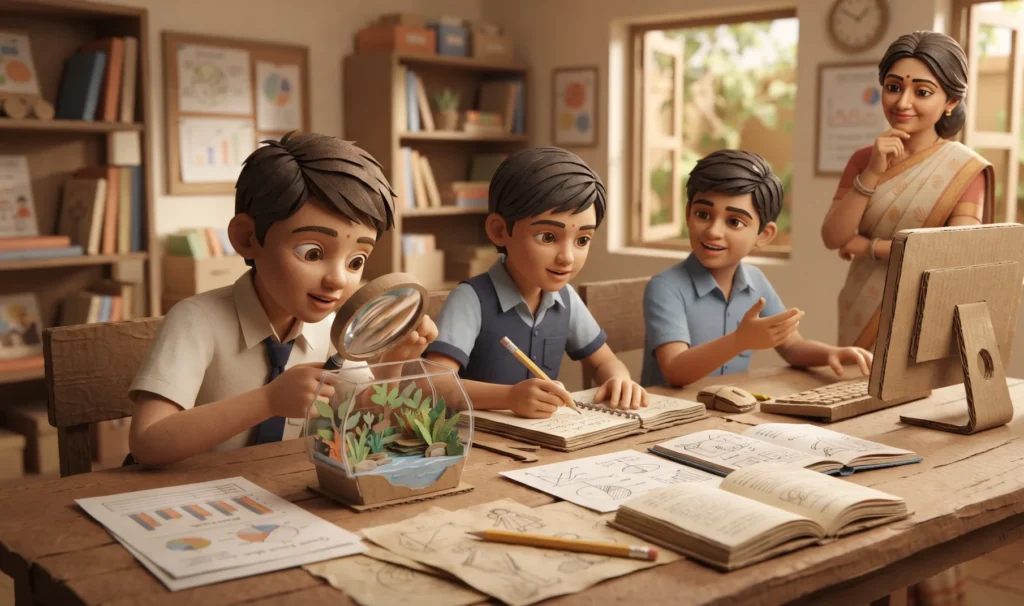
Sometimes students learn very quickly that asking too many questions slows the class down.
So they stop.
They write down the answer.
They move to the next question.
Eventually, curiosity becomes something they do privately instead of something they bring into the classroom.
That is a missed opportunity.
The latest PISA 2025 results show that curiosity is positively associated with science performance across participating education systems. At the same time, several indicators of curiosity declined between 2022 and 2025 in many systems. OECD
That makes the question even more important:
Are our learning environments giving students enough reasons to stay curious?
Education Can Measure More Than Answers
This conversation is already changing.
In its recent work on assessment, PARAKH’s Holistic Progress Cards look beyond marks to capture areas such as inquiry, creativity, collaboration and reflection.
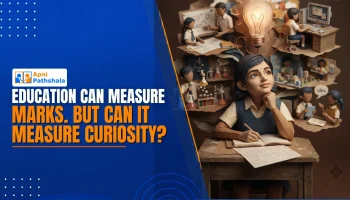
Apni Pathshala explored a similar question in Education Can Measure Marks. But Can It Measure Curiosity?, asking whether a report card can really capture everything important about how a student learns.
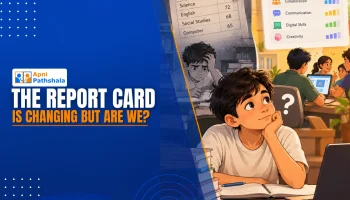
And The Report Card Is Changing. But Are We? takes the conversation further by looking at what assessment might recognise beyond a percentage.
The point is not that marks do not matter.
They do.
The point is that they are one part of the story.
Education Should Make Students Comfortable With “I Don’t Know Yet”
There is a difference between:
“I don’t know.”
and
“I don’t know yet.”
The second one leaves the door open.
It tells the student that not knowing is not necessarily failure.
It can be the beginning of investigation.
That mindset is particularly important in a world where students will repeatedly encounter problems they have never seen before.
They will need to know how to find out.
How to ask.
How to test.
How to change their approach.
How to keep going.
Education Becomes Stronger When Questions Travel Beyond the Classroom
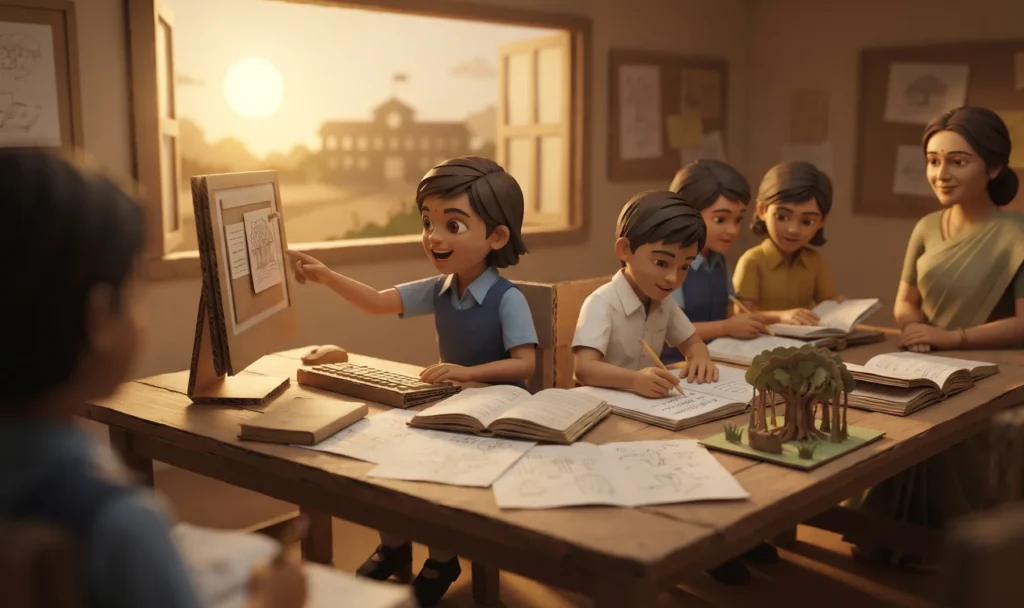
A question should not always end when the school bell rings.
A student may continue thinking about it at home.
They may discuss it with a friend.
They may investigate it in a community learning space.
They may come back the next day with another question.
This is where Apni Pathshala’s wider learning approach connects naturally.
Through Learn From Peers, students can discuss ideas and learn from one another instead of treating knowledge as something that only moves from teacher to student.
The goal is simple:
Make learning something students continue because they are curious about what comes next.
Education Should Leave Something Behind
The best lesson may not be the one where a student remembers everything the teacher said.
It may be the one where they walk out thinking:
“I want to know why.”
That question can lead somewhere.
To another book.
Another conversation.
A small experiment.
A project.
A new interest.
Maybe even a future career.
At Apni Pathshala, we believe learning should help students become more confident in asking, exploring and figuring things out.
If you are a student, try something simple tomorrow: before looking for an answer, write down three questions about the topic you are learning.
If you are a teacher or parent, ask a student one question that has no single obvious answer.
And if you want to see how this kind of curiosity and student-led learning can become part of a wider learning environment, explore Apni Pathshala’s learning community.
Because the goal of education is not to make students who always have the answer.
It is to make students who know what to ask next.
Frequently Asked Questions
1. Why are questions important in education?
Ans. Questions help students investigate ideas, connect concepts and develop deeper understanding. Research on student question-asking and learning found that stronger question-asking was positively related to open-ended project performance.
2. Can curiosity improve student learning?
Ans. Yes. PISA 2025 found a positive association between students’ curiosity and science performance. Read the OECD’s findings on student curiosity.
3. What is inquiry-based learning?
Ans. Inquiry-based learning allows students to investigate questions, test ideas and develop conclusions. A 2026 meta-analysis of inquiry-based learning found a significant positive effect on critical thinking, while noting that outcomes vary by context.
4. How can Apni Pathshala encourage students to keep learning?
Ans. Apni Pathshala creates opportunities for students to explore, collaborate and learn beyond a fixed lesson. Its Learn From Peers approach helps students learn from one another and become active participants in their learning community.