For years, the report card has been one of the simplest ways to describe a student’s progress.
A few subjects. A few marks. A percentage at the bottom.
It tells us something.
But does it tell us enough?
What if a student who scored 70% is asking better questions, becoming more confident, learning from mistakes, and discovering something they genuinely enjoy?
Those things matter too.
That’s exactly why the conversation around student assessment is changing.
What Is Changing About Assessment?
In July 2026, PARAKH published a detailed look at how its stage-wise Holistic Progress Cards can capture inquiry-based learning. The idea is simple: assessment should recognise how students observe, question, investigate, collaborate, create, and reflect, not only how many answers they get right.
That is a different way of looking at a report card.
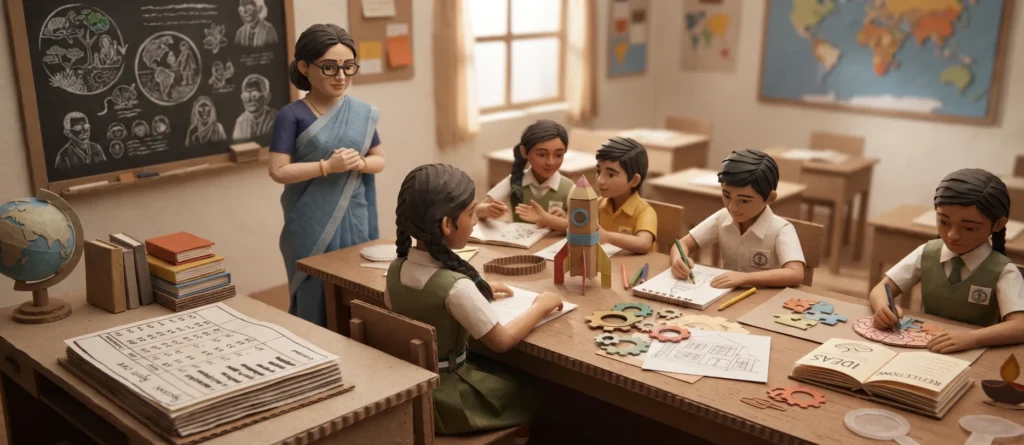
A student who asks an unusual question is showing something.
A student who finds another way to solve a problem is showing something.
A student who can explain where they struggled and what they want to improve is showing something too.
The challenge is making sure we notice it.
Two Students Can Get the Same Marks and Learn Completely Differently
Imagine two students who both score 70%.
The first memorised the material, reproduced it accurately, and forgot most of it soon after the exam.
The second struggled at first. They asked questions, discussed the topic with classmates, tried different approaches, and eventually understood it well enough to explain it to someone else.
Their report cards may look almost identical.
Their learning journeys are not.
This is why assessment can become more useful when it helps us understand progress, not just performance.
NITI Aayog’s 2026 review of India’s school education system looks at learning outcomes alongside access, infrastructure, equity, and inclusion. It reflects a broader understanding that improving education requires looking at several parts of the system together. NITI Aayog
The Better Question Is “What Next?”
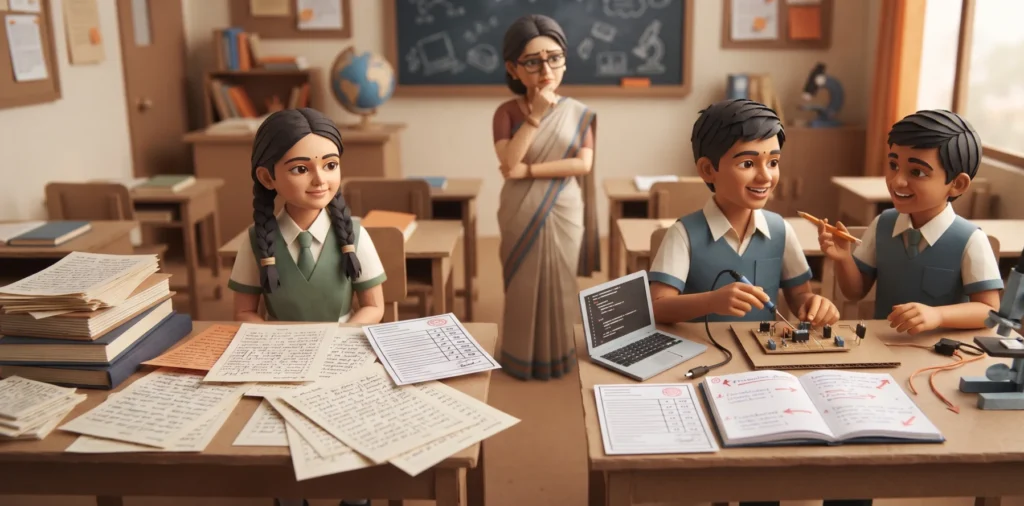
After an exam, we usually ask:
“How much did the student score?”
What if we also asked:
“What should this student do next?”
If a student is struggling with fractions, they may need more practice.
If they have mastered the topic, they may need a harder problem.
If they have developed an unexpected interest in design, perhaps they should get an opportunity to explore it.
A useful assessment should help us answer those questions.
That turns assessment from something that simply closes a chapter into something that helps open the next one.
Students Need More Ways to Show What They Know
Sometimes the best evidence of learning is not an exam answer.
It can be a project.
A presentation.
A discussion.
A student explaining an idea to another learner.
A solution that did not work the first time but was improved after several attempts.
These moments show students using knowledge, not simply reproducing it.
The National Education Policy 2020 also emphasises competency-based learning, experiential learning, critical thinking, and a more holistic approach to student development.
This does not mean exams suddenly become unimportant.
It means they become one part of a bigger picture.
A Report Card Can Become a Conversation
Imagine a parent-teacher meeting that begins differently.
Instead of:
“Your child scored 62%.”
Imagine hearing:
“Your child has started asking better questions.”
“They are much more confident while working with others.”
“They understand the concept but need more practice here.”
“They have developed a strong interest in design.”
Now the conversation is about the learner.
That is where assessment becomes useful.
It helps parents understand what is happening.
It helps teachers decide where support is needed.
And it helps students see that one difficult test does not define them.
What This Means for Apni Pathshala
At Apni Pathshala, we have always been interested in the part of learning that happens after the lesson.
Does a student become confident enough to try something independently?
Do they discover an interest they did not know they had?
Can they explain something to another student?
Can they turn what they learned into a project?
Our Student Stories are full of these moments.
They show students moving from learning basic skills to creating projects, exploring careers, taking internships, mentoring others, and finding new possibilities.
A report card may capture one part of that journey.
It cannot capture all of it.
The Goal Is Not to Remove Marks
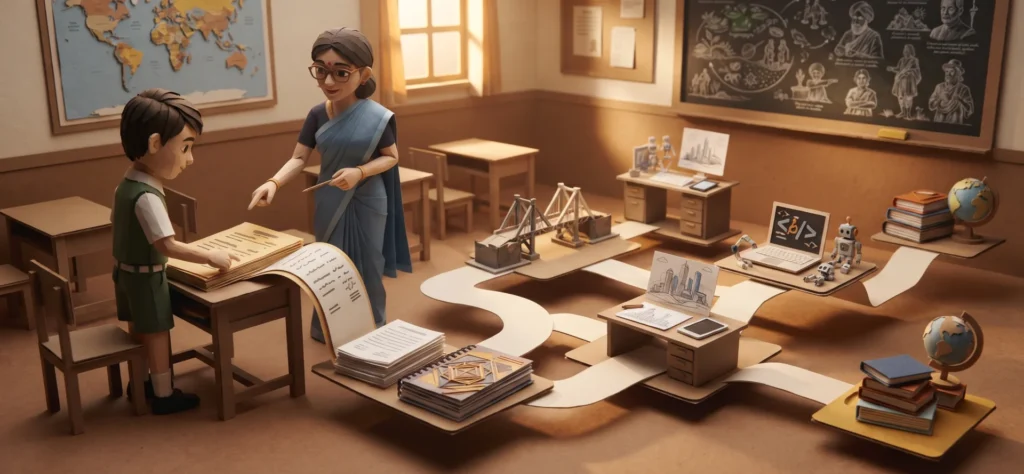
Marks still matter.
Exams still matter.
Academic foundations still matter.
The point is not to remove them.
The point is to stop treating one number as the complete story of a student.
A student is also developing confidence, curiosity, communication, creativity, problem-solving ability, and the ability to learn from mistakes.
Those qualities may not always appear in a traditional marksheet.
But they can shape what happens next.
The Future of Assessment May Be More About Growth
A better assessment system should help answer four simple questions:
Where is the student today?
What can they already do?
Where do they need support?
What are they ready to try next?
That is much more useful than simply knowing whether they scored 65 or 75.
And perhaps this is where education is slowly moving; from asking students to prove what they remember to helping them understand how they are growing.
Start Looking Beyond the Score
The next time a student receives a report card, look beyond the percentage.
Ask what they enjoyed.
Ask what they found difficult.
Ask what they learned outside the textbook.
Ask what they want to try next.
If you are a student, use your marks as feedback, not as a label.
If you are a parent, ask for the story behind the score.
If you are a teacher, look for curiosity, effort, collaboration, and growth.
And if you want to see what that growth can look like in real life, read the stories of Apni Pathshala students and see how learning can turn into skills, confidence, projects, and new possibilities.
You can also explore Learn From Peers to see how students can move from receiving help to helping someone else.
Because a report card can tell us how a student performed.
The more important question is what that student is becoming.
Frequently Asked Questions
1: What is a Holistic Progress Card?
Ans. A Holistic Progress Card looks beyond marks to recognise areas such as inquiry, creativity, reflection, collaboration, and learner development. Read PARAKH’s work on Holistic Progress Cards and Identity Development.
2: Can peer learning support student development?
Ans. Yes. Peer learning gives students opportunities to explain ideas, collaborate, communicate, and learn by helping one another. Explore Apni Pathshala’s Learn From Peers.
3: How can students become more independent learners?
Ans. Students can build independence by practising regularly, reflecting on mistakes, exploring their interests, and taking greater responsibility for their learning. Read How Self-Learning Can Change a Student’s Future.
4: What should a good assessment tell us about a student?
Ans. A useful assessment should help identify what a learner understands, where they need support, and what they may be ready to learn next. It should contribute to a broader picture of student growth, not only a final score.