

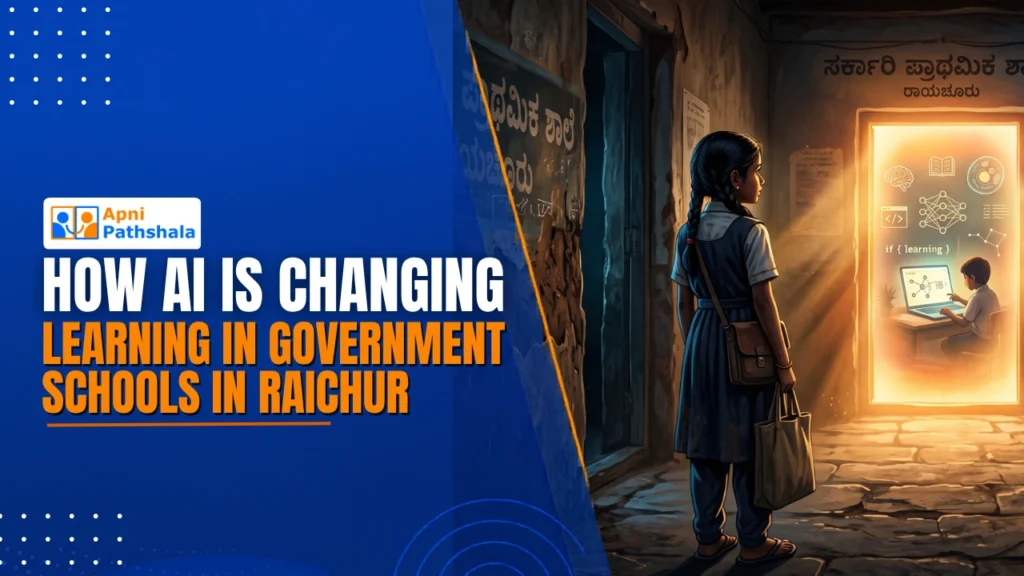
I will be honest. I did not expect this to happen so fast.
When Apni Pathshala announced Project Narayan, I assumed the hardest part would be finding the first school. The first government school principal in Raichur is willing to trust that AI-powered learning actually belongs inside their classroom.
I was completely wrong.
Three schools said yes on day one.
Three government school principals, without waiting for proof, without waiting for somebody else to go first, without waiting for a government circular telling them to, raised their hands and said, “Bring it here.”
That changed something for me.
Project Narayan is named in memory of Sir Narayan Malpani. A visionary. A mentor. An inspiration to everyone whose life his work touched.
He believed, without apology, that every child in India deserves access to quality education. Not just the children whose parents can afford it. Every child.
The simplest way to honor a person like that is to do the work he believed in.
These three schools are doing exactly that.
The First School That Believed It
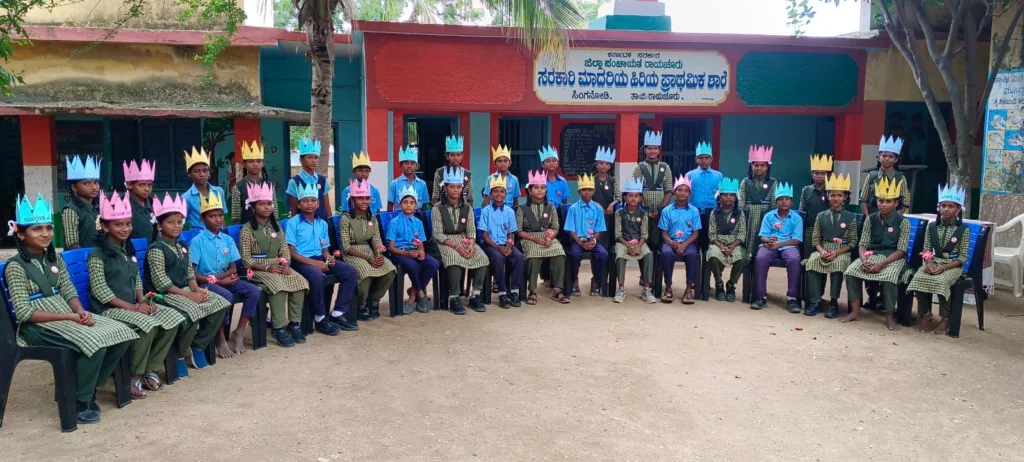
Government Model Higher Primary School. Singanodi, Raichur Taluk.
Headmaster Anjaneya runs this school.
Singanodi is not a place most edtech companies consider when planning their next product launch. The children studying here are not the target audience for expensive AI platforms. Nobody is running investor decks about bringing cutting-edge technology to Singanodi.
That is precisely why Headmaster Anjaneya’s decision matters so much.
He did not wait for a government pilot. He did not wait for a neighboring school to try it first and report back. He looked at what Eklavya AI could do for his students and made the call himself.
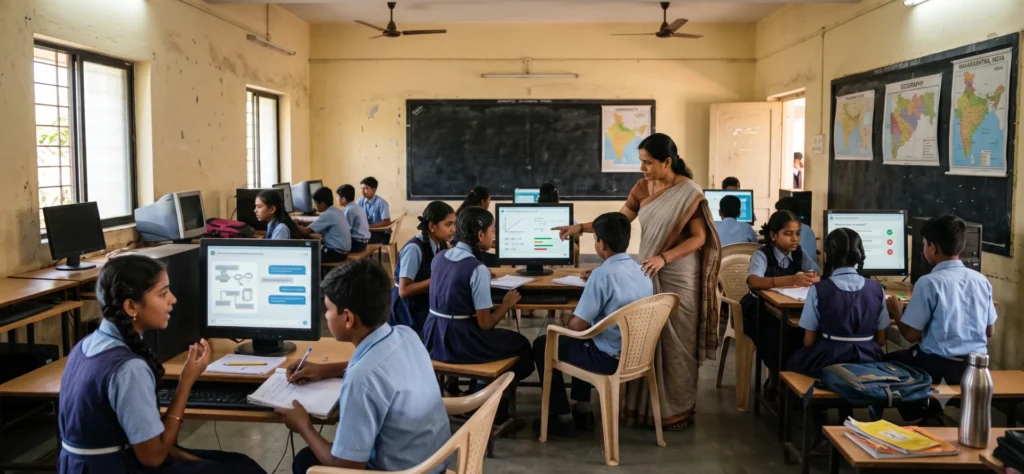
The children of Singanodi now learn with an AI that understands their curriculum. That adapts to how each individual child processes a concept. That never runs out of patience.
That is not a luxury.
That is what every child in this country deserves.
Who Knew Exactly What Was Missing
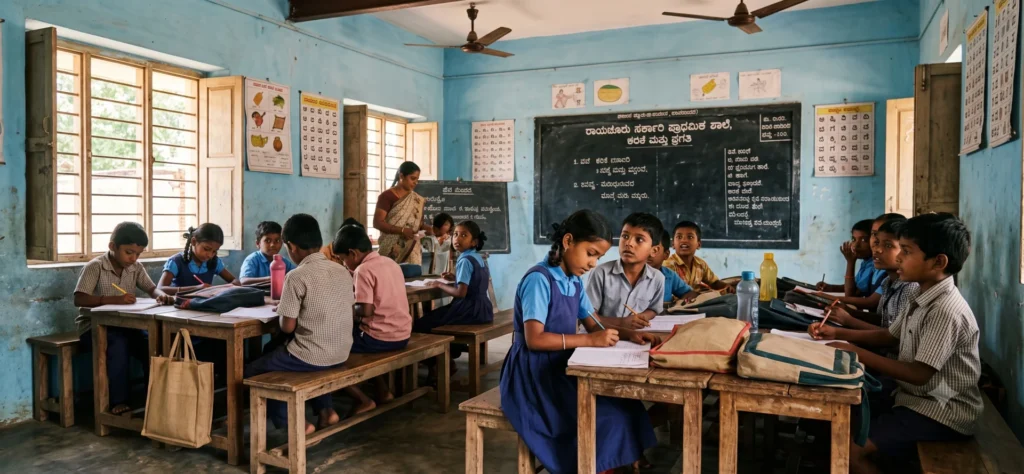
Government Higher Primary School, LBS Nagar.
Headmistress Saraswathi leads this school.
Here is the reality of most Indian government classrooms. One teacher. Forty students. A syllabus that moves fast. And somewhere in that equation, the child who did not understand today’s lesson falls behind quietly. Tomorrow they fall a little further. A month later, they gave up without saying a word.
Headmistress Saraswathi has watched this happen. She knows exactly what it looks like, and she knows exactly where the gap is.
Eklavya AI does not replace her. It fills the gap she cannot physically fill on her own. It sits beside the student who needed one more explanation, in a slightly different way, without shame, without judgment, without holding the entire class back.
For a child with no tutor, no coaching center, and no extra support waiting at home, this is the difference between staying in the race and quietly dropping out.
She did not need convincing.
She needed the tool to exist. Now it does.
The School That Was Built to Break Barriers
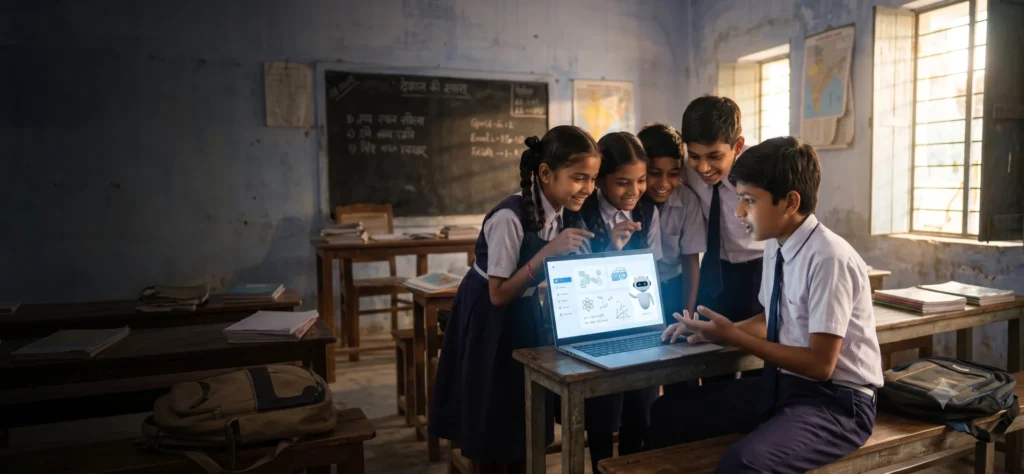
Adarsha Vidyalaya RMSA, Yeramaras. Principal Younous.
RMSA schools were built for one reason: to reach students that the regular system was failing to reach. That is the entire premise of Rashtriya Madhyamik Shiksha Abhiyan. Access for the students who did not have it.
Project Narayan fits inside that purpose, so naturally it almost feels like it was always supposed to happen here.
UNESCO’s research on AI in education has found, consistently, that AI learning tools have the most impact not in well-resourced institutions but in schools where every additional resource counts. Where a single well-placed intervention changes the trajectory of hundreds of children.
Adarsha Vidyalaya is exactly that school.
Principal Younous understood this before the research needed to tell him.
What Eklavya AI Is Actually Doing In These Classrooms
I want to say this clearly because “AI in education” has become a phrase that floats everywhere and means very little anymore.
Eklavya AI is not a generic chatbot. It is not a flashy app that impresses parents on school open days.
It integrates directly with the Raichur District curriculum. A student in Singanodi learning fractions gets AI support that matches exactly what their teacher taught that morning. The AI does not build a separate system running parallel to the classroom.
It deepens the one that already exists.
India’s National Education Policy 2020 has been calling for exactly this kind of integration for years. Project Narayan is delivering it inside real government school classrooms, not in a pilot lab or a private school boardroom.
At Apni Pathshala, we have always believed that real learning happens when real communities have real tools. That is the same belief behind every learning POD we have built. And the physical infrastructure that makes this possible inside a school, including the hardware, is exactly what Apna PC exists to provide.
The tools exist. The schools exist. The students are waiting.
Three Schools. One Foundation That Is Real.
The goal is 100 schools across Raichur.
We are at three.
That number does not feel small to me. It feels like the exact kind of beginning that every large, lasting thing needs. Three principals who did not wait. Three classrooms where students are already learning differently today than they were last month.
Narayan Malpani Sir never built things for announcements. He built things to last.
Project Narayan is his kind of project.
Partner With Apni Pathshala
We need 97 more schools to reach the goal.
If you lead a CSR fund, run an education nonprofit, or hold authority over any school in the Raichur district, we are ready to have that conversation.
The work is real. The impact is already visible. The children are not waiting for a better time.
Contact Apni Pathshala today and help build the next 97 schools. Or start a POD in your own community and bring this model directly to the children in your neighborhood.
Frequently Asked Questions
1: How does Eklavya help students study better?
Ans. Eklavya helps students follow a more organised learning process by providing digital academic support for regular study, revision, and exam preparation.
2: What is an Apni Pathshala POD?
Ans. An Apni Pathshala POD is a community learning center where students can access digital learning, computers, practical skills, and guided learning support.
3: How can Artificial Intelligence improve education?
Ans. AI can support education by enabling personalised learning, improving teaching practices, supporting lesson planning, and helping address major educational challenges. UNESCO highlights AI’s potential to accelerate progress toward inclusive and quality education.
4: Does NEP 2020 focus only on academic learning?
Ans. No. It promotes multidisciplinary learning along with critical thinking, creativity, vocational education, practical skills, and holistic development.
3 Responses
Bringing AI learning to government schools is a great step toward making quality education more accessible to every child.
Thank you so much. We’re happy to see AI learning reaching students in government schools and creating better learning opportunities for every child.
AI-powered learning in government schools can make quality education more accessible and personalised for every student. A meaningful step toward inclusive education!