

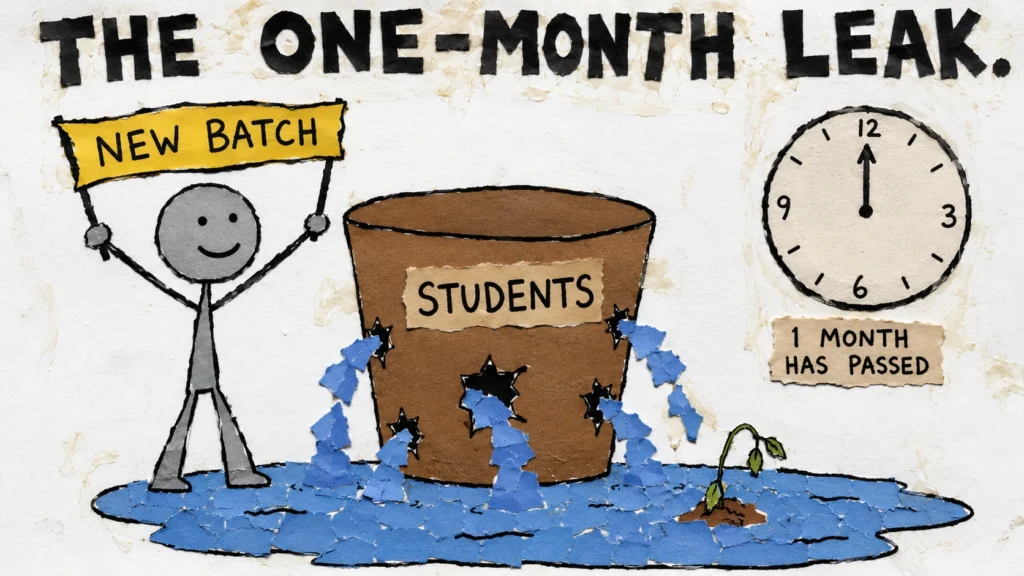
The most dangerous moment in education entrepreneurship usually comes one month after launch.
Launch day is easy to love. People congratulate you. A few photos happen. Someone fixes the banner five times. The first batch looks promising because hope is doing free marketing.
Then the first parent decides whether to pay again.
They will not use words like “education entrepreneurship” or “social impact education.” They will look at their child and ask a much simpler question:
“Has anything changed?”
If the answer is unclear, the business starts leaking.
What Education Entrepreneurship Actually Means?
Education entrepreneurship means building a learning initiative that solves a real education problem and keeps running long enough to matter.
It can be a learning centre, digital skills program, coaching alternative, school support model, NGO project, community hub, or education startup. India has room for many models.
(IBEF projects India’s education market to reach US$313 billion by FY30, which explains why so many people are looking at this space.)
But a big market does not rescue a weak idea. A weak idea just fails in a bigger room.
The first question is simple: who learns better because this exists?
Start With a Demand Signal
Most beginners start with the format.
They ask whether they should open a coaching centre, start a computer institute, build an app, run a school program, or launch some shiny “future skills” thing with a logo that looks suspiciously expensive.
Format comes later. Start with a demand signal.
A demand signal is a real-world clue that people care enough to act. Parents may be complaining that children waste time after school. Students may want computer skills but have no guided place to learn. A school may want digital learning support. An NGO may already have students but no structured program.
A good education initiative is usually hidden within a recurring local complaint.
The 30-Day Test Before You Build Big
Before renting a large space or buying twenty computers, run a small test.
Talk to parents and students. Ask what they already tried, what failed, what they pay for, and what they wish existed nearby. People will praise many ideas for free. Their behaviour is more useful than their compliments.
Then run one small batch.
It could be a weekend digital skills class, a ten-day computer basics program, an after-school study group, or a school partnership session. The point is not to look big. The point is to find out whether people return.
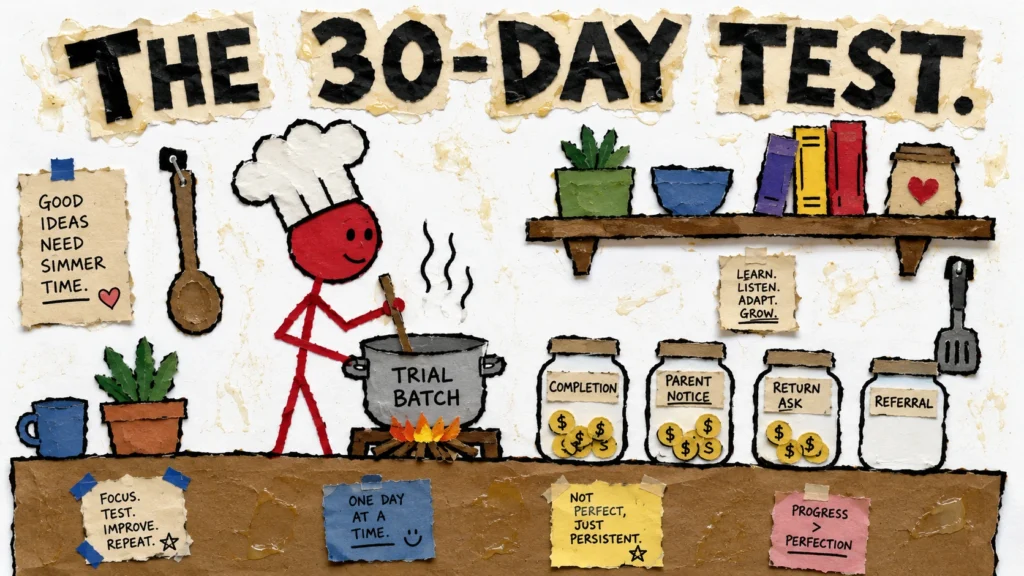
After 30 days, ask four questions:
- Did students complete something visible?
- Did parents notice a change?
- Did anyone ask for the next batch?
- Did someone refer another student?
That is better than a beautiful ad.
4 Education Business Ideas in India You Can Test
- A local after-school learning centre – works when parents need a safe, useful place for children after school. It fails when children only sit there and time passes like a bored ceiling fan.
- A digital skills centre – works when students leave with real computer confidence. A certificate alone is thin proof. A small project, presentation, or completed digital task says more.
- A coaching alternative – works when crowded classes are not solving doubts. Smaller groups, progress updates, and honest communication with parents become the edge.
- An NGO-led learning centre – works when the community already trusts the organisation. Good intentions help people start. Routine keeps the centre alive.
An education startup or hybrid model works when technology supports a real learning process. Many education startup ideas begin with the app. The smarter ones begin with the student.
Well, you know what to target now.
The Numbers That Fool Founders
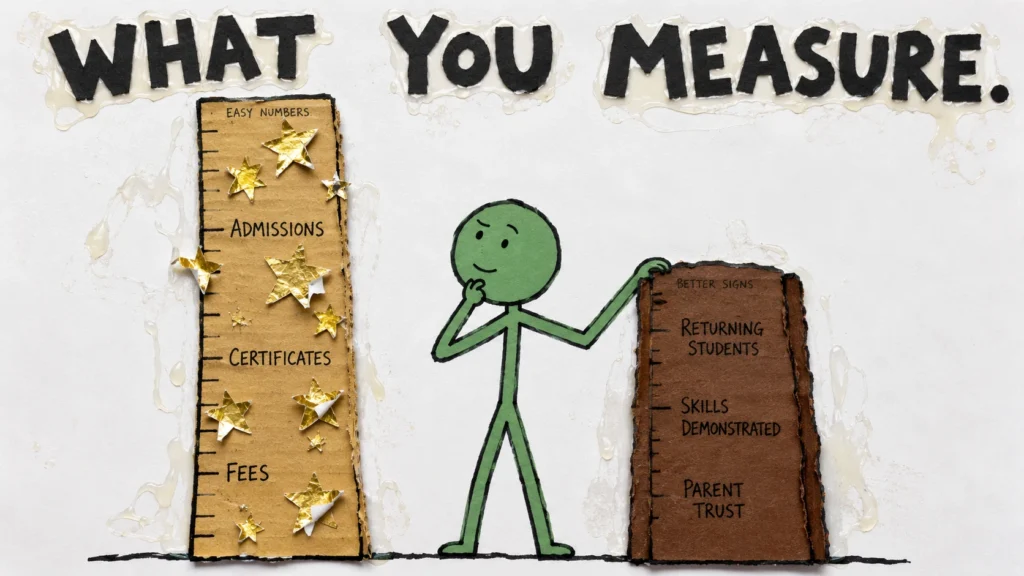
Education founders often measure the easiest things: admissions, fees, batches, certificates, workshops, and photos.
Those numbers are not useless. They are incomplete.
| Easy numbers to count | Better Signs to watch |
|---|---|
| Students enrolled | Students who return next month |
| Classes conducted | Skills or modules completed |
| Certificates given | Work students can show |
| Computers installed | Students using computers confidently |
| Workshops held | Behaviour or skill change |
| Fees collected | Parent trust and repeat payment |
What you measure quietly becomes what your centre protects. If you only track admissions, you build an admissions machine. If you track progress, retention, and student work, the model has a chance to become a learning business.
Purpose and Profit Can Work Together
Some people feel strange about earning from education. Others become so focused on earning that the learning becomes a frustrated 9-5 job.
Both paths break something.
A parent pays again when progress is visible. A school partners when the program solves a real gap. A donor supports when the outcome can be explained. A student returns when the class feels useful.
Purpose creates trust. Profit gives the model stamina. When they work together, the centre can help people without disappearing after three months.
A Real Example: Apni Pathshala’s POD Model
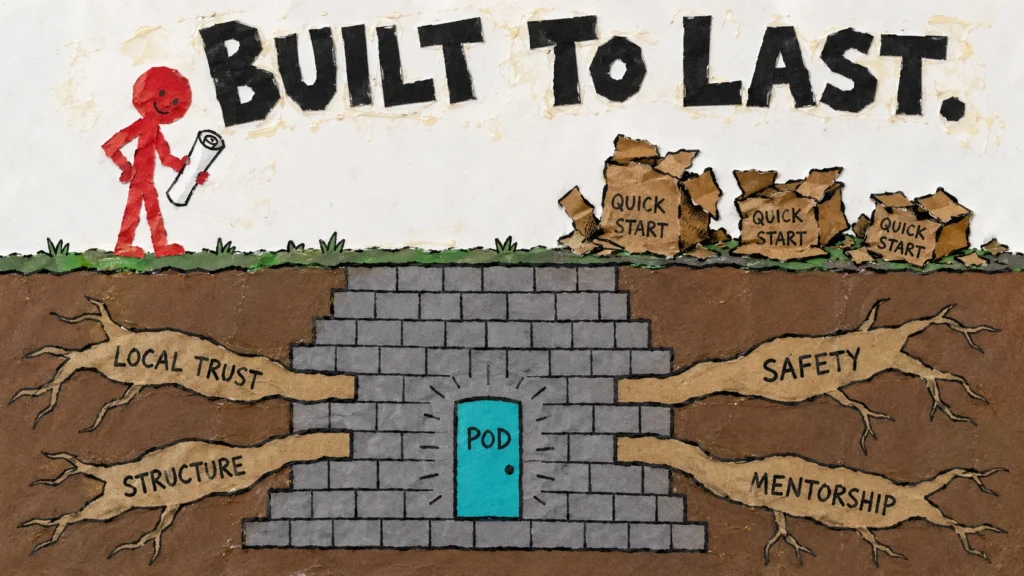
A POD, or Point of Digital Learning, is one practical example of education entrepreneurship built around a local learning need.
Apni Pathshala describes a POD as a small digital learning centre set up by individuals, schools, or NGOs with its support. Each POD uses Apna PC computers and learning tools to help students learn computer basics, creativity, communication, and coding.
The local leader brings space, consistency, and community trust. Apni Pathshala brings computers, tools, training, technology support, and guidance.
That matters because many people want to start an education initiative but get stuck at the lonely-founder stage. They see the problem. They may even have the space. But they do not have the full operating model.
A POD lowers that gap.
Proof: Small Local Models Can Create Serious Results
The Patwa Toli story is useful because it keeps the argument grounded.
Apni Pathshala reports that students from Patwa Toli used a POD, peer learning, computers, internet, and a quiet learning space while preparing for IIT JEE Advanced. Ten students from that POD group cleared JEE Advanced.
This does not mean every education project should promise IIT results. That would be foolish and loud.
The lesson is cleaner: a small local learning model can produce serious outcomes when access, routine, peer support, and guidance come together.
4 Mistakes That Make Education Projects Weak
#1 – Starting with branding before knowing the learning outcome. A name and logo can make the idea feel real before the model has earned that feeling.
#2- Buying devices before knowing how students will use them. Equipment without a learning path becomes furniture with electricity.
#3- Treating parent updates like extra work. Parent trust is not a side feature. It is part of the trust.
#4- Confusing free service with impact. Free work can still be weak. Paid work can still be honest. The question is what changes for the learner. Value is always the king!
Build the Part People Return For
An education initiative does not become real because it launches. It becomes real when people return.
A parent sends the child again. A student asks for the next class. A school wants another session. A local partner says, “Can we do this every week?”
That is the good part.
If you want to build an education initiative around local trust, digital tools, student progress, and a model that can keep running, explore Apni Pathshala’s POD model and start a POD in your community.
And if your next question is cost, read our previous guide: How to Start a Low Investment Education Business Without Building a Cheap One. It explains how to start small without making the model feel weak, random, or hard for parents to trust.
FAQ: Education Entrepreneurship
1. What is education entrepreneurship?
Ans. Education entrepreneurship means starting a learning centre, program, startup, or community model that solves an education problem and can keep running.
2. How do I start education entrepreneurship in India?
Ans. Start by finding one local learning pain. Test it with a small batch, track student progress, talk to parents, and improve before investing heavily.
3. What are good education business ideas in India?
Ans. After-school learning centres, digital skills centres, coaching alternatives, school partnership programs, NGO-led learning centres, and POD-style community learning hubs are strong options.
4. What are education startup ideas with social impact?
Ans. Digital skill programs, mentorship platforms, career readiness programs, hybrid learning centres, learning dashboards, and community PODs can create social impact by solving a clear learning problem.




5 Responses
nice blog
Glad you enjoyed the blog!
Very inspiring article! Education entrepreneurship has the power to create lasting social impact. Wishing the team continued success!
Thank you! We’re committed to creating lasting impact.
Impact builds trust, and trust builds sustainable education. Great perspective!