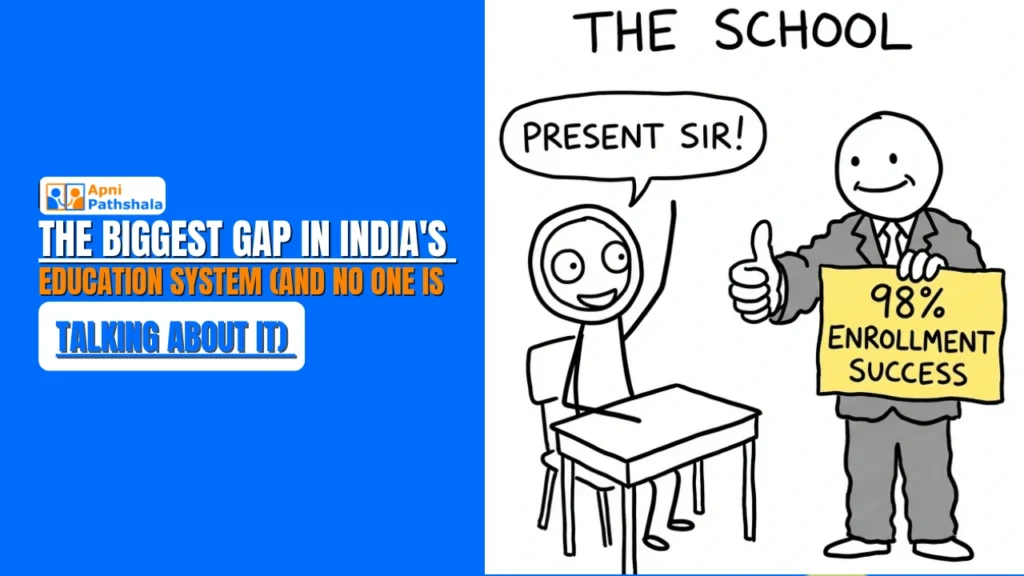
98 percent of children aged 6 to 14 in rural India are enrolled in school
Sounds like a massive victory. But only 20.5 percent of Grade 3 students can actually read a Grade 2-level text.
Same report and same year. The children are physically in the building but the learning is simply not happening inside it.
And the gap between those two numbers is the most important unreported crisis in Indian education right now
We focus on attendance while ignoring comprehension.
India did not build an education system, it built the world’s largest school attendance programme and called it the same thing.
Two Indians One Exam Paper
Picture two students with the exact same age reading the same NCERT textbook and following the exact same CBSE syllabus on paper
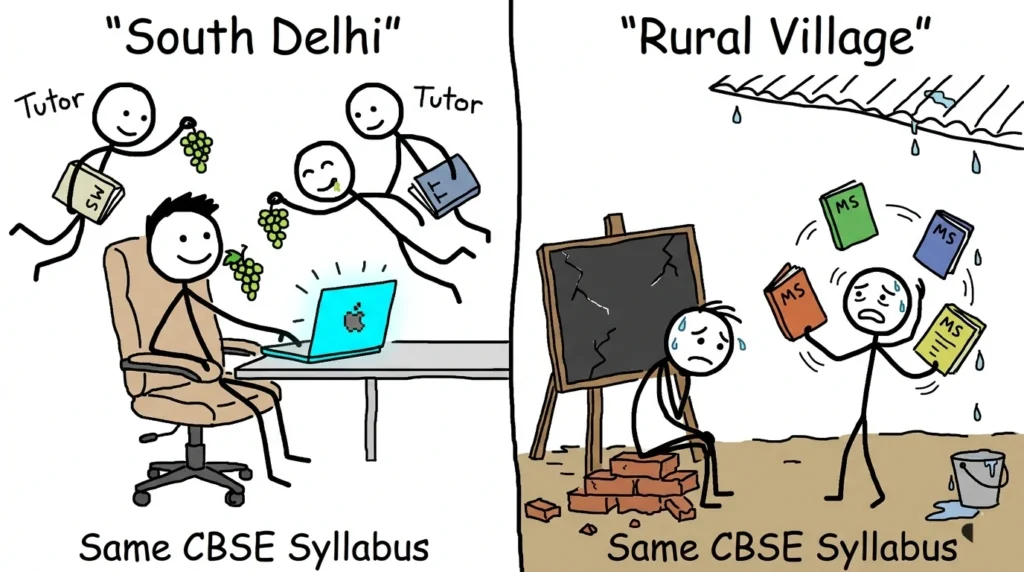
One is in South Delhi with a smart classroom and high speed WiFi and two tuition teachers and a personal laptop at home
One is in a village in Bihar with a cracked blackboard and one teacher managing four grades simultaneously.
This is part of the over 1 lakh single teacher schools still operating in India today. Same exact exam and same exact marking scheme
But they are living in a completely different universe. Of India’s 14.71 lakh schools exactly 12.10 lakh are in rural areas.
That means more than a third of rural India’s schools are asking students to prepare for a digital economy without a single digital tool in the building.
The Enrollment Illusion
India celebrating 98 percent enrollment is exactly like a hospital celebrating 98 percent patient admission
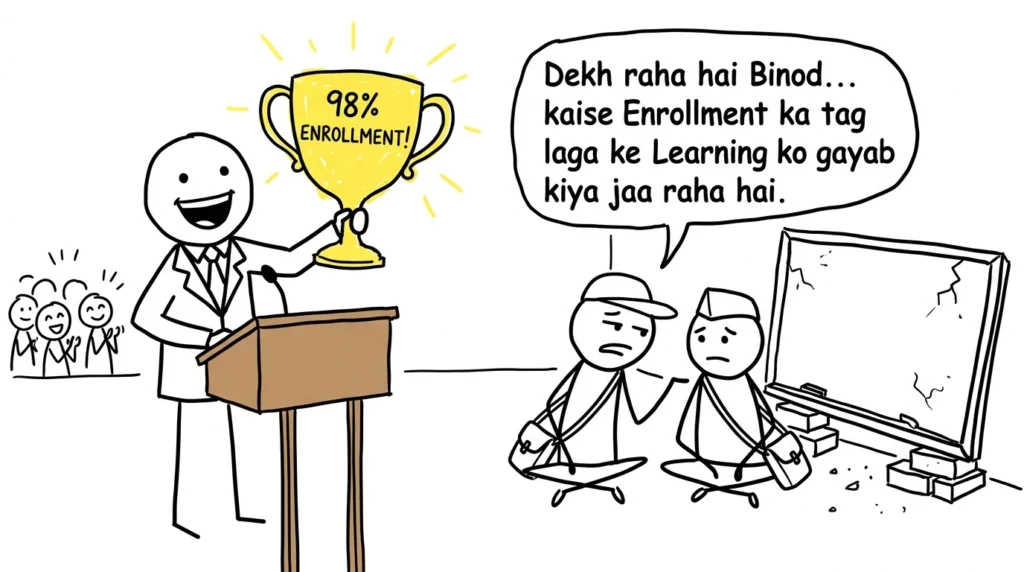
while half the patients are not receiving actual treatment.
The physical infrastructure expanded but the learning absolutely did not follow it.
Why did this happen? Enrollment is highly measurable and highly visible and incredibly politically useful.
Learning outcomes are slow and complex and often embarrassing to officially report.
So the system optimized entirely for the metric it could easily celebrate and quietly ignored the one that actually mattered
India built the world’s largest school attendance system and completely forgot to build learning inside it.
The Gap Nobody Measures What Happens at Age 22
The Delhi student and the Bihar student both clear their 12th board exams and both apply for the exact same entry level job.
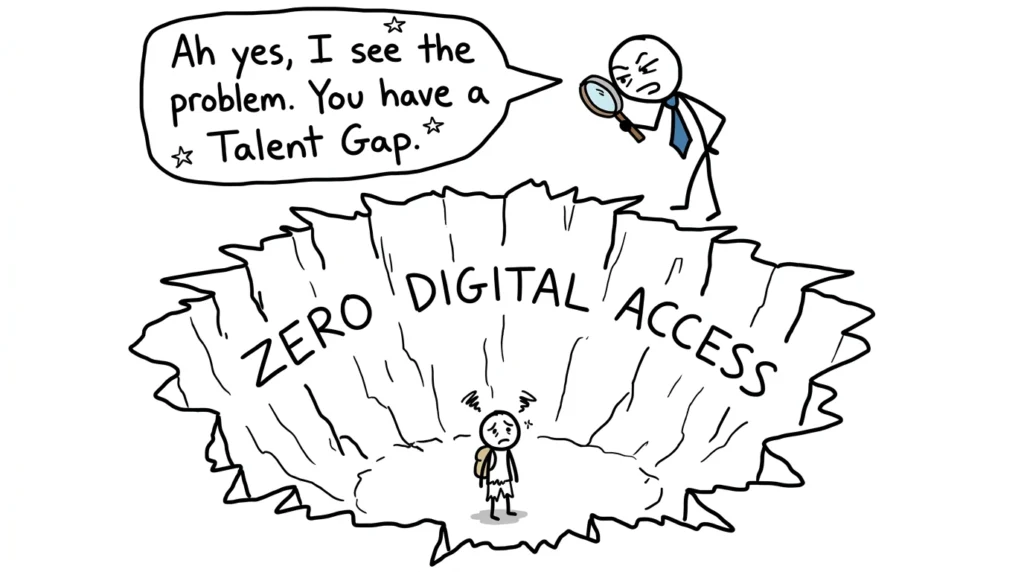
One has three years of digital familiarity and a personal laptop and basic coding from a coaching centre and a thin portfolio of actual work.
One has never touched a physical computer outside a stressful examination hall. The interviewer asks one simple question about basic MS Office proficiency.
They have the same degree and the exact same percentage on the marksheet. But they have a completely different answer.
The system confidently calls this a “talent gap” . It is absolutely not a talent gap. It is an access gap and those are absolutely not the same thing.
The gap compounds with every single grade. By Class 10 it is not a gap anymore it is a massive brick wall.
The Gender Layer Nobody Mentions
According to the latest ASER Beyond Basics report exactly 43.7 percent of boys in rural India own their own smartphone while only 19.8 percent of girls do.
That massive gap holds across almost every single state in the country.
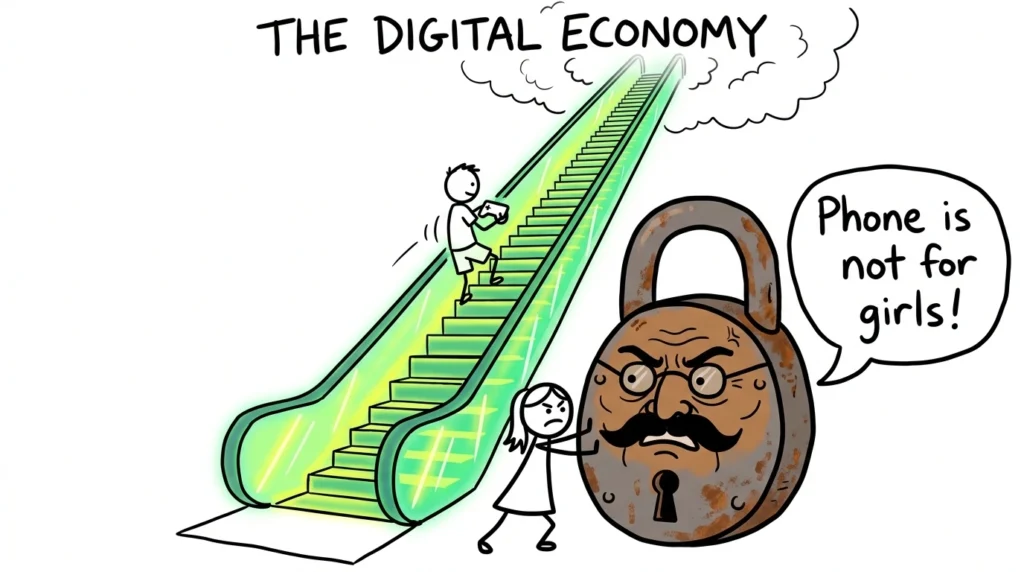
Girls in states like Madhya Pradesh and Uttar Pradesh and Rajasthan are still not enrolled at the same rates as boys
And the girls who are enrolled are working with significantly fewer digital tools than their male peers. The digital economy did not wait for government policy to catch up
The gap is not just rural versus urban. It is rural girls versus absolutely everyone else!
And it gets wider and harder to close with every single year of delay.
What Is Actually Being Done The Honest Answer
Top down government solutions absolutely exist. BharatNet promised high speed broadband to 6 lakh villages by 2023 but as of late 2024 it had only reached 2.14 lakh.
The strict deadline passed and the villages waited while the entire economy moved on without them
What is moving much faster is smaller and community driven and already operating on the ground.
Apni Pathshala runs 109 physical learning centres called PODs across 22 states. These are not only in metros but in Bihar and Nagaland and Maharashtra and Uttarakhand
They are placed exactly where the cracked blackboard and the single teacher still exist. Each POD arrives with computers and a structured curriculum and an AI tool called Eklavya. .
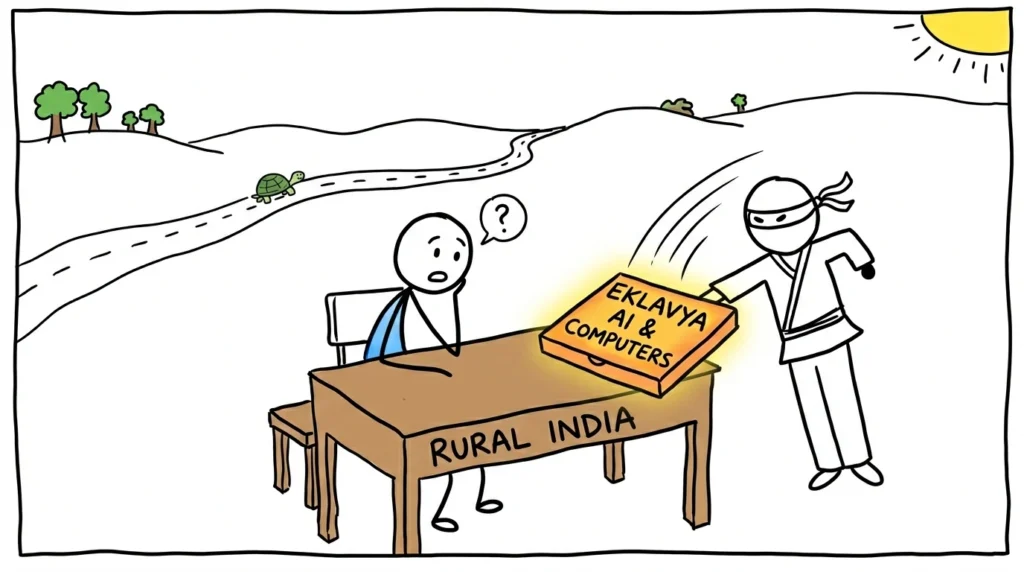
It is the exact same quality of correction a Delhi tuition student gets by default. This is not charity and it is not a theoretical pilot programme.
It is real infrastructure that already exists in places that were explicitly told to just wait for infrastructure.
Over 22,000 students have already come through these physical centres.
If you know a community that needs this, start at apnipathshala.org because it takes five minutes to see if one exists near you.
The Mental Shift And The Choice
The massive gap in India’s education system is not between “good” students and “bad” students.
Government policy will definitely move eventually. But the student sitting in that classroom with a cracked blackboard does not have the luxury of waiting for “eventually“.
But here is the highly uncomfortable part. The actual tools to close this gap already exist right now.
Community learning models and digital infrastructure and AI powered feedback systems are completely real and not theoretical.
It is running right now in 22 states. The only question left is whether they reach the right students before the exam and the interview and the compounding actually does.
if this article made you curious to know more.
👉 Learn how Apni Prerna helps parents ensure safe and effective digital learning, explore now.
Why does CBSE feel so difficult without a tutor? What’s really causing it, find out.
Frequently Asked Questions
1. What if you could understand CBSE concepts without depending on a tutor?
Ans: You can learn concepts clearly, ask doubts freely, and become independent in your learning, without depending on a tutor.
2. What is Apni Prerna and how does it help in digital learning?
Ans: Apni Prerna is a digital learning tool that helps children learn safely and effectively on computers by reducing distractions and improving focus.
3. What makes CBSE feel impossible for so many students?
Ans: Because students often move ahead without understanding the basics, and those small gaps eventually make the entire subject feel overwhelming.
4. Why do parents need Apni Prerna for their children?
Ans: Because many children use computers for non-learning activities, and parents often don’t realize how their time is being spent online.